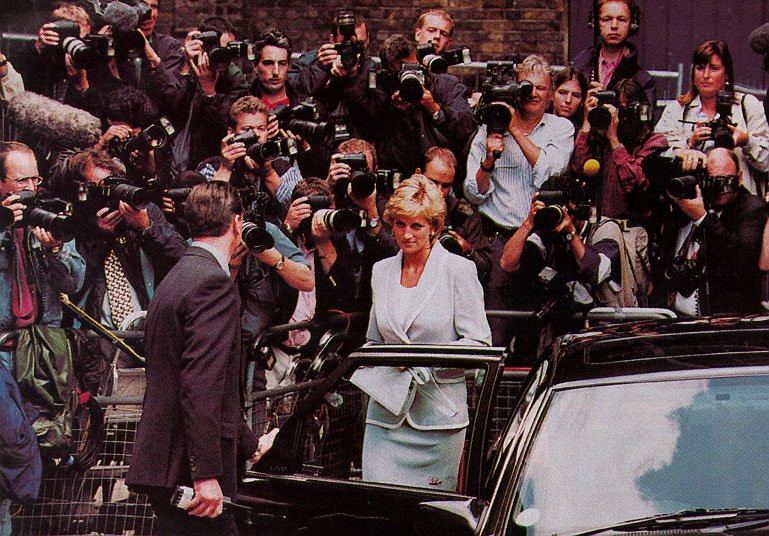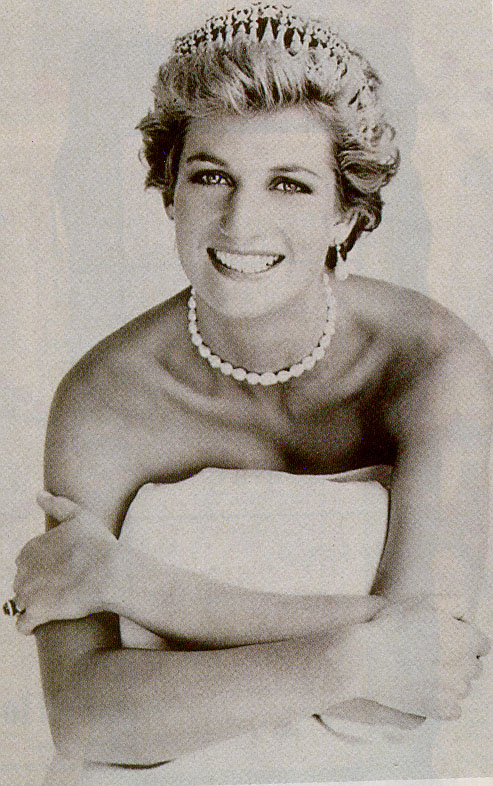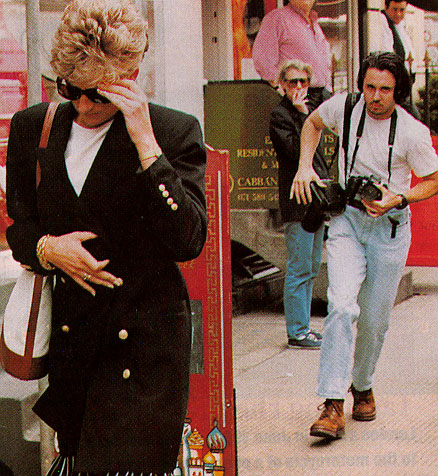
Beirne, Brendan. (REX USA) Fallows, James. "Are Journalist's
People?" U.S. News and World Report September 15, 1997 p. 31-34
Beirne, Brendan. (REX USA) Fallows,
James. "Are Journalist's
People?" U.S. News and
World Report September 15,
1997 p. 31-34
The purpose of our Media Framing web page is to analyze way the paparazzi was framed by the print media directly following Princess Diana's fatal car accident. We found three categories that establish how the print media framed the controversial issue. The three categories are 1) the paparazzi framed negatively, 2) the paparazzi framed objectively, using shared blame between both the public and the paparazzi/press, and 3) the paparazzi doing their job. These categories will be examined by using various articles of the print media, and analyzed by using concepts and theories advance by qualified experts in the mass media field.
The most prevalent of all the attitudes towards the paparazzi after the death of Diana was that of a negative nature. The paparazzi, and the mass media in general had an immediate shadow of guilt cast down upon them. It was almost instantly that a guilty/innocent dichotomy was established. Obviously Diana was the innocent, and the paparazzi, the aggressive and ruthless men and women who were chasing her to her death were the guilty. James S. Ettema and Theodore L. Glasser write that reality must be made into a narrative, and that this can only be done with a moral vision, meaning essentially that through the print media, by way of a narrative, two specific tasks were accomplished, the realization of innocent, and guilt. From the very beginning Diana was deemed as a victim, innocent and helpless against the wrath of the stalking paparazzi. This role assignment enables the media to create the realization of guilt, once one is established, the other can be made as well. This particular quote illustrates our point, "For people outside the business, dealing with reporters is like dealing with the police: There is no such thing as a fair fight."
In addition, society's need for an immediate scapegoat should be addressed. Carol Wilkie writes, "Reporters, after all, have vital knowledge of the events and people about whom they write. Should they choose to shape this knowledge into stories which create a scapegoat situation, the interested readers have no touchstones which allow them to deny the printed word. " The print media as well as the entire mass media field used the paparazzi as the scapegoat in the majority of their reports. After the tragic and heart-wrenching death of such a loved celebrity, it could not possibly be left with no one to blame. Someone had to take, or be assigned responsibility for her death to set society at ease. And because the paparazzi was there following her to get "priceless" photographs, they were the obvious targets of this scapegoating process.
Another important aspect of the paparazzi being framed negatively, is the tremendous amount of celebrity support that seemed to come out of the woodwork overnight to criticize the paparazzi. "They were grieved, of course, over the tragic death of Princess Diana. But they were also eager to gripe about the paparazzi, whose aggressive tactics may have played a role in her death. Elizabeth Taylor called them murderers. Tom Cruise recounted how he and his wife Nicole Kidman had been chase by photographers through the very same Paris tunnel. Everyone from George Clooney to Whoopi Goldberg chimed in; boycotts were advocated; legislation proposed."Hey wana buy
Objectively, many of the print media journalists painted a picture of shared blame. This blame was shared between the paparazzi for being so aggressive and ruthless , and the public because we are the ones buying the USA Today's, Entertainment Weekly's and National Enquirers. Like nosy neighbors, we want to know what our favorite celebrities are up to. It's a simple case of supply and demand. Demand for the celebrity news is high so the paparazzi will go to the lengths necessary to give us our supply. Carol Wilkie, "The Scapegaoting of Bruno Richard Hauptmann: The Rhetorical Process in Prejudicial Publicity," defines this notion of society being blames as categorical guilt. She writes, "The process begins when the press takes an isolated crime and characterizes it, not as an act against the individual, but as a symptom of corruption in society as a whole" (Wilkie, 101). Even before the story had fully developed, categorical guilt was assigned; society as a whole was guilty for allowing it to go as far as it did. In turn, because society must be redeemed, someone needed to be blamed, and in this case, the paparazzi, only to later be followed by the drunk driver, all are turned into a victim of that society, able to bear society's sins. U.S. News and World Report argued that , "The paparazzi chased Diana because pictures of her are so valuable; they are so valuable because newspapers know they will boost sales; ergo the people who buy the tabloids to see photos of Diana helped to chase her to her death." 15HARM In the same issue, another article states that, "The tabloids would not be paying so much for celebrity pictures unless people were buying the tabloids." In Newsweek, Jonathan Alter, author of "Diana's Real Legacy" writes, "Princess Diana was killed not just by a speeding car but by a speeding culture - " The author goes on and says, "Only the most determined literalist could fail to see a connection between her death and her epoch, a time - our time - when celebrity obsession seems as out of control as a hurtling Mercedes on a late summer night in Paris." One of the most powerful statements we found within the print media's coverage of the story was in Time magazine. Margaret Carlson wrote, "If there is any doubt that the world of photography has gone insane, moments after Princess Di had been pronounced dead, the dilemma facing some British publishers was what to do about the pictures taken on that fateful night. The National Enquirer's Coz says he will not purchase any such photos, in an effort "to send a message." Someone may well publish a picture from the tunnel, and to keep blood off its hands, the public must avert its eyes. We can blame the press only if we stop watching. "paparazzi These excerpts illustrate the objective viewpoint that was adopted not only by the journalists writing the stories, but by society as well, who were reading the stories during the dramatic event.
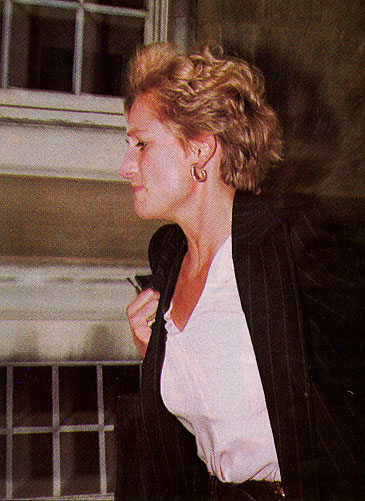
In the weeks that followed Princess Diana's death, some defended the actions of the paparazzi. Some journalists asked the world, "Was the paparazzi just doing their job?" After all journalism is a business. Celebrity scandal sells papers and magazines. Would we have seen so many headlines of "Diana and her new beau" or "The Kiss," if the public wasn't buying those papers? Of course not. It's argued that the paparazzi and press at large are merely responding to our appetite for celebrity news. The paparazzi are doing what we the public and they the journalistic press pay them to do. The paparazzi document those figures whom we find compelling. We find Princess Diana compelling. From her fairy tale wedding to Prince Charles in 1981 through the birth of her sons Princes William and Harry, the messy divorce burdened by whispers of adultery, to the tragic auto accident that claimed Princess Diana's life, the paparazzi were ever present, recording history as it happened.
Media expert W. Lance Bennett wrote an article, "Toward a Theory of Press-State Relations in the United States," which explains the interaction between the press and the government. Bennett's concepts can be applied to the relationship between the press/ paparazzi and the celebrities they follow. Bennett queries, "If for some reason the voices of government are . . . irresponsible, does the responsibility to correct the problem lie with journalists or with the people . . . ? Should not responsible journalists report primarily what governments say and let the people form their own reactions?" Bennett's concept here is that journalists are responsible for their coverage not how we the public interpret and react to their reports. We reshaped Bennett's quote to address the viewpoint that paparazzi are just doing their job. "If for some reason the habits of the public are irresponsible, does the responsibility to correct the problem lie with journalists and paparazzi or with the greater masses? Should not responsible journalists and photographers report primarily what celebrities do and say and let the people form their own reactions?" Why does the responsibility for on the job actions which can be interpreted in any number of ways by the public, press, and state, have to fall on the heads of the paparazzi?
In his essay in the September 15, 1997 U.S. News & World Report, Richard Folkers argued that the paparazzi who took pictures of Diana's car wreckage were just doing their job. "A victim may lie bleeding, unconscious, or dead: Your job is to record the image. You're a photographer, not a paramedic. You put away your emotions and document the scene." Job In Ruth Walker's September 3, 1997 Christian Science Monitor article, she includes a quote from celebrity photographer Rino Barillari who defends the ramifications of his job, placing blame on the greater press. "It's easy today to condemn the paparazzo. For what? The paparazzo does his job. It isn't his fault. It's the fault of the publishers: the newspapers and the editors. They want that kind of picture. I do what the newspapers ask me to do, what the public wants." CS Monitor
In the paparazzi's attempt to shift blame to the publishers and the institutions that give them their paychecks, they argue that it's difficult to give celebrities breathing room without a collective standard of when and when not to take celebrity pictures, that all paparazzi must abide by. Case in point, in Margaret Carlson's September 8, 1997 Time article, she reports how "Princess Diana met with photographers to ask them to give her sons some breathing room, while on a skiing trip. All but one did, and he made a fortune for his exclusive pictures." Time The papers reward the paparazzi handsomely for their intrusive actions. These quotes, few and far between in the print media's recent coverage of the paparazzi, give weight to the minority viewpoint that the paparazzi were just doing their job in covering Diana's passing.
In conclusion, the print media used three categories in their coverage and framing of blame directly following Princess Diana's fatal car accident. The most prominent category was by far the negative framing of the paparazzi. In the rush to find a scapegoat, and society's need to create a guilty/ innocent dichotomy, the paparazzi fulfilled our notion of criminal. In their attempt to be objective, the print media asked society to look inward and re-evaluate our own actions. The print media suggested that we the public also accept responsibility for perpetuating the cycle of public-press-paparazzi-celebrity relations. A small portion of the print press gave the paparazzi the voice to defend themselves. The paparazzi argued that they were just doing their job, documenting the actions of public figures that we find intriguing. We found that our examination of various print media articles highlighted and supported our three categories and the concepts advanced by such experts as Ettema and Glasser, Wilkie and Bennett.
|
|
|
Buckmaster, Jonathan (REX USA)
Noah, Timothy,
et. al "All Steve Coz Wants Is A Little R-E-S-P-E-C-T"
U.S. News and World
Report September 15, 1997
p. 36-39
Demarc Helier, Patrick (Camera Press London) People Photo Essay September 15, 1997