Setting Up Json
Jed Rembold
November 12, 2025
Announcements
- Project 4: Enigma due next Monday night
- Get a start if you haven’t already!
- Sections today and tomorrow will help with milestones 3 and 4
- I’ll have test feedback for you by Friday
- New grade reports will be posted as soon as I have the test scores done
- Techbytes tomorrow on AI in the classroom
- Polling: polling.jedrembold.prof
Review Question
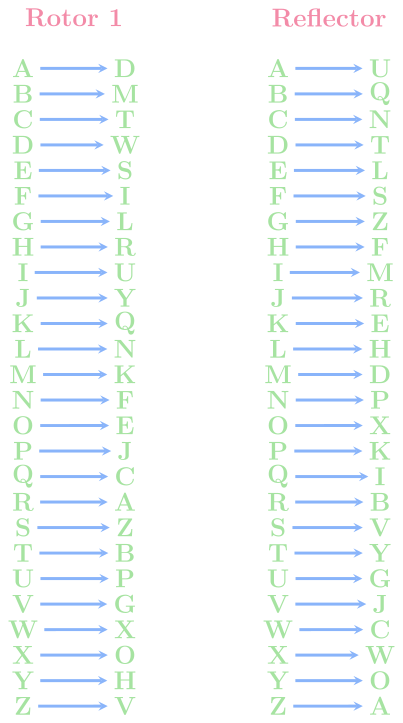
Let’s consider a greatly simplified Enigma machine, which only has
one rotor that is not turning. So the signal goes through the rotor then
the reflector and back through the rotor. Given the rotor and reflector
mappings shown to the right, what would the word
python encrypt to?
aicmnzhnktgerfqblszghpmy
Last Dictionary Bits
Iterating through a Dictionary
Frequently we might want to iterate through a dictionary, checking either its values or its keys
Python supports iteration with the
forstatement, which has the form of:for key in |||dictionary|||: value = |||dictionary|||[key] |||code to work with that key and value|||You can also use the
.itemsmethod to grab both key and values together:- Returns a tuple with both the key and corresponding pair
for key, value in |||dictionary|||.items():
    |||code to work with that key and value|||
Finding Students by grade
Suppose we had a file of student ids and corresponding grades on a test
We want a simple program where we can enter in a target grade and have it tell us all the students who received that grade
def read_to_dict(filename):
    dictionary = {}
    with open(filename) as f:
      for line in f:
          ID, score = line.strip().split(',')
          dictionary[ID] = score
    return dictionary

def get_students_with_score():
    scores = read_to_dict('SampleGrades.txt')
    done = False
    while not done:
        des_grade = input('Enter a letter grade: ')
        if des_grade == "":
            done = True
        else:
            for st_id, grade in scores.items():
                if grade == des_grade.strip().upper():
                    print(f"{st_id} got a {grade}")
Common Dictionary Methods
| Method call | Description |
|---|---|
len(|||dict|||) |
Returns the number of key-value pairs in the dictionary |
|||dict|||.get(|||key|||, |||value|||) |
Returns the value associated with the
key in the dictionary. If the key is not
found, returns the specified value, which is
None by default) |
|||dict|||.pop(|||key|||) |
Removes the key-value pair corresponding to
key and returns the associated value. Will
raise an error if the key is not found. |
|||dict|||.clear() |
Removes all key-value pairs from the dictionary, leaving it empty. |
|||dict|||.items() |
Returns an iterable object that cycles through the successive tuples consisting of a key-value pair. |
Dictionary Records
While most commonly used to indicate mappings, dictionaries have seen increased use of late as structures to store records
Looks surprisingly close to our original template of:
boss = {
    'name': 'Scrooge',
    'title': 'founder',
    'salary': 1000
    }
Allows easy access of attributes without worrying about ordering
print(boss['name'])It is still using a mutable data-type to represent something that should be immutable though
Let’s Talk About Sets
Pythonic Sets
- Enclosed within squiggly brackets
- No key-value pairs, just single values separated by commas
digits = { 0, 1, 2, 3, 4, 6, 7, 8, 9 }
squares = { 0, 1, 4, 9 }
primary = { "red", "green", "blue" }- Set elements must be immutable
- Sets themselves are generally mutable
- Can not create an empty set just using
{ }!- Python assumes this to be an empty dictionary!
- Must instead use
set().
Set Operations
- The fundamental set operation is membership (∈)
- 3 ∈ primes
- 3 ∉ evens
- red ∈ primary
- -1 ∉ N
- The union of the sets \(A\) and \(B\) (\(A \cup B\)) consists of all elements in either \(A\) or \(B\) or both.
- The intersection of the sets \(A\) and \(B\) (\(A \cap B\)) consists of all elements in both \(A\) and \(B\).
- The set difference of \(A\) and \(B\) (\(A - B\)) consists of all elements in \(A\) but not in \(B\).
- The symmetric set difference of \(A\) and \(B\) (\(A\triangle B\)) consists of all elements in \(A\) or \(B\) but not in both.
Python Implementations
- Python’s built-in implementation of sets supports all these same operations
- Can either use appropriately named methods on sets or operators between sets
- Membership
3 in primes
- Union:
A.union(B)A | B - Intersection
A.intersection(B)A & B
- Difference
A.difference(B)A - B - Symmetric difference
A.symmetric_difference(B)A ^ B
Venn Diagrams
- A Venn Diagram is a graphical representation of a set which indicates common elements as overlapping areas
- The following Venn diagrams illustrate the effect of the 4 primary set operations
Practice
If we have the following sets from earlier:
| digits = { 0, 1, 2, 3, 4, 5, 6, 7, 8, 9 } |
| evens = { 0, 2, 4, 6, 8 } |
| odds = { 1, 3, 5, 7, 9 } |
| primes = { 2, 3, 5, 7 } |
| squares = { 0, 1, 4, 9 } |
What is the value of each of the following:
- evens ∪ squares
- odds ∩ primes
- primes - evens
- odds ∆ squares
Understanding Check
Looking at the same sets:
| digits = { 0, 1, 2, 3, 4, 5, 6, 7, 8, 9 } |
| evens = { 0, 2, 4, 6, 8 } |
| odds = { 1, 3, 5, 7, 9 } |
| primes = { 2, 3, 5, 7 } |
| squares = { 0, 1, 4, 9 } |
What is the set resulting from: \[ (\text{primes} \cap \text{evens}) \cup (\text{odds}\cap\text{squares})\]
- ∅
- { 1, 2, 9 }
- { 1, 3, 4, 5}
- { 0, 3, 4, 5, 7}
Set Relationships
- Sets \(A\) and \(B\) are equal (\(A = B\)) if they have the same elements.
- This would make them the same circles in a Venn diagram
- In Python:
A == B
- Set \(A\) is a subset of
\(B\) (\(A\subseteq B\)) if all the elements in
\(A\) are also in \(B\).
- This would mean that the circle for \(A\) would be entirely inside (or equal) to the circle of \(B\)
- In Python:
A <= B
- Set \(A\) is a proper
subset of \(B\) (\(A\subset B\)) if \(A\) is a subset of \(B\) and the two sets are not equal
- In Python:
A < B
- In Python:
Python Set Methods
- Can also use “set comprehension” to generate a set
{ x for x in range(0,100,2) }
| Function | Description |
|---|---|
len(|||set|||) |
Returns the number of elements in a set |
|||elem||| in |||set||| |
Returns True if
|||elem||| is in the set |
|||set|||.copy() |
Creates and returns a shallow copy of the set |
|||set|||.add(|||elem|||) |
Adds the specified |||elem||| to the
set |
|||set|||.remove(|||elem|||) |
Removes the element from the set, raising a
ValueError if it is missing |
|||set|||.discard(|||elem|||) |
Removes the element from the set, doing nothing if it is missing |
Why use sets?
- Sets come up naturally in many situations
- Many real-world applications involve unordered collections of unique elements, for which sets are the natural model.
- Sets have a well-established mathematical foundation
- If you can frame your application in terms of sets, you can rely on the various mathematical properties that apply to sets.
- Sets can make it easier to reason about your program
- One of the advantages of mathematical abstraction is that using it often makes it easy to think clearly and rigorously about what your program does.
- Many important algorithms are described in terms of sets
- If you look at websites that describe some of the most important algorithms in computer science, many of them base those descriptions in terms of set operations.
Compound Data
Representing Data
- To use computation effectively, we frequently need to be able to
represent real world data in a way that computers can easily work with
- Real world data is often more complicated or nuanced than just “a list of numbers”
- Python’s existing data structures are tools, which
you can use to help represent certain ideas
- Lists when you have sequential type data, wherein there is
a logical ordering to the data in question (where position matters)
- Example: GPA over the course of 4 years
- Tuples or classes when you have elements that
should be grouped together but which have no inherent ordering.
Generally use tuples for simple records and write custom classes for
more complex. Could potentially also use a dictionary or set.
- Example: Student names in a class
- Maps or dictionaries when you have specific keys
corresponding to other values.
- Example: Student grades
- Lists when you have sequential type data, wherein there is
a logical ordering to the data in question (where position matters)
Tricky Data
- Human readable data is not always the best machine-readable data!
| Name | Class | Q1 | Mid | Q3 | Final |
|---|---|---|---|---|---|
| Sally | Python | A | B | B | A |
| Jake | Python | B | B | B | C |
| James | Astro | B | B | A | |
| Lily | Astro | A | A | B | |
| Ben | Python | C | B | B | A |
- Storing the above in a 2D array would work, but would be frustrating to work with
A Computer Friendly Approach
- Student grades are time ordered, so we could use a list for the grades
- Each student has a corresponding sequence of grades (and students are unordered), so we could use a dictionary where student names are the keys and the list of grades the values
- Each class corresponds to an unordered set of students. Could have another dictionary where the keys were the class names and the values were the dictionary of students/grades
Example Representation
{
    "Python": {
        "Sally": ["A", "B", "B", "A"],
        "Jake": ["B", "B", "B", "C"],
        "Ben": ["C", "B", "B", "A"]
    },
    "Astro": {
        "James": ["B", "B", "A"],
        "Lily": ["A", "A", "B"]
    }
}
Compound Structure Storage
- Structures representing complicated data can often be large enough that you don’t want to store them within your program itself
- We can put them in their own file, but reading them in with our
current tools would be complicated
- Current methods read in text, so we would need to parse the text to identify what data structures we needed to create and what elements we needed to add
- This is certainly possible, but potentially more overhead than what we would like for some structures
- Useful then to store the data structure in file in such a format that it can be easily read into Python
File I/O
- A variety of ways this can be done
- XML, YAML, JSON
- JSON is particularly interesting to us, because its syntax almost exactly matches Python’s (even though it was made for Javascript)
- Python has a built-in library to read and write JSON files, just
called
jsonjson.load(|||file_handle|||)- Loads the JSON data structure from the specified file into its Python equivalent
json.dump(|||data_object|||, |||file_handle|||)- Writes a JSON text representation of the data object to the given file
- Both methods are used inside our normal
with open(|||filename|||) as |||fhandle|||:syntax
Using JSON
To read a JSON file into a variable
data:import json with open('file.json') as fh: data = json.load(fh)To write a variable with complex structure out to a JSON file:
import json
with open('file.json', 'w') as fh:
    json.dump(data, fh)
The Power of JSON
- One very nice aspect of JSON is that it is often the defacto way that information is passed around the internet
- This means it can be easy to find data providers where you can access or download information already in a JSON format
- DND Fireball Spell info here
- We could download this information to a file, which we could then read in and use within our Python program
- Later we’ll also look at how we could process the information straight from the internet as well
JSON Gotchas
- If you are writing JSON files from within Python or using files gotten elsewhere, they should already be properly formatted
- If you need/want to edit a JSON file directly though, you should be
aware of a few “gotchas” where the JSON syntax varies slightly
from Python’s syntax
- You can not have trailing commas at the end of a
JSON structure
- Something like
[1, 2, 3,]is perfectly fine in Python, but illegal in JSON
- Something like
- JSON strings require double quotes
- In Python you can use either double or single quotes, but JSON requires double
- Booleans are all lowercase in JSON
- Vs starting with a capital letter in Python
- You can not have trailing commas at the end of a
JSON structure