Inheriting Snakes

Jed Rembold

November 4, 2022

Announcements

  • ImageShop due tonight!
  • I’ll be around most of the afternoon until 6:30
  • New (and last!) problem set will go out tomorrow
  • My priority this weekend is to get grade reports issued
    • I’m deeply sorry these have taken as long as they have. I’ve needed time to make changes to my system and the past 3 weeks have been crazy for me
  • Polling: rembold-class.ddns.net

Review Question

The code block to the right starts defining a class. Only 1 of the below options for defining an increment method will work. Which one?

class BestCounter:
  def __init__(self, start):
    self.counter = start
def increment(self, value):
    counter += value
def increment(value):
    counter += self.value
def increment(self, value):
    self.counter += self.value
def increment(self, value):
    self.counter += value

Specifying Inheritance

  • Subclass definitions in Python differ from standalone classes in two ways:

    1. A subclass definition includes the name of its superclass in parentheses after the name of the subclass
    2. The constructor for the subclass explicitly calls the constructor for its superclass before doing its own initialization
  • Together, they form the following pattern:

    class subclass(superclass):
      def __init__(self, parameters):
          superclass.__init__(self, any_relevant_parameters)
          # Rest of subclass initialization

A Swashbuckling Example

Some Swashbuckling Code

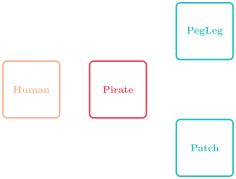
class Human:
    def __init__(self, name, age):
        self.name = name
        self.age = age
        self.speed = 10
        self.perception = 10

    def __repr__(self):
        return f'Human({self.name},{self.age})'

    def agree(self):
        print('Sure!')

class Pirate(Human):
    def agree(self):
        print("Aye matey!")

    def __repr__(self):
        return f'Pirate({self.name},{self.age})'

class Pegleg(Pirate):
    def __init__(self, name, age):
        Pirate.__init__(self, name, age)
        self.speed = 5
    
    def __repr__(self):
        return f'Pegleg({self.name},{self.age})'

class Patch(Pirate):
    def __init__(self, age):
        Pirate.__init__(self, name, age)
        self.perception = 5

    def __repr__(self):
        return f'Patch({self.name}, {self.age})'

Overusing Inheritance

  • Inheritance is often used in situations where it does not really apply
    • A common example you might see in textbooks is a Pizza class with various subclasses of pizza, like Pepperoni or Hawaiian.
    • This is silly, there is only one point of difference between those: the ingredients
      • Just make a pizza class with a list of ingredients as an attribute
  • Inheritance makes sense when subclasses share behavior

Extensions

  • While designing new class hierarchies will prove useful as you move on to larger applications, it is often more useful to extend existing classes to add new, desirable behavior
  • This can be done with any existing class, but a few classes in the GObject hierarchy make very enticing targets as the bases for potential extension:
    • The GPolygon class makes it easy to define new subclasses that have a polygonal outline.
      • Also automatically support filling, since GPolygon is a subclass of GFillableObject
    • The GCompound class can serve as a great parent for new subclasses that are composed of a combination of other shapes.
  • In either case, it is generally useful to add additional methods or attributes to the subclass that are specific to that type.

Graphical Object Decomposition

  • Using the GCompound class as a parent class makes it possible to apply the strategy of decomposition to graphical objects!
    • Can decompose a graphical display into successively simpler pieces
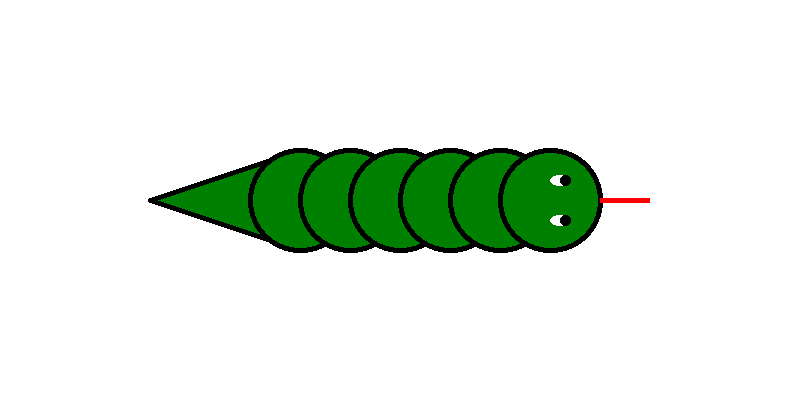
  • Here I will use as an example a simple segmented snake
 

The Snake Hierarchy

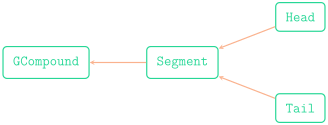
  • Here I will utilize a generic snake body segment which will be a subclass of GCompound
    • The snake head and tail segments will then be subclasses of the body segment class

  • All the common elements will be added in the body segment, with the head and tail subclasses only adding their specific details.
Nesting Snakes

  • Since a GCompound is also a GObject, you can go ahead and add a GCompound to another GCompound
  • Here I will add all the snake pieces to a new class Snake, which is a subclass of GCompound
  • One advantage of doing so is that we can then animate the entire snake as a whole easily!

 

Snakey Code

from pgl import GWindow, GCompound, GOval, GLine, GPolygon

R = 50

class Segment(GCompound):
    """ Create as generic snake body segment. """
    def __init__(self):
        GCompound.__init__(self)
        body = GOval(-R, -R, 
                     2*R, 2*R)
        body.set_filled(True)
        body.set_fill_color('green')
        body.set_line_width(5)
        self.add(body)

class Tail(Segment):
    def __init__(self):
        Segment.__init__(self)
        tri = GPolygon()
        tri.add_vertex(0, R)
        tri.add_vertex(0, -R)
        tri.add_vertex(-3*R, 0)
        tri.set_filled(True)
        tri.set_fill_color('green')
        tri.set_line_width(5)
        self.add(tri)
        tri.send_to_back()

class Eye(GCompound):
    def __init__(self):
        GCompound.__init__(self)
        eye = GOval(-10,-5,20,10)
        eye.set_filled(True)
        eye.set_color("white")
        pupil = GOval(-5,-5,10,10)
        pupil.set_filled(True)
        self.add(eye,-10,-5)
        self.add(pupil, 0,-5)

class Head(Segment):
    def __init__(self):
        Segment.__init__(self)
        self.add(Eye(), 10, 20)
        self.add(Eye(), 10, -20)
        tongue = GLine(R, 0, 2*R, 0)
        tongue.set_line_width(5)
        tongue.set_color('red')
        self.add(tongue)

class Snake(GCompound):
    """ Put all the snake pieces together. """
    def __init__(self, length):
        GCompound.__init__(self)
        self.add(Tail(), 0, 0)
        for i in range(1,length-1):
            self.add(Segment(), i*R, 0)
        self.add(Head(), (length-1)*R, 0)

def make_snake():
    def move_snake():
        snake.move(10,0)

    gw = GWindow(800,400)
    snake = Snake(3)
    gw.add(snake, -500,200)
    gw.set_interval(move_snake, 30)

make_snake()
// reveal.js plugins