Searching the Cosmos with Neural Networks
Jed Rembold
November 18, 2021
Motivation
- The amount of data that telescopes produce is growing…astronomically
- LSST to collect 20 TB per night starting in 2022
- Square Kilometre Array will generate 2 PB daily starting in 2028
- One of the largest sky surveys currently, SDSS, has collected 40 TB over the past 20 years
- New systems and methods are necessary to process and keep up
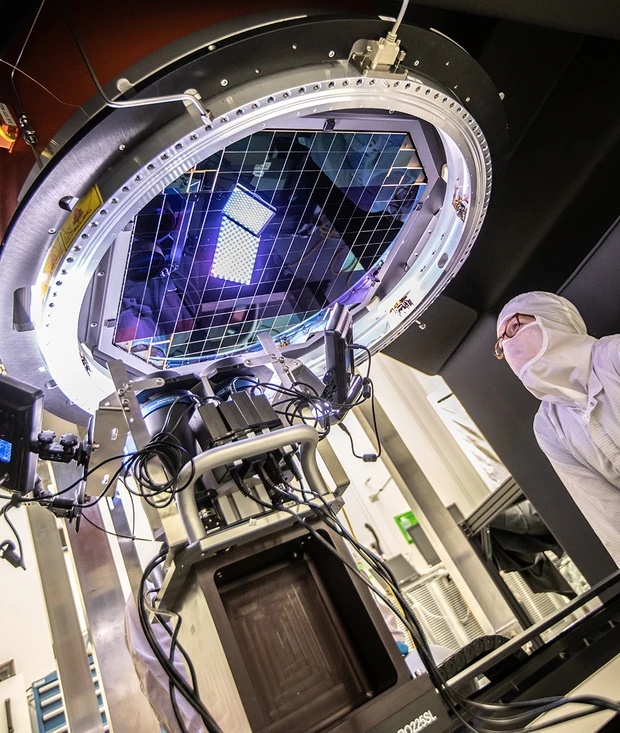
![The 3.2 GPixel LSST Camera]() The 3.2 GPixel LSST Camera
The 3.2 GPixel LSST Camera
Gravitational Lenses
Gravitational Lenses
Convolutional Neural Networks
- The networks “learns” the best kernel weights
- Generally use many kernels and combinations of kernels
Challenges
- Choosing the convolution model
- How many kernels to use each step of the way?
- What size should they be?
- How do decide when to pool or stride?
- Lots of practice to get a feel for what seems to work well and what does not.
- Acquiring and reading in training data
- Need labeled data for a supervised algorithm like this
- Often times large datasets, so can only read in a bit at a time
- Practice working, cleaning, and streaming in large datasets
- Dealing with poor fitting or overfitting
- Practice looking at different analytics to determine how your model is performing
Interested in More?
- Talk to me!
- My office is Collins 311
- Email: jjrembold@willamette.edu
// reveal.js plugins