Locating the Cosmos
Jed Rembold
January 12, 2026
Announcements
- Welcome to DATA-275: Data in the Cosmos!
- Things to do:
- Access the course webpage here!
- This page is also linked from Canvas
- Read over the full syllabus
- Join the class Discord server for ease of communication and
announcements
- Invite information will be in an announcement on Canvas
- If you don’t already have a GitHub account, sign up for one
- Access the course webpage here!
- Homework 1 will be posted Thursday. Not due until the following Friday.
An introduction
Who Am I?
- Name
- Jed Rembold
- Background
- PhD in Physics with specialization in Astrophysics
- Office
- Ford 214
- Office Hours
- M, W 4:30 - 5:30
- T, Th 2:00 - 4:00
- Online or anytime my door is open
- jjrembold at willamette.edu
Why This Course?
- The amount of data that telescopes produce is growing…astronomically
- LSST to collect 20 TB per night starting this
year!
- Final tune-ups after first light last July
- Square Kilometre Array will generate 10 PB compressed daily starting in 2028
- LSST to collect 20 TB per night starting this
year!
- One of the largest sky surveys currently, SDSS, has collected 40 TB over the past 20 years
- As such, the field of astronomy is becoming (or has become) a data
science field
- Astrophysicists adopting data science skills
- Collaboration between astronomers and data scientists only going to build
Course Objectives
- Learn some science! How do astronomers and astrophysicists attempt to make sense of their data?
- Learn some new data analysis techniques!
- Learn scientific communication! The most brilliant analysis is worthless if not well communicated.
- Learn teamwork! It is invaluable, and most of us are worse at it than we should be.
Deliverables and Scoring
- Standard 90/80/70 etc grade cut-offs
- Top 2% get +’s, bottom 2% get -’s
| Homework (6) | 45% |
| Checkins (14) | 5% |
| Quizzes (3) | 25% |
| Projects (1) | 25% |
Homework
- One assignment due each week, using 2-3 per unit
- Assignments will be done in pairs
- Pseudo-randomly assigned for each unit (You won’t be with the same person more than once)
- 1 problem per assignment
- Solutions should be written up as short computational essays, using a Jupyter Notebook, RMarkdown, or Quarto, and exported to HTML before being submitted
- Distribution and submission of materials managed through GitHub Classroom
- 3 cumulative late days over the semester without penalty, then a 20%
loss of credit per 24 hours late
- Late days count against both partners, so don’t be that person who tanks your partner’s grade because you had the days
Check-ins and Debriefings
- A large portion of this course revolves around working with peers
who may have very different skill sets to your own
- Doing this well is difficult!
- Each week an assignment is due, you will have the weekend to
complete a very short debriefing/check-in
- Reflect on what you did well as a partner, where you dropped the ball this past week, and how you could improve going forward. You can’t improve what you don’t realize needs improving.
- You have the weekend to complete these. They can not use late days.
Group Dissolution
- You will likely have a mix of great groups, and less great groups
over the course of the semester
- You can learn from and improve your ability to work in groups from both
- What is inexcusable is ghosting your fellow group members. Nobody learns anything in that case.
- I will thus dissolve a group should one of the members ask and be
able to show me the following:
- A written communication to a group member that clearly requests a response, and which has not been responded to (in the same form) 48hrs after being sent
- This is brought to my attention at least 48hrs before the assignment deadline
Repercussions
- Group dissolution is meant as a last resort, if things just really are not working
- To incentivize you treating it as such, dissolved groups incur the
following:
- Group members will be responsible for turning in and submitting their own independent work, to be graded separately, for the remainder of the unit
- The member that asked for the group to be dissolved takes a mild 2.5% penalty on the remaining unit assignments
- The member that failed to communicate takes a harsher 7.5% penalty on the remaining unit assignments
Quizzes
- This course is a mix of science and data analysis techniques
- Quizzes are about the science
- After every 2 units, there will be a short quiz (30 min) at the end
of class
- A handful of multiple choice or short answer questions pertaining to the scientific topics we have discussed in the previous 2 topics
- I’ll have example questions and study materials for you a week before each quiz
Projects
- One final project at the end of the semester
- Projects will be group based, most likely of 3-4
- Projects are a chance for you to dive deeper into a topic that has
been discussed, or look to bring several topics together to look at
something that interests you
- Can also be an opportunity to introduce the class to a concept that we haven’t discussed, if your topic of interest necessitates
- Project deliverables will be an approximately 10-12 minute
presentation to the class during our final’s slot
- Do not plan to leave before late May 6th
Outline
- Core units this semester will focus on:
- The Solar System
- Stars
- Exoplanets
- Galaxies
- MCMC
- Dark Matter and Cosmology
- Expect to spend about two to three weeks on each unit
- Class lectures will be a mix of background science, analysis
techniques, and interactive tutorials
- Plan to bring a laptop if possible to work on during class activities
Remain Flexible!
- This is now the fourth time this class is being taught! (wowsers)
- While I try immensely hard to be good at what I do, I can not (yet) see the future
- I am incredibly excited to teach this class again, and that somehow more people seem interested each time the class is taught.
- I ask in return that you be patient and forgiving if some things do not go perfectly
- I promise to engage you and solicit feedback about any changes or tweaks we need to make on the fly
Today’s Content
Topics for Today
- Positions on the Sky
- What can we tell about the position of an astronomical object?
- How do we describe those positions?
- What are the common methods?
- How can we transition between those methods?
Looking to the heavens
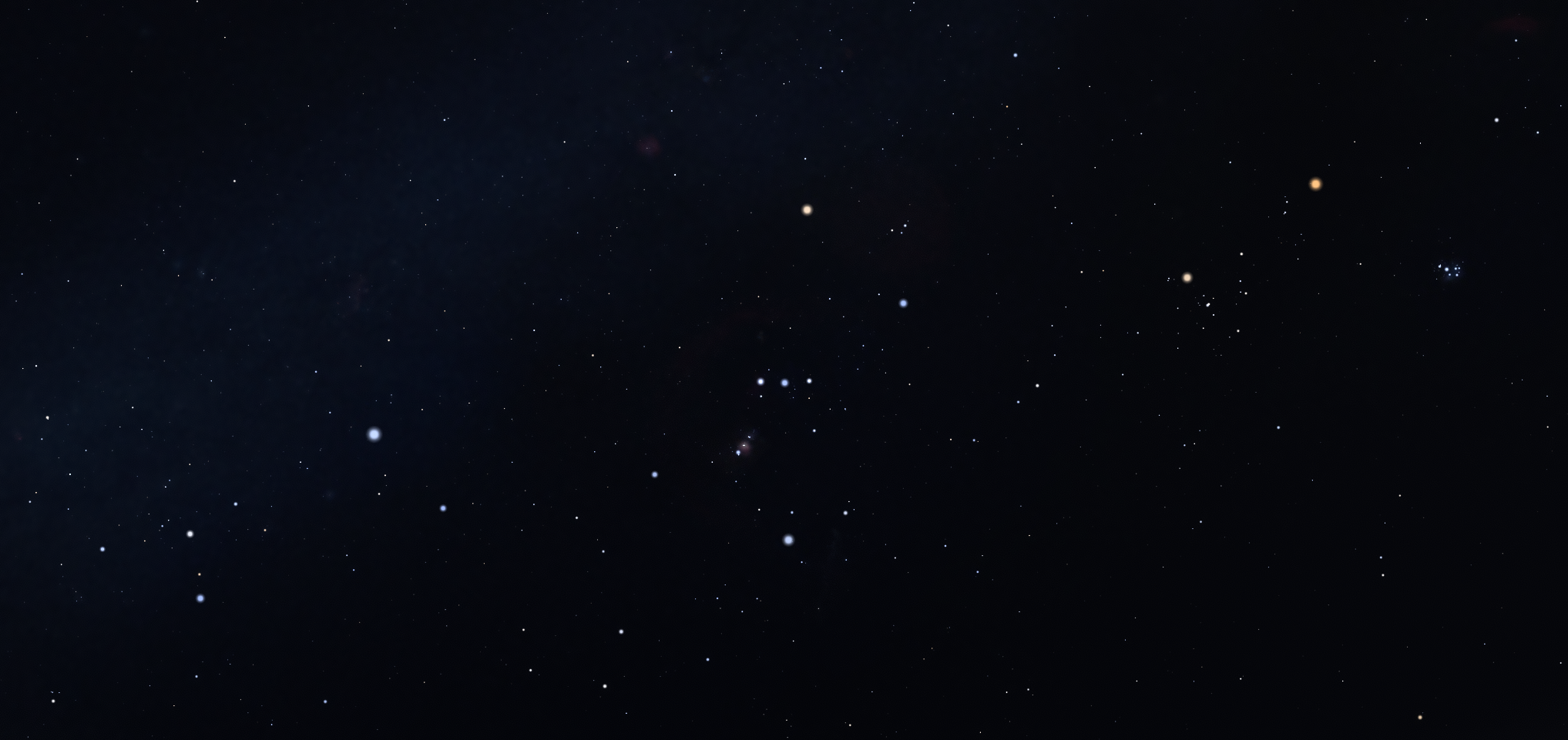
Looks can be deceiving
- Stars (or other bright objects) generally only appear to be
next to one another
- In reality, they are almost certainly separated by massive distances
- Stars are so far away that we lose essentially all depth perception
- Comparable to looking at far away headlights on a dark road
- Looking upward, we could not tell the difference between space (as we know it to be) and us living inside a huge dark bubble with holes poked in it to let in light
- Embracing this analogy, we commonly refer to the Celestial Sphere, which could be envisioned as this giant dark bubble with holes poked in it
The Celestial Sphere
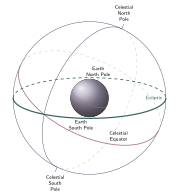
- Defined to align with Earth’s sphere:
- The celestial North pole is directly above Earth’s North pole
- The celestial South pole is directly below Earth’s South pole
- The celestial “equator” aligns with Earth’s equator
- The celestial equator does not align with the disk
of the Solar System, because Earth is tilted
- The ecliptic traces the intersection of the celestial sphere and the disk of the Solar System, and is the path that the Sun and planets follow through our sky
Orientation and Vocabulary
From Our Perspective
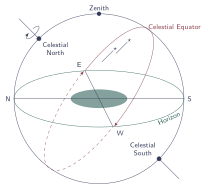
The Equatorial coordinate system
- Coordinates on the Celestial Sphere are determine just like on Earth: with a latitude and longitude
- Varies from -90 to +90 degrees
- High precision uses arc-minutes, where 60 arc-minute \(=60^\prime = 1^\circ\)
- Can also use arc-seconds, where 60 arc-second \(=60^{\prime\prime} = 1^\prime\) \[\begin{aligned}15^\circ45^\prime30^{\prime\prime} &= (15 + 45/60 + 30/3600)^\circ\\ &= 15.75833^\circ \end{aligned}\]
- Varies from 0 to 360 degrees
- Because the celestial sphere rotates about its poles once every 24 hours, Right ascension is also commonly indicated in units of hours, minutes, and seconds
- 1 hr = 15 degrees \[\begin{aligned}14h32m14s &= (14 + 32/60 + 14/3600)h\\ &= 14.5372h\\ &= (14.5372 \times 15)^\circ\\ &= 218.0583^\circ\end{aligned}\]
Movement
- The further away something is from us, the more it seems to be
“locked” to the celestial sphere
- Stars are essentially motionless, with basically fixed declination and right ascension
- Solar system objects, like planets or the Sun, slowly traverse along the ecliptic
- The Moon follows a curve quite close to the ecliptic, but not exactly, at a faster pace
- Objects in orbit, like satellites, do not seem fixed to the celestial sphere at all
- The Milky Way, being comprised of stars, is fixed to the celestial
sphere
- The galactic plane lines up with neither Earth’s equator nor the disk of the Solar System, and thus stretches across the sky at an alternative angle
The Local System
- Determined by where and when you are looking at the sky
- Still commonly uses two coordinates:
- The direction you are looking (Azimuth)
- Generally determined by something like a compass bearing
- The angle above the horizon that the object appears
(Altitude)
- Generally determined with a sextant, possible with rough hand measurements
- The direction you are looking (Azimuth)
Other Coordinate systems
- Astronomy will frequently utilize other coordinate systems as well:
- Solar barycentric coordinates: based on the center of mass of the Sun
- Galactic coordinates: also centered on the Sun, but with different orientation
- Even Equatorial coordinates can vary some owing to the precession of the Earth, and thus often specify an epoch
- All can be transformed between one another using geometry
- Not always very nice geometry!
- We won’t need to convert between coordinates too often in this class, and we’ll try to leverage existing libraries to do this wherever possible
Celestial Sphere Demonstrations
- How long is the Sun up today (not that you can see it…) here on the 45th parallel?
- How long is the Sun up in Alaska (roughly on the 65th parallel)?
- How long after sunset will the bright star Arcturus rise today in Salem?
Plotting Coordinates Demonstration
- The file here is a CSV file containing the names and coordinates of the brightest 200 stars
- Suppose we want to visualize this arrangement of stars to see if we could identify any constellations