Kepler’s Ellipses
January 21, 2026
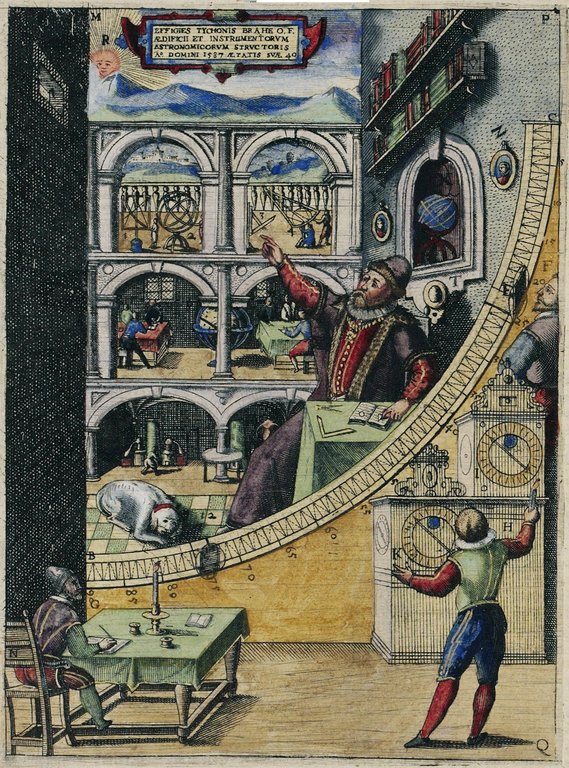
Tycho Brahe
- Last real “naked-eye” astronomer
- Took very precise angle measurements of stars and planets
- Did not believe in a heliocentric universe, as he saw no stellar parallax
- Hired Johannes Kepler to analyze all his data
Kepler’s 1st Law
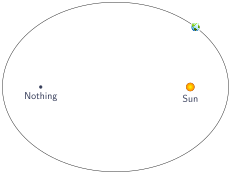
- The orbits of the planets are ellipses
- The Sun sits at one focus, with nothing at the other
An Ellipses Aside
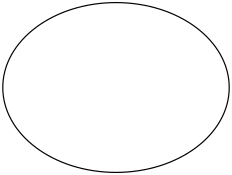
Look like squished circles
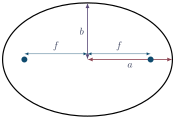
Described by:
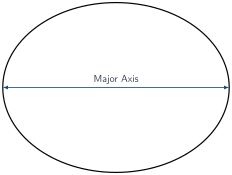
- Major Axis (longest width)
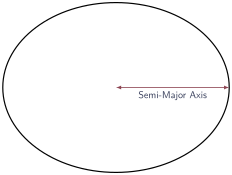
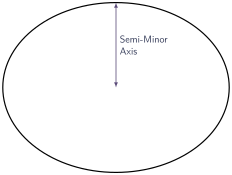
- Half lengths are “semi-”
- Minor Axis (shortest width)
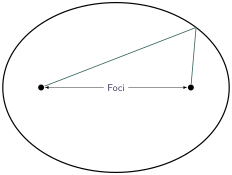
- Foci distances
- Eccentricity (squished-ness)
- Major Axis (longest width)
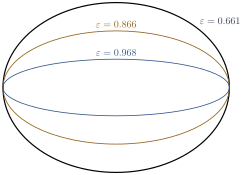
Some Ellipse Math
You can always get the foci locations and eccentricity from the semi-major and minor axes.
- Foci: \[ f = \sqrt{a^2 - b^2} \]
- Eccentricity: \[ \varepsilon = \sqrt{1 - \frac{b^2}{a^2}} \]
- Area: \[ A = \pi a b \]
Elliptical Orbits
- Most planets in the Solar System have orbits that are not very eccentric
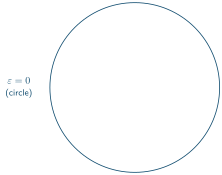
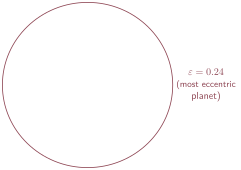
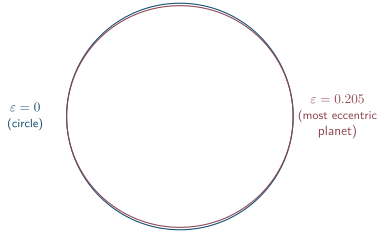
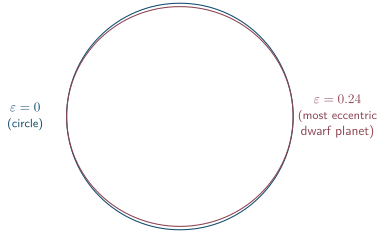
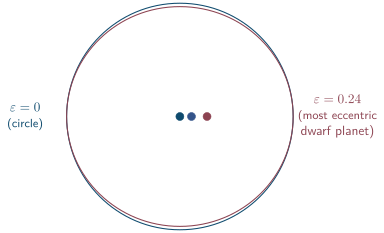
- The Sun is clearly not at the center however
More Vocab
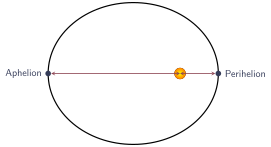
- Apogee/Aphelion: The point at which a body is at its furthest from the Earth/Sun
- Perigee/Perihelion: The point at which a body is at its closest to the Earth/Sun
Kepler’s 2nd Law
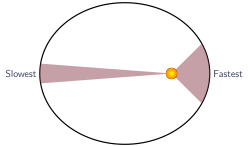
- A line joining a planet to the Sun sweeps out equal areas in equal
times
- Results in planets moving faster when close to the Sun and slower when far away