I am open to discussion on this, but I think it would benefit us all
to move homework deadlines to Monday nights
You get a weekend to potentially coordinate with members with busy
weekday schedules
I get to feel like content can be presented on Wednesdays and still
give you enough time
New homework comes out the same day new content is presented
Thoughts?
Recap
Distributions show bulk trends
Histograms
KDE plots
2D distributions
Asteroids
Belt
Resonance
Today’s Plan
Asteroids
Impending doom
Gravity
Brightness / Magnitudes
Work time?
Back to Asteroids
How long before we all die horribly?
Ensuring Life
Stated goal was to find 90% of asteroids 1 km or
larger with near-Earth orbits
How do we know when that goal is
reached?
Crater comparisons
Rediscovery analysis
Theoretical models
Latest Estimates
Dissertation work
Newton’s Gravity
Why Gravity?
Kepler told us that there must be these
relationships, but he couldn’t say why
Newton found that, if the direction that something is moving
changes, then it must have experienced some force
Newton’s big connection (one of them) was determining that the
necessary force turns out to be from gravity (at least for most
astronomic objects)
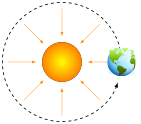
Gravity
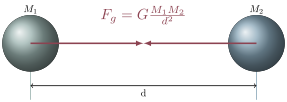
Gravity is the universal attractor
Anything with mass attracts anything else with mass
Strength of force increases with the amount of mass involved
Strength of force decreases rapidly with distance between the
masses
Newton meets Kepler’s 3rd
Kepler already had worked out \[
\frac{a^3}{p^2} = \text{same value for all planets orbiting Sun}
\]
Newton worked out, starting with the force, that two objects held in
orbit by gravity would obey: \[
\frac{a^3}{p^2} = \frac{G(M_1 + M_2)}{4\pi^2} \] where:
\(M_1, M_2\) are the masses of the
objects in kilograms
\(a\) is the average separation
between the objects in meters
\(p\) is the orbital period in
seconds
\(G\) is the gravitational constant
(\(6.67\times10^{-11}\,\tfrac{m^3}{kg\,s^2}\))
Some nicer units
Put in more convenient units, Newton’s formulation of Kepler’s 3rd
boils down to: \[ \frac{a^3}{p^2} = (M_1 +
M_2)_\odot \] where
\(M_1, M_2\) are the masses of
objects in solar masses (multiples of the Sun’s mass)
\(a\) is the average separation of
the objects in AU
\(p\) is the orbital period in
years
For the Sun and most planets, \(M_1 + M_2
\approx 1 M_\odot\)
If you can measure \(a\) and \(p\), then you can work out the mass of the
objects!
Understanding Brightness
How Bright!
Apparent brightness is the intensity of radiation (or reflected
radiation) from a celestial body
As measured by the observer, so generally from the Earth’s
surface
Measured in units of watts per meter squared (\(W/m^2\))
For our Sun, this is about $ 1400\ W/m^2$
Clearly, the apparent brightness of other stars is going to be much,
much less
It is frequently useful to thus use a different scale, where instead
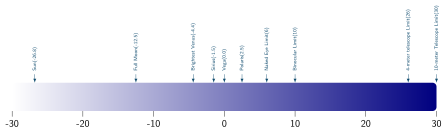
we talk about apparent magnitude
Apparent Magnitude
System introduced around 150 BC!
Hipparchus divided stars into six groups:
Brightest were “1st magnitude”
Faintest (that he could see) were “6th magnitude”
These days we are much more precise, but have defined things to
still largely adhere to these same ideas
Measured on an inverted logarithmic scale
Brighter objects have small magnitudes, and they can be
negative
A factor of 100 in brightness corresponds to a difference of 5 in
magnitude
\[ m =
-2.5\log\left(\frac{B_{obj}}{B_{Vega}}\right)\]
Making Magnitudes Intuitive
Smaller numbers mean brighter stars
Numbers can be negative
Smaller differences in magnitude correspond to larger differences in
brightness
Work Time?
Time is Yours!
I won’t usually give you much of time in class to work on
homework
But in this case:
To try to get content to you sooner with the Friday deadlines, I’d
squeezed and compressed some ideas forward
I suspect there are questions about the homework that I can
address