Peak Star Types

Jed Rembold

February 9, 2026

Announcements

  • Unit 1 partner feedback form is live until midnight tonight
  • Homework 3 due tonight
  • Homework 4 is up!

Recap

  • Atomic energy levels result in emission or absorption spectra
    • Exact levels depend on chemical composition
    • Hot diffuse gases emit, colder gases absorb
  • Movement towards or away from us shifts our perceived wavelengths
    • Redshifted (longer wavelength) going away from us
    • Blueshifted (shorter wavelengths) coming toward us
    • Shifts are usually tiny, and so we fit Gaussians to pinpoint them

Today’s Plan

  • Emission Spectra Detectives
  • Luminosity
  • Stellar Distances
  • Star Types
  • HR Diagrams

On the Case

  • Scattered around the room are ~4 different gas lamps, each with a different type of gas

  • Given the descriptions below, can you identify which is corresponds to which gas?

    Gas Description
    Hydrogen Two strong lines, one red, one greenish-blue, and a weaker blue-violet
    Nitrogen Broad red and violet lines, strong green and yellow
    Mercury Strong yellow, green, and violet lines, numerous weaker red lines
    Chlorine Strong and evenly narrow lines at ROY-G-BIV

Luminosity

So what can we observe?

  • Light from the stars tells us:
    • Their location in the sky
    • Their overall brightness
    • Their intensity at different wavelengths (their spectrum)
  • From these, we can determine:
    • Surface temperature
    • Radial motion
    • Distance (sometimes)
    • Size (in a fashion)
    • Power output or Luminosity
    • Mass (sometimes)

Luminosity

  • We measure the apparent brightness \(B\) of an object here at Earth (area under spectra)
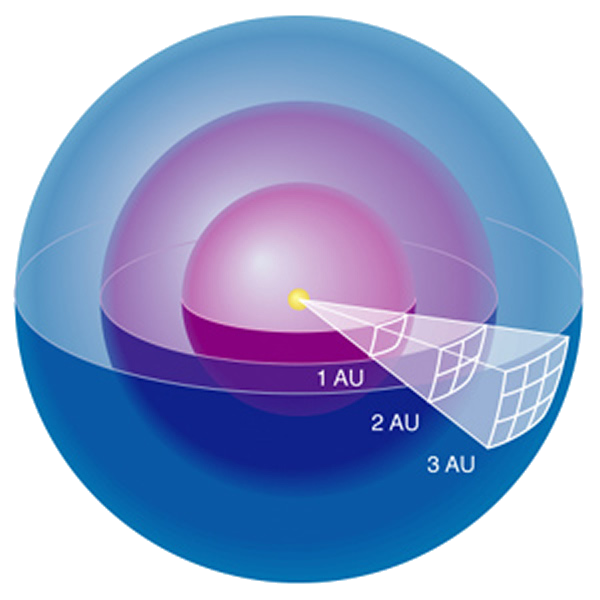
  • Like ripples around a dropped rock though, brightness falls off with distance:
    • Unlike pond ripples, the waves spread out radially, so the energy gets spread over a sphere
  • Thus the luminosity is: \[ L = 4\pi d^2 \times B \] where \(d\) is the distance
  • The range of possible stellar luminosities is huge
    • \(L_{sun} = L_\odot = 4 \times 10^{26}\) W
    • Dimmest at around \(0.000001L_\odot\)
    • Brightest around \(100000L_\odot\)
Energy at the source is spread over ever larger spheres

Accounting for Distance

Stellar Distances

  • Initially, coming from parallax
    • Shifts of the foreground relative to the background when the viewpoint changes
  • Parallax effects are larger for closer objects, and stars are far away
    • Need as large a baseline as possible: observing during 6 month intervals to be on opposite sides of the Sun
    • Parallax effects from stars are still tiny: generally less than an arcsecond
  • A parsec is the distance that corresponds to a parallax angle of 1 arcsecond
    • Equivalent to 3.26 light-years, or 3.26\(\times\) the distance light travels in a year
  • Measuring the parallax angle \(p\) in arcseconds gives the distance in parsecs \(d\): \[ d_{pc} = \frac{1}{p_{asec}} \]

Absolute Magnitude

  • Astronomers will also use absolute magnitude as a proxy for luminosity
  • A star’s absolute magnitude (commonly denoted \(M\)) is the magnitude it would seem to have if it was 10 parsecs away
  • Still requires knowing the distance to the star to compute: \[ m - M = 5\log_{10}\left(\frac{d_{pc}}{10}\right) \] where \[ \begin{aligned} M &= \text{ absolute magnitude} \\ m &= \text{ apparent magnitude} \\ d_{pc} &= \text{ distance in pc}\\ \end{aligned} \]

Classifying Stars

Star Types

  • Stars were originally classified by the strength of their Hydrogen lines
  • The strongest were classified type A, all the way down to type O, which showed virtually no hydrogen lines
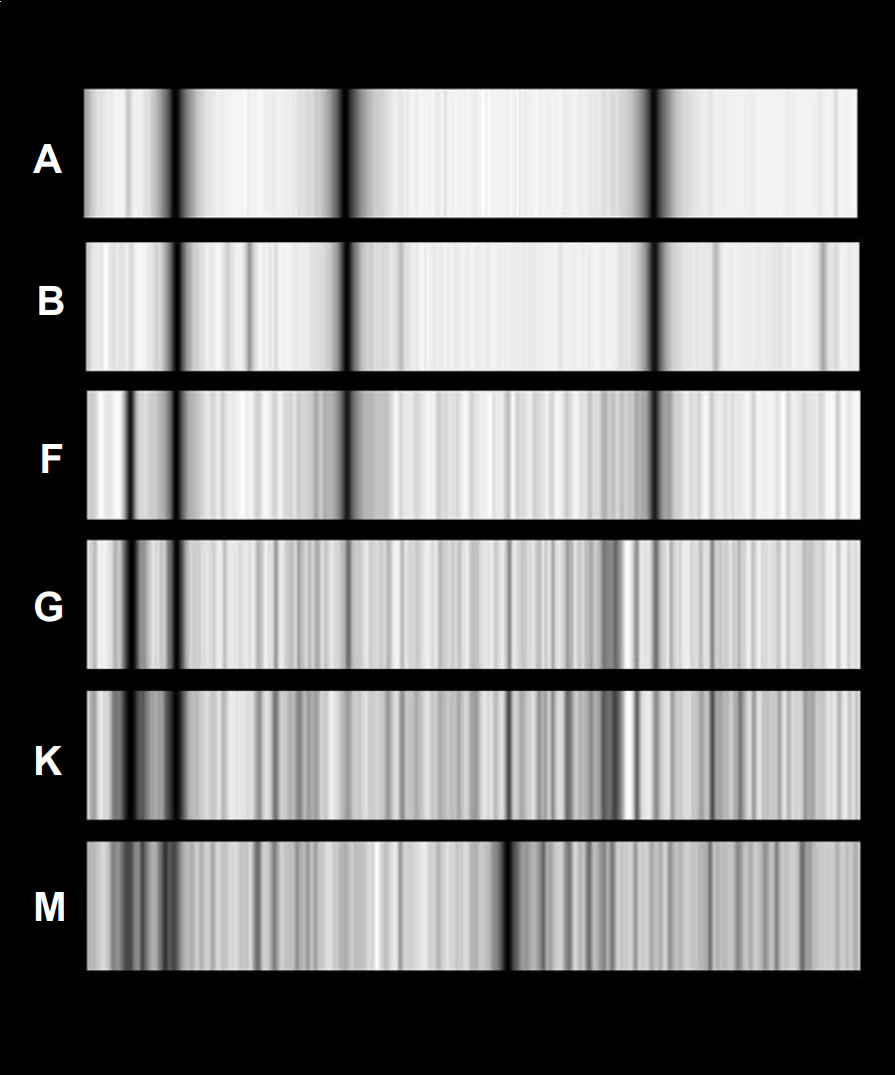
Original Star Types

Scrambling the System

  • As more spectra were observed, the H lines were proving to be less reliable in predicting similar properties
  • Enter Annie Cannon
    • Hired as one of the Harvard Computers
    • Classified some 350,000 stars (yikes!)
    • Drastically simplied the system and eliminated many classes, focusing mainly on the Balmer line transitions
    • Once the relationship between spectra lines and temperature was understood, the letters were reordered to match the temperature trend

HR Diagrams
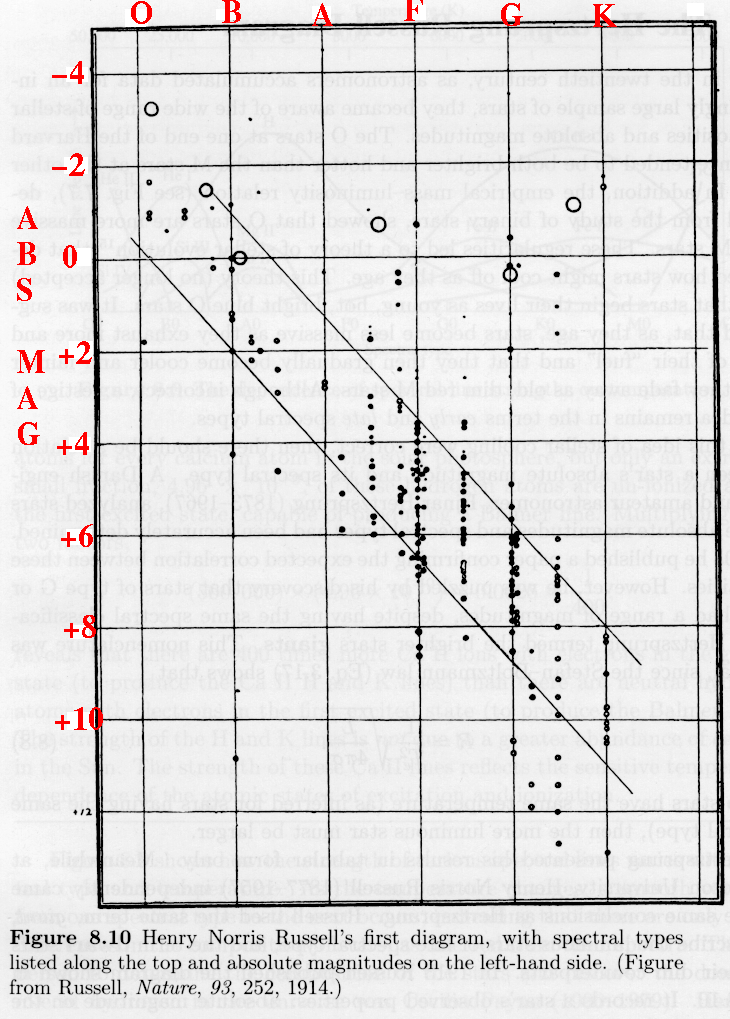
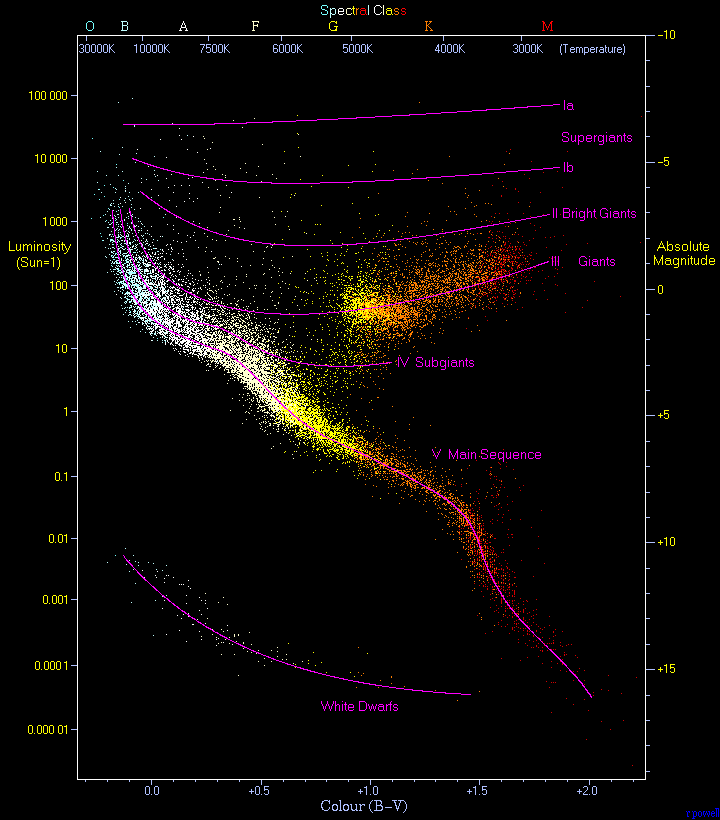
HR Diagram

Main Sequence White Dwarfs Giants Supergiants

Star Sizes

  • Given certain names, you can perhaps guess how stellar size varies in an HR diagram
  • But why?
    • Recall that total brightness over some interval of wavelength is measured in watts per square meter
      • This would be the area under a spectra curve
      • This is why brightness drops off as it travels away from the star to us
      • This also means though that the total energy emitted from the surface of the star will depend on the star’s size!
    • The area under the curve depends (heavily) on the temperature \[ L = 4\pi R^2_s \times \sigma T^4 \]

Mass and HR Diagrams

  • What about patterns in the mass of stars on the HR diagram?
  • Globally, there is no obvious trend
  • There do appear to be trends within the subgroups though:
    • Main sequence stars decrease in mass from upper left to lower right
    • White dwarfs are generally fairly low in mass
    • Giants and supergiants can vary wildly
  • Mass determines many of the equilibrium points in stars, so no clear trend is interesting!
// reveal.js plugins // Added plugins ,