Discrete Fourier
Jed Rembold
February 18, 2026
Announcements
- HW5 is due on Monday
- Don’t forget the Unit 2 debrief form! Due by end of Friday
- I’m gone for the rest of the week. Reach out to me over email or Discord if you have questions
Recall
- Measuring periodicity for noisy data can be very sensitive to initial guesses
- Any periodic signal can be represented as a combination of sine waves
- The Fourier transform wraps a signal at different periods and
measures the “overlap” of that signal at each period
- Moves a signal from “time-space” to “frequency-space”
- The signal’s power spectrum is the square of the amplitude of its Fourier transform
- Can use
fft(orrfft) to compute the power-spectrum, andfftfreq(orrfftfreq) to compute the corresponding frequencies
Today’s Plan
- Going from frequency-space to time-space
- Understanding discrete data’s effect on the Fourier Transform
- Quiz
Back it up
The Inverse FFT
- You can also go backwards!
- The Inverse Fourier Transform moves you back from the frequency-domain to the time-domain
- In Python, this is given by
ifft - In R, use the
inverse = TRUEflag insidefft - Make it possible to filter out certain frequencies, and then transform back to a clean signal
Activity!
- I’ve generated noisy data of a single oscillation here.
- Your task is to determine the period/frequency, filter out everything else by setting it to 0, and then transform that signal back and plot it atop the original noise
Discrete Effects
Common Transforms
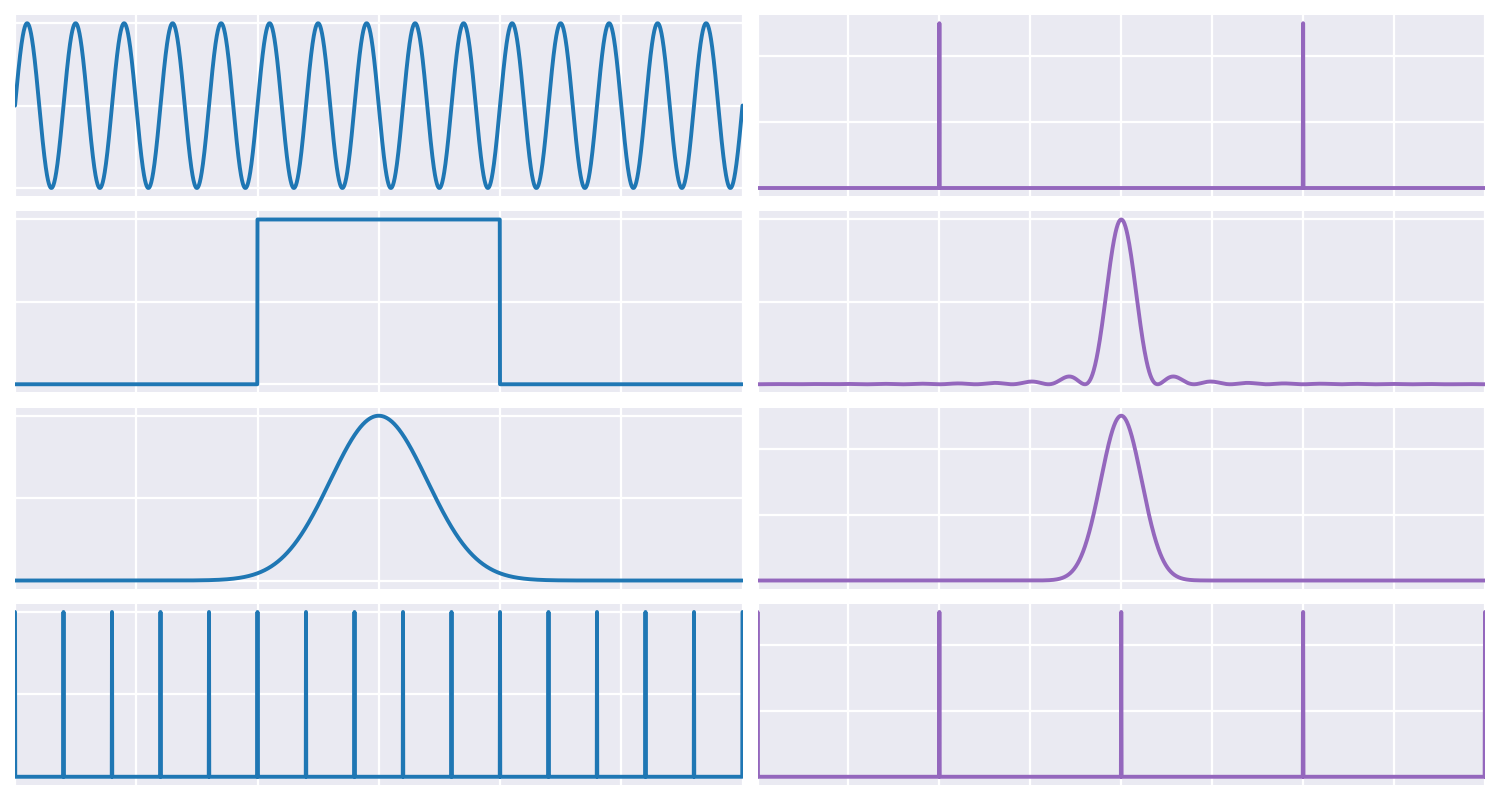
Convolutions
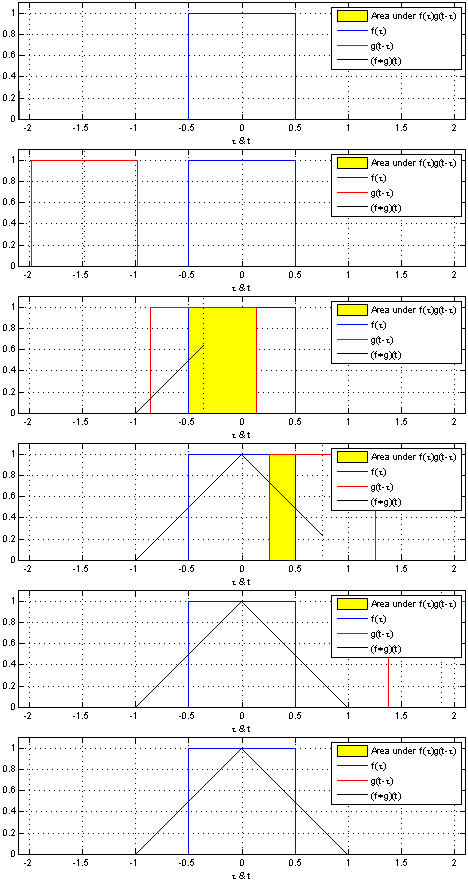
- Mathematically, a convolution is defined as: \[ [f * g](t) = \int_{-\infty}^{\infty} f(t)g(t-\tau)\,d\tau \]
- Conceptually, this is the same as:
- Taking the second function and flipping it about the y-axis
- Then “sliding” that function across the other, from left to right
- Each step, summing the area beneath both functions
Visual Convolutions
Why do we care?
- Fourier Transforms have a particular attribute: \[ \mathcal{F}\{f * g\} = \mathcal{F}\{f\} \cdot \mathcal{F}\{g\} \] or \[ \mathcal{F}\{f \cdot g\} = \mathcal{F}\{f\} * \mathcal{F}\{g\} \]
- In other words: convolutions in one space are the same as just multiplying the function point-wise in the other space
Example 1: Window
Example 2: Discrete Measurements
Our Powers Combined…
- In practice, most real world data consists of both effects:
- Data was measured over some duration: the window
- Will cause broadening of our peaks. The narrower the window, the greater the broadening.
- Data was collected at some frequency: the discrete measurements
- Will cause aliases of the signal, spaced according to the sampling rate
- The slower the sampling rate, the more densely packed the aliases
- Data was measured over some duration: the window
The Nyquist Limit
- Note that if the window of observations gets too small, or the time between observations too large, our Fourier Transform peaks will begin to overlap!
- In this case not all of the frequency information can be recovered
- This is called the Nyquist Limit, and occurs at a frequency of half the sampling frequency
- The FFT algorithm generally measures frequencies up to but not beyond this point, so you shouldn’t see aliases in your results, but your results might not capture what you were hoping to see.
Nyquist Visual
Quiz 1
Quiz Time!
- Put your notes away and have just a writing implement and a calculator out!
- Show as much work or your thought process as you can on all problems for the potential of partial credit
- When you are finished you can leave