Doppler Techniques
Jed Rembold
February 25, 2026
Announcements
- We’ll talk more about Quiz 1 in just a moment
- Homework 6 due on Monday
- You have everything you need after today
- Dealing with aliases can be confusing, and time-pressure just adds to that. I’d recommend not waiting until the last minute to make good progress
- Office hour tweak for the rest of the semester
Quiz Discussion
Aggegrate Results
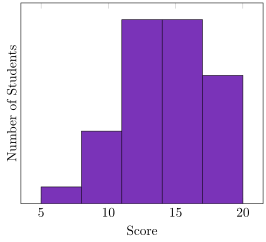
- Pre-curve:
- Max: 100%
- Mean: 67.76%
- Median: 67.5%
- St Dev: 18.18%
Quiz Talk
- I think many could have benefitted from a bit more studying, or perhaps just looking at the study materials a little more
- Quizzes can be a bit more punishing owing to limited points, plus
this was the first one in this class, so perhaps you didn’t know what to
expect
- As such, I’ve added 1 point (5%) to your total score in the gradebook
- Grade Reports will be coming out as soon as I get more caught up in HW grading
- Focus on explaining the why in your computational essays. I promise it will help engrain the science concepts better in your mind
Introduction
Recap
- The Lomb-Scargle Periodogram is an approach that works well for
non-uniform data
- Requires you to specify the range of angular frequencies / frequencies / periods that you want to computer the power over
- Aliasing will generally be a factor you need to content with
- Planets and their parent star technically orbit their shared center of mass
- Causes the star to “wobble”, which can be measured!
- Astrometric method looks for the shift in the star relative to background stars
- Doppler method looks for the Doppler shift in light as the star move towards then away from us
Discussing Today
- Planet properties from wobbling methods
- Finding multiple signal components
- Determining all component properties
- Subtracting contributions
- Rechecking the results
Determining Planetary Mass
Animated Example
Beginning to extract planetary properties
- In general, to understand any exoplanet, you must first understand its parent star
- This is often considerably easier, since the star is big and bright
- Several parameters in particular are useful to know:
- The mass of the star
- The size of the star
- Both generally require knowing the distance to the star, but otherwise can be worked out from luminosities or location on the HR diagram
Planetary Period and Distance
- If you have the period of the star, then you have the period of the
planet
- Both move in lockstep about the center of mass
- If you have multiple planets, you can separate the different components from the stars motion
- Extracting the distance to the planet / semimajor axis requires application of Kepler’s 3rd law along with the center of mass location: \[\text{Kepler's 3rd: } \frac{GM_{tot}}{4\pi^2} = \frac{a^3}{p^2} \qquad\qquad\text{Center of Mass: } M_1a_1 = M_2 a_2 \]
Planetary Mass (Part I)
- Combining \(a_1\) and \(a_2\): \[ a = a_1 + a_2 = a_1\left(1 + \frac{a_2}{a_1}\right) = a_1\left(1 + \frac{M_1}{M_2}\right) = \frac{a_1}{M_2}\left(M_2 + M_1\right) = \frac{a_1 M_{tot}}{M_2} \]
- Plugging into Kepler: \[ \frac{GM_{tot}}{4\pi^2} = \frac{1}{p^2} \left(\frac{a_1 M_{tot}}{M_2}\right)^3 \]
- If you know \(a_1\) by direct observation, then you are done, and can solve for \(M_2\)!
- Otherwise you need to write \(a_1\)
in terms of a velocity
- If you assume mostly circular orbits: \[v_1 = \frac{2\pi a_1}{p} \quad\Rightarrow\quad a_1 = \frac{v_1 p}{2\pi}\]
Planetary Mass (Part II)
- Plugging that back into Kepler: \[ \frac{GM_{tot}}{4\pi^2} = \frac{1}{p^2} \left(\frac{a_1^3 M^3_{tot}}{M^3_2}\right) \]
\[ \frac{GM_{tot}}{4\pi^2} = \frac{1}{p^2} \frac{M^3_{tot}}{M^3_2} \left(\frac{v_1 p}{2\pi}\right)^3 \]
\[ \frac{GM_{tot}}{4\pi^2} = \frac{1}{p^2} \frac{M^3_{tot}}{M^3_2} \frac{v_1^3 p^3}{8\pi^3} \]
\[ G = \frac{M^2_{tot}}{M^3_2} \frac{v_1^3 p}{2\pi} \]
\[ M_2 = \left(\frac{M^2_{tot}}{G}\frac{v_1^3 p}{2\pi}\right)^{1/3} \]
Some Caveats
- The true velocity is only what is measured at the peak of the Doppler curve if you are viewing the orbit perfectly edge-on
- In general: \[ v_{obs} = v_1\sin(i)
\] where \(i\) is the
orbital inclination (\(0^\circ\) if viewing face-on, or \(90^\circ\) if viewing edge-on)
- If the inclination angle in unknown, then technically you are finding a minimum mass
- If the eccentricity is known, then: \[ M_2 = \left(\frac{M^2_{tot}}{G}\frac{v_1^3 p}{2\pi}(1- \epsilon^2)^{3/2}\right)^{1/3} \]
Finding Multiple Signals
Hidden Signals
- Like with our FFT methods, a signal might be comprised of several different components
- This is especially true with Doppler methods, as each orbiting planet tugs on the star a bit differently
- Frequently then need to look for multiple significant peaks within the periodogram
- This is greatly complicated by aliases vs our FFT methods
Visualizing Aliases
- We saw last class that: \[f_{alias} =
\left| f_{signal} \pm k \cdot f_{sampling} \right| \] where \(f_{sampling}\) you can get from the
spectral window
- Note that you might have several \(f_{sampling}\) values that all need to be accounted for
- Don’t just iterate over a few \(k\)
values, go at least up to 4 or 5
- Can be useful to compute a flattened outer product, or could just handle with looping
Flattened Outer Products
Imagine an “outer product” as creating a grid of all the multiplied values of two arrays/vectors
We don’t really care about the grid nature here, but would rather have just a list of all the possible combinations
In Python:
np.outer(array₁, array₂).ravel()In R:
as.numeric(outer(array₁, array₂))
Proceeding Forward
- Once you have flagged all the potential aliases of a signal, you might be able to identify other potential component peaks
- A more robust way though is to subtract the found component wave from the signal and then repeat the process
- But how to compute the component wave?
- We have the frequency/period, but what about the amplitude/phase angle?
- No complex values to compute those from like with Fourier Transforms
Fitting the Wave Directly
- While we discussed early that non-linear fitting doesn’t work well by itself, it does work quite well if you have established and “locked” the period/frequency
- Define a way function but with your found peak frequency: \[ A \sin\left(2\pi f_{peak} t + \phi\right) + H \]
- Use your nonlinear fitting tool to find all the other unknown constants: \(A\), \(\phi\) and \(H\)
- Subtract the result from your original signal
Rinse, Wash, Repeat
- Now, with the new signal, compute a new Lomb-Scargle periodogram,
and continue the process
- Identify a candidate peak
- Compute and visualize aliases to see if they make sense
- Extract freqency, compute wave properties, and subtract
- Repeat
- When does it end?
- Subtracting will get rid of most of the signal, but not always quite all of it
- If all you are left with in your Lomb-Scargle on peaks/aliases that you have already found, then you are done!
Practice
- The file here contains velocity information determined from the redshift/blueshift of a star with a single planet orbiting it.
- You can assume the planet is traveling in a mostly circular orbit.
- You know that the parent star has a mass of \(2\times10^{30}\) kg.
- Determine:
- The period of the planet
- The minimum mass of the planet