Identifying Transits

Jed Rembold

March 2, 2026

Announcements

  • Homework 6 due tonight
  • Homework 7 coming out later today
    • Still with the same partners
  • I’m extending this unit into Wednesday

Recap

  • By utilizing Kepler’s 3rd law and the definition of center of mass, we can extract the mass of the exoplanet (assuming the star’s mass is much larger)
  • We can get the full wave properties from Lomb-Scargle data by doing a nonlinear fit back to the data once we’ve identified our peak frequency
  • We can subtract out found wave components to look for more hidden waves

Discussing Today

  • Transit methods
  • Rolling Averages
  • Rebinning

Determining Size

Full Example

Transits

  • If a planet system is oriented towards us just right, then on occasion we should see a planet pass in front of the star
    • This is a much narrower restriction than what we had with Doppler, which was just that we needed the planet system to be tilted toward or away from us at all
  • The effect is similar to a solar eclipse on Earth
    • Light from the Sun/star is blocked for a certain amount of time
  • Some important differences owing to perspective though:
    • Our Moon is of a size and distance that it can totally block our Sun. That is not the case for exoplanets
    • Our Moon orbits Earth, not the Sun as exoplanets do
  • We can observe these same effects for Mercury and Venus though

Venus Transit

Transit Info

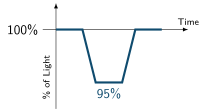
  • The most important information from a transit involves the depth of the brightness reduction
    • This directly correlates to the ratio of the cross-sectional area of the star and the planet
  • Duration of transit can give other useful information, but tougher to extract
    • Planet speed
    • Inclination angle

Planetary Radii

  • As long as your transit shows a flat portion at the bottom of the dip, then you know that the planet fully covered the star
  • Then you can work out the planet radius

\[\begin{aligned} \text{% of light } &= \frac{\text{Area of planet}}{\text{Area of star}} \\ &= \frac{\pi R^2_p}{\pi R^2_s} \\ &= \left(\frac{R_p}{R_s}\right)^2 \end{aligned}\]

Consequences of Shape

Non-sinusoidal oscillations

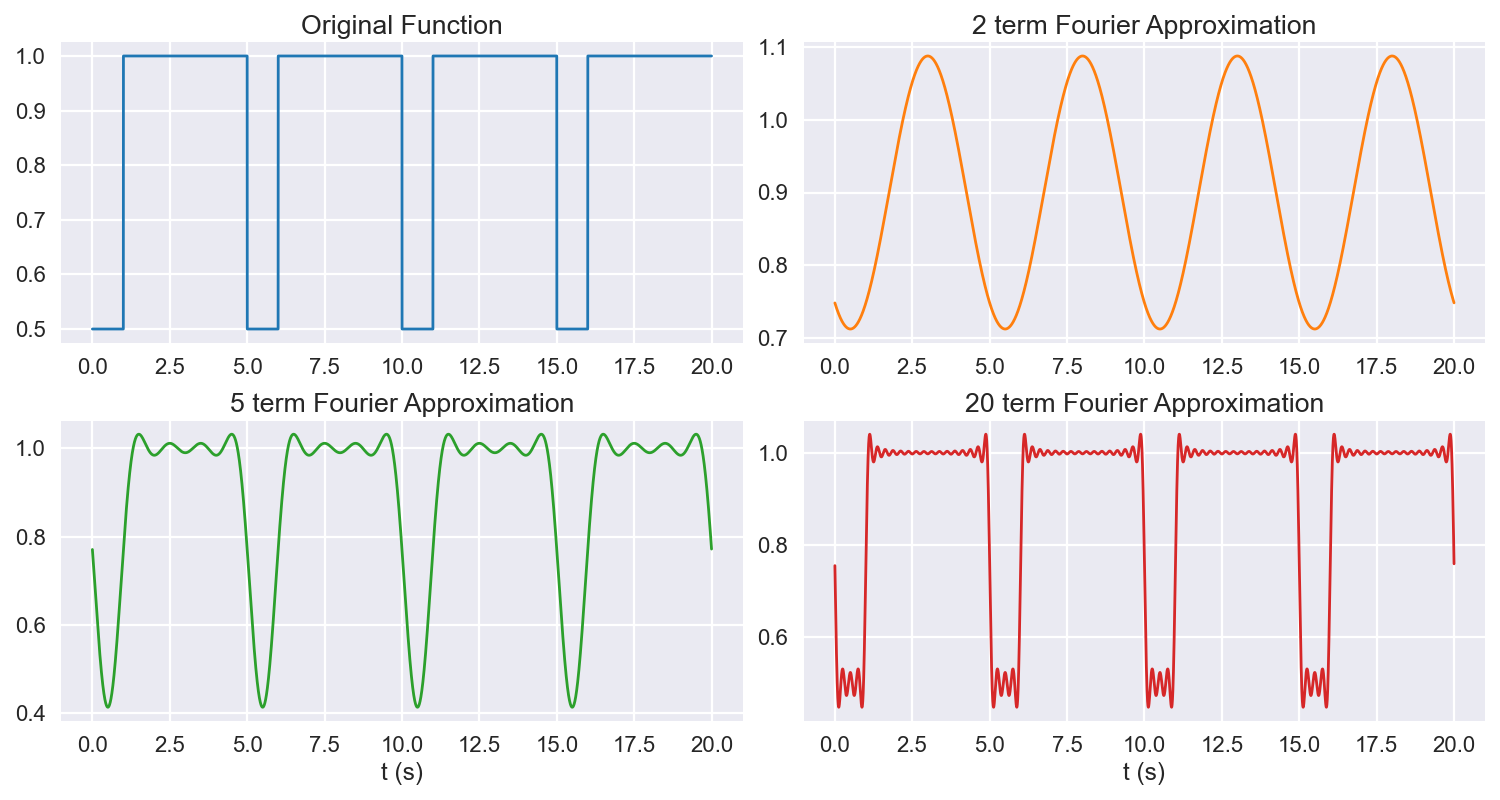
  • Recall that we originally motivated Fourier Transforms by maintaining that they could be used on any periodic motion
    • Because anything periodic could be written as a sum of sine waves
  • But there is a price in practice
  • We are going to see peaks from all of those major contributions
    • These are called harmonics

Fourier Series of a Square Wave

FFT of Transits
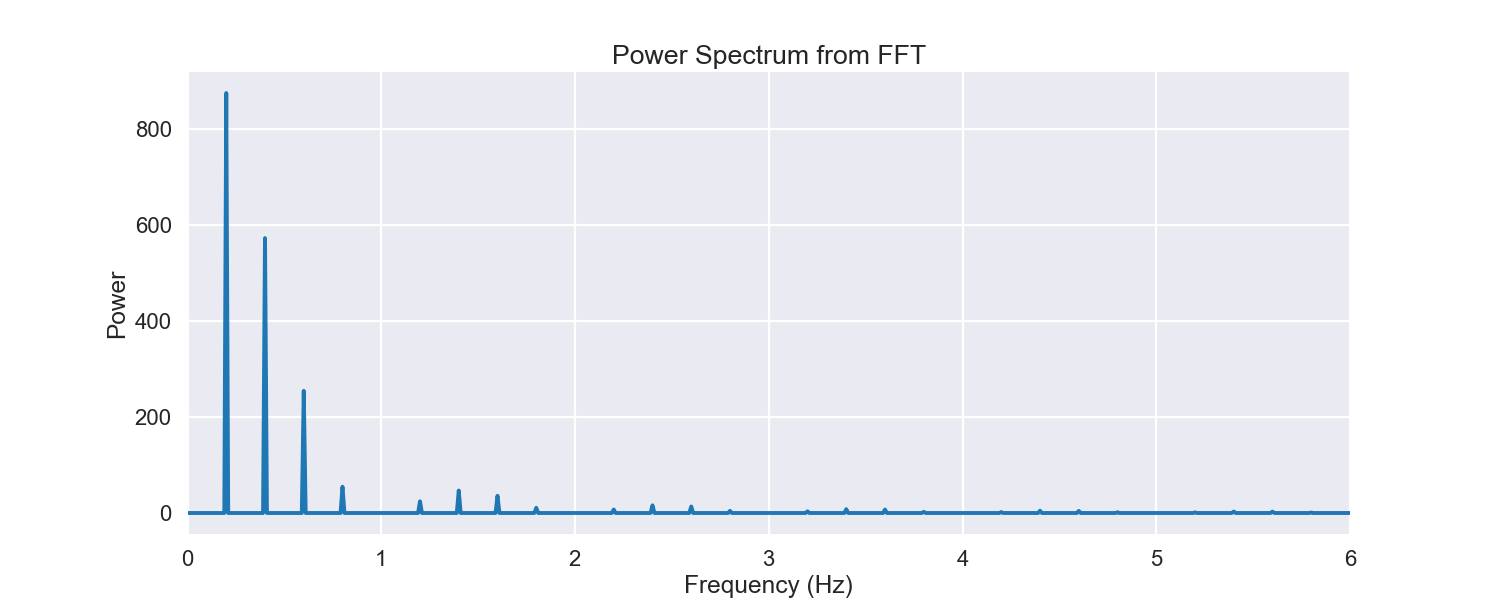
  • Those extra peaks are not aliases, they are harmonics
  • Technically needed to “center” the signal around 0 to get the above

Lomb-Scargle of Transits
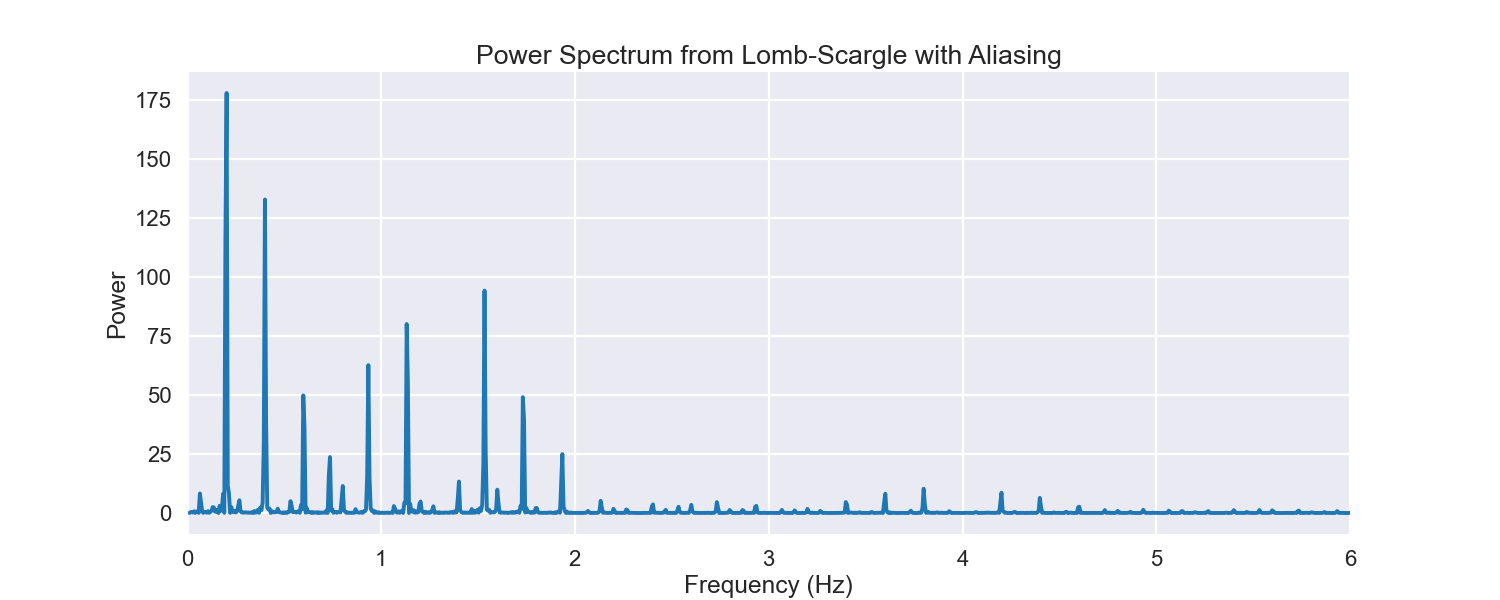
Frequency Spread

  • There is another problem here beyond just “I don’t want to deal with all of these peaks”
  • Each component peak represents a bit of the signal
  • By having many peaks, we are essentially smearing the signal out over many more peaks
  • This lowers the power of all the peaks, making it harder to detect a peak in the first place

A New Approach

Phase Folding

  • Periodograms are excellent for determining the frequency / period of hidden signals, but they don’t let you see those signals

  • Alternatively, could guess a period and then use that to “fold” the signal back in on itself

    • Snippets of the signal that may have been captured by very different observations get properly aligned or stacked
    • Noise can get properly averaged out, improving signal to noise ratios
  • The phase of the signal describes how far is signal is through its period

  • Calculating phase is a classic example of using the modulo operator:

    phase = times % period
    normalize_phase = phase / period

Visual Phase Folding

  • Often times you’ll see the phase normalized by the period, so that it starts at 0 and ends at 1
  • Be careful! Folding at integer multiples of the true period may look clean, but will contain more than a single oscillation
  • Notebook Demonstration (requires the ipywidgets package)
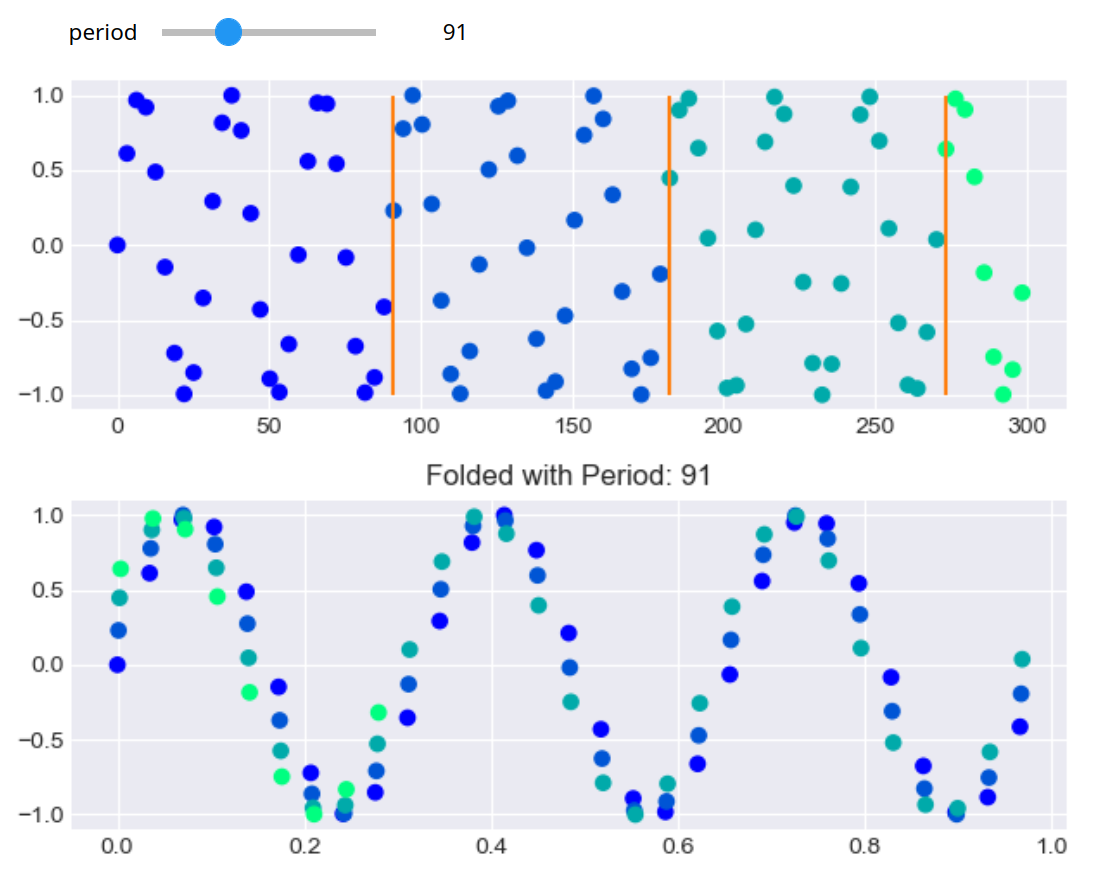
Phase Folding Demo

Box Least Squares (BLS)

  • In 2002, Kovàcs, Zucker, and Mazeh published the original BLS, or Box Least Squares, approach, and it has been further optimized is the years since
  • BLS emphasizes a grid-search approach, sliding a rectangular box over a phase-folded signal
  • The goal is to find where the biggest difference between the average inside the box and the average outside the box exists
  • Grid-search = brute force method
    • Looks at a wide variety of periods (for the folding)
    • Transit durations (for the size of the box)
    • Start points (for how quickly to move the box)

Step 3: Phase-Folding and Binning

  • For every frequency/period in the grid, we compute a normalized phase for the data and reorder it
  • To greatly speed up the next step, we rebin the phase space data, usually into 200 - 1000 bins
  • For each bin, need to track:
    • The weight: count of number of points that went into that bin
    • The average signal of all points in that bin

Step 4: The Scan

  • For the specific period, a box of width L (the duration) is slid through the bins
  • At each position, the Signal Residue is computed
    • \(s\) = sum of the signal in the box
    • \(r\) = sum of the weights in the box
    • \(N\) = the total weight overall (number of points)
    • \(S\) = the power \[ S^2 = \frac{s^2}{r(N-r)} \]
  • Keep the highest \(S\) (but write down the \(L\) and position as well)

Step 5: Periodogram Construction

  • Can then construct the periodogram as usual
    • Frequency/Period across the bottom
    • \(S\) on the y-axis
// reveal.js plugins // Added plugins ,