The Dark Forest
Jed Rembold
March 18, 2026
Announcements
- HW9 is due the Monday after break!
- You have everything you need after today
- Quiz 2 on Exoplanets and Galaxies two weeks from today
- Review and study materials going out today
- Will start a new unit the Monday we get back
Recap
- For certain data, alternative models are necessary to capture relationships within the data
- Decision Trees are one alternative method of creating a classifier
model
- Comprised of a conditional tree of yes/no questions
- Each question attempts to minimize the resulting overall “impurity” of the classifications
- Utilizing a full decision tree will often overfit the data, and thus various parameters can be chosen to “prune” the tree
- Decision trees are unstable in that the resulting tree can heavily depend on the randomized initial training data
Discussing Today
- Useful Tidbits
- Combining Models
- When and why might an ensemble of models give better results?
- How can we easily generate new “models”?
- Introducing and understanding random forest models
Tidbits
Selecting all but one
In both Python and R, we commonly need to select many feature columns, which can be cumbersome
Can select all “but one” fairly easily:
model.fit(
  train_df.drop('label', axis=1),
  train_df.label
)
model_fit <- model %>% fit(label ~ . - label, data=train_df)
Iterations and Convergence
ML models operate on iterative approaches toward some optimum
If they move slowly toward that optimum, you might need to allow for more iterations
model = LogisticRegression(max_iter=10000)model <- multinom_reg() %>% set_engine("nnet", maxit=10000)Can also try different solvers/engines
LogisticRegression(solver="newton-cg")model <- multinom_reg() %>% set_engine("glmnet", maxit=10000)
Strength in Numbers
Why Ensembles?
- Ensembles leverage the idea that many efforts trying to get the right answer will be off in a random way
- This is in fact what the Galaxy Zoo project does!
- Most volunteers are not experts, and will make mistakes from time to time
- But the mistakes will be random, and thus averaging them will get close to the correct answer
- You can actually do this with any machine learning model
Voting Classifiers
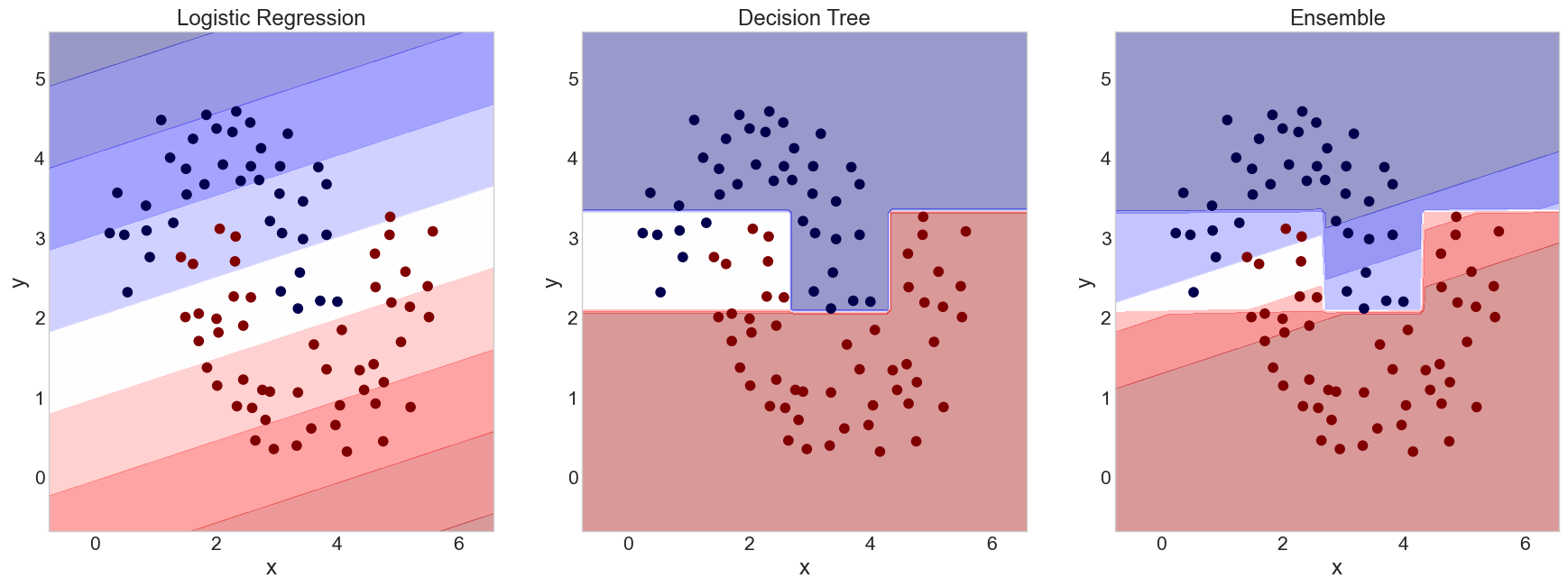
You can construct your own arbitrary ensembles
In Python:
combo = VotingClassifier(
            [
              ('logreg',log_mod), # first model
              ('dec_tree',tree)   # second model
            ],
            voting='soft')
combo.fit(training_df[['x','y']])
A bit more complicated, but can be done in R with the
stackslibrary
Gerrymandering (Voting Boundaries)
Generating Chaos
Creating Model Variations
- Changing the
random_statewon’t always generate a very different model- And in some cases, like logistic regression, there is no random element
- A better way is using bagging (Bootstrap Aggregation)
- In SkLearn as
BaggingClassifier - In R from
baguettelibrary
Bias and Variance

Applications to Ensembles
- The ability of an ensemble of classifiers to generalize depends on:
- The strength of the individual classifiers (how well does each individual model do at predicting a class?)
- The inverse correlation of the models
- 100 of essentially the same model isn’t going to gain you anything in the averaging
- The more distinct the models are in their own unique errors, the better the ensemble will operate as a whole
- Often worth making an individual model worse if it uncorrelates the ensemble models
Entering the Forest
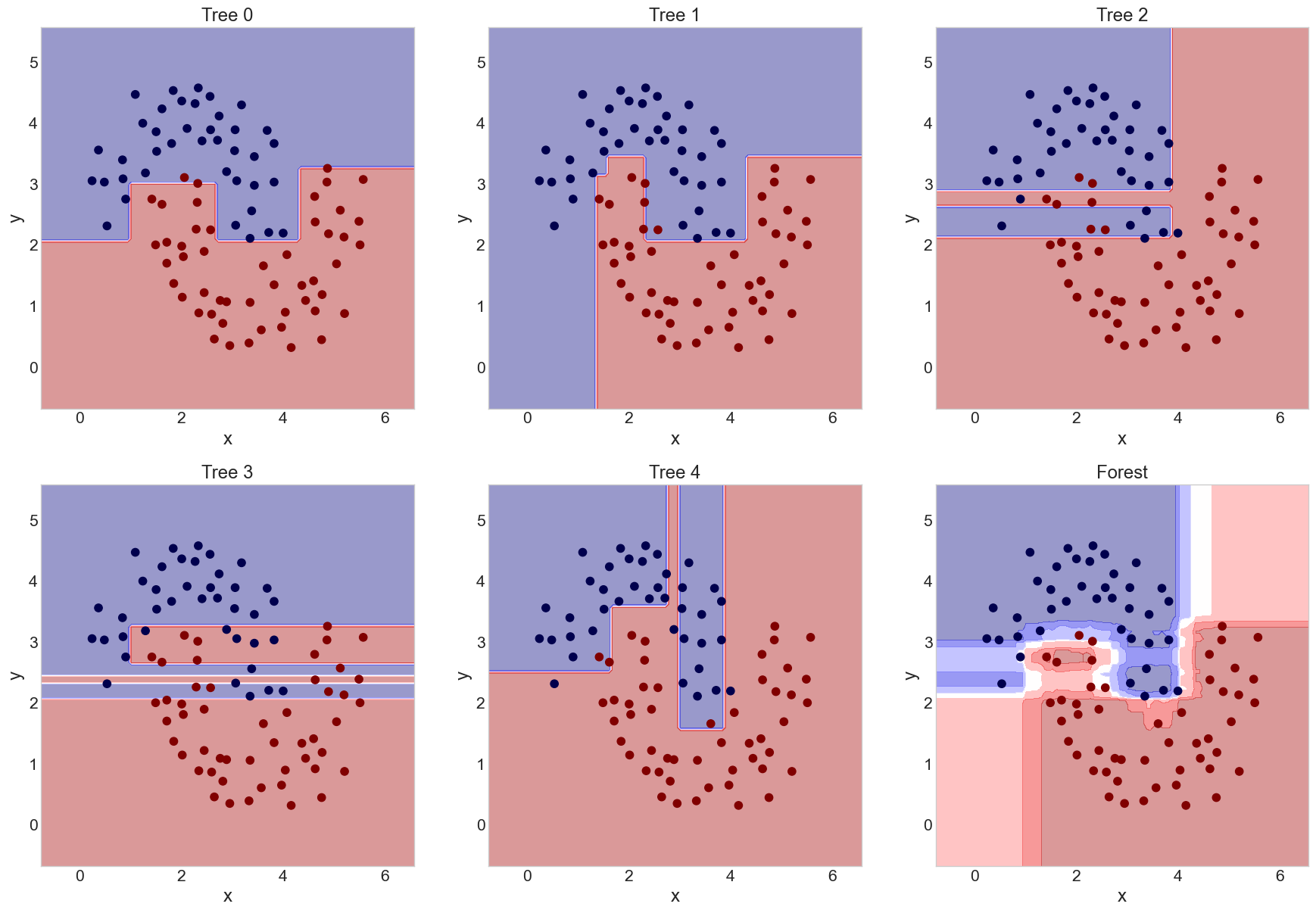
Building a Forest
Randomizing Trees
- Random forests are created by randomizing each tree in two ways:
- Bagging the training data for each tree
- For each split, picking a random subset of features to use
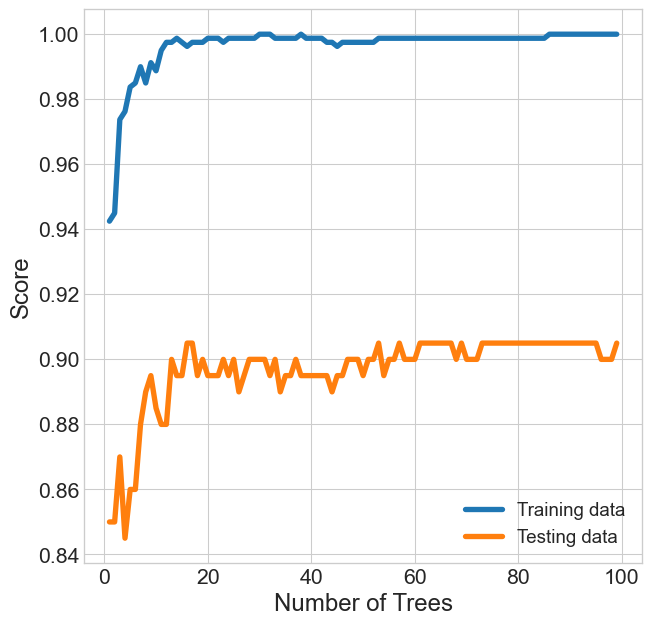
- More trees are always better, but will slow training
Creating a Random Forest
In Python, random forest models come from the Scikit-learn
ensemblemodulefrom sklearn.ensemble import RandomForestClassifier forest = RandomForestClassifier()In R, they are one of Parsnips available models
forest <- rand_forest(mode="classification")Fitting, computing confusion matrices, visualizing classification boundaries, etc. proceed exactly as they have for other models
Trimming the Forest
Tuning Forests (Python)
- How many trees in the forest?
n_estimators(default=100)
- Main tuning parameter:
max_features- Determines how many features to keep at each split
- For classification, using about \(\sqrt{\text{n_features}}\) is best, and this is the default
- Tree pre-pruning can still help!
- If nothing else with model size and training time
- Still
max_depth,max_leaf_nodes, etc.
Tuning Forests (R)
- How many trees in the forest?
trees(default=100)
- Main tuning parameter:
mtry- Determines how many features to keep at each split
- Default is the same \(\sqrt{\text{n_features}}\)
- Tree pre-pruning can still help!
min_nis the minimum number of points still in a node to be split further
Warming Up
- More trees is always better, but at a cost to time
- How many trees get you the most “bang for your (time) buck”?
- Sklearn’s
warm_startoption lets you resume from last training point
Activity
- Taking the same dataset from before (here!) build a classifier using a random forest
- For several sizes of forest and pre-pruning parameters, create a forest and then compare its confusion matrix to the others.
- If you have a time, see if you can determine the least number of trees you need while still maximizing your model’s effectiveness.
Working Time!
HW9 Working Time!
- I’ve set aside the rest of class for you to touch base/work with your partner(s) on HW9
- Ensure you are on track! Limit what you need to do over break!
- Questions for me? Ask them now! :)