Likelihood Models
Jed Rembold
April 6, 2026
Announcements
- HW10 due tonight
- HW11 coming out today
- Quiz 2 on Wednesday
- Poll will be going out about partner preferences on final group
project
- Please respond by end of week, as I want to have groups formed next week
Recap
- A Monte Carlo Markov Chain is a semi-random walk wherein the next
step is determined by the current location and a bit of randomness
- Semi-random in the sense that is has a preference to move “uphill”, toward higher parts of the function it is sampling
- By letting the sampling run for a while, and keeping track of where
the walker has been, you can regenerate the walked function by looking
at a histogram of where the walker spent the most time
- Really just regenerate the shape, the scaling will be different
Today
- How does this all apply to fitting models?
- Baye’s Theorem
- Writing out our priors and likelihood
- Walking the probability
- Interpreting the results
Fitting Models
Model Fitting and Baye’s Theorem
- Here we are not as concerned with the best fit
- Concerned instead with our confidence about our fit parameters
- “What was the probability of getting these parameters given this data?”
- Baye’s Theorem provides a way to compute this probability \[ P(\theta | D) = \frac{P(D | \theta) \cdot P(\theta)}{P(D)} \] where \(\theta\) represents our fit parameters and \(D\) represents the data
- For our purposes, viewing this through a Bayesian lens will be more informative
Baye Life
The Breakdown (Part I)
- The Prior is the probability of the parameters
without any consideration of the data
- This generally reflects any knowns or assumptions you are making about the parameters
- Are they all positive? Are they bounded in some way?
- The Likelihood is the probability of getting the
data given the parameters
- For model fitting, this is where we compare the actual data to the predicted data by our model
- The better the match, the greater the likelihood
The Breakdown (Part II)
- The Evidence is the probability of the data being
the way it is
- This is extremely hard to measure, and also largely pointless for our use-case
- It doesn’t depend on the parameters, so would just be a constant scaling factor
- The Posterior is the probability of the parameters
given the data
- This is what we want!
- “How likely are these parameters given our data?”
The Big Picture
- Our goal here is to sample the right-hand side of Baye’s theorem using MCMC
- The resulting distribution would also describe the probabilities on
the left-hand side
- At least within a scaling factor
- What we are really interested in though is the spread of the posterior probability distribution, so this scaling is of no consequence to us
Logging
- We can get a pretty huge dynamic range when computing the values of the right-hand side
- Recall that we compute these for each step to see if we take the random step or not
- To avoid computational overflow/underflow errors, it can be recommended to work in ln-space instead
- Here, the accept/rejection step becomes: \[\frac{f(\theta^\prime)}{f(\theta)} > r \quad\rightarrow\quad \ln f(\theta^\prime) - \ln f(\theta) > \ln r \]
Defining the Component Functions
The Prior
The prior dictates the probability of a parameter having a particular value, regardless of the data
If using an unbounded, flat, prior, then it should just return 1 always (0 in ln-space)
If bounded, check the parameters and return 1 (0 in ln-space) if within the bounds or \(-\infty\) otherwise (
-np.infin Python,-Infin R)Pseudo-example:
|||function ln_prior(|||params|||)|||
  if |||illegal condition|||
    return -|||infinity|||
  return 0
|||function ln_prior(|||params|||)||| if |||legal condition||| return 0 return -|||infinity|||
The Likelihood
- The likelihood essentially compares the data our model would output to our actual data
- The goal is to minimize the differences between the two
- Additionally, things are normally scaled by known errors, so that values with more error have less weight
- If our individual data points were arranged around the model with some uncertainty: \[ P(y_i | \theta,\sigma) = \frac{1}{\sqrt{2\pi\sigma^2}} \exp\left(-\frac{(y_i - f(x_i, \theta))^2}{2\sigma^2}\right)\]
- The likelihood is just the sum over all these points. So \[ \log \mathcal{L} = \sum^n_{i=1}\log P(y_i|\theta,\sigma) = \sum^n_{i=1}\left[ -\frac{(y_i - f(x_i,\theta))^2}{2\sigma^2}-\frac{1}{2}\log(2\pi\sigma^2)\right]\]
The Likelihood (In Code)
The ln-likelihood then could look like:
|||function ln_likelihood(|||params, data|||)|||
  m,b = params
  x,y,errY = data # extract data
  y_model = m * x + b # compute model result
  residual = y - y_model # compute the difference
  term1 = - 0.5 * |||log|||(2 * |||pi||| * errY ** 2)
  term2 = - 0.5 * (y - y_model) ** 2 / errY ** 2 )
  return |||sum|||(term1 + term2)
All together now…
Bring both pieces together (since we don’t care about \(P(D)\)):
|||function ln_pdf(|||params, data|||)|||
  p = |||call ln_prior|||
  if p == -|||infinity||| # no sense continuing
    return -|||infinity|||
  return p + ln_likelihood(params, data)
Example Time
Extended Example
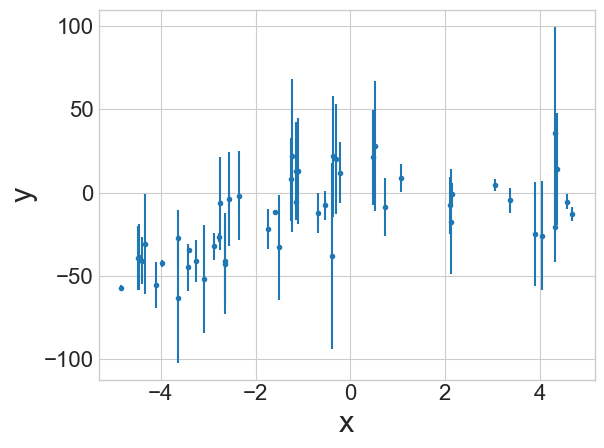
Suppose we want to evaluate the uncertainties in our parameters for a fit to the data to the right.
Our model will look something like: \[y = ax^2 + bx\]
MCMC does not tell you about the quality of a fit. It tells you about the variability in the fit parameters.
Interpreting the Results
Reminder!
- All previous methods still hold:
- Trace plots to establish that things have leveled off and determine potential burn-in
- Lag plots to investigate if your step-sizes looked good
- Histograms to visualize the spread of the parameters
- For higher dimensional fits, pair-wise 2d histograms are very common
Visualizing the Best Fit with Errors
- There are a few ways you can visualize the best fit model with uncertainties in the parameters reflected
- My go-to looks like:
- Randomly select some number of indices from your leveled chain
- For each index, grab the corresponding parameters and compute your model output with those parameters, appending the result to a list
- Compute the median and standard deviation of the results in your
list, being sure to specify
axis=0 - Plot the median values for your best approximation, and shade the region between the median - std and the median + std
- Alternatively, you could just plot the model output for each of the randomly selected parameter combinations, though I don’t think it looks as nice