Does Dark Matter?
Jed Rembold
April 08, 2026
Announcements
- HW11 is live, and you have everything you need to do it!
- I do want you to know that I am desperately trying to get feedback
back to you. I’ve been pulling 12+ hour days trying to stay on top of
everything and it hasn’t been showing outside of me being very tired.
- I’m granting extra points on homework going forward to help compensate for my failings on timely feedback there, in addition to not counting any late days against you if you need them.
- The group preferences poll didn’t get posted yet because I’ve been constantly working on everything else the past 3 days. Expect that tonight.
Recap
- A Monte Carlo Markov Chain is a semi-random walk wherein the next step is determined by the current location and a bit of randomness
- Directed in the sense that is has a preference to move “uphill”, toward higher parts of the function it is sampling
- We can sample the probability of parameters given particular data
(\(P(\theta | D)\)) using Baye’s
theorem
- Requires being able to write out our priors and our likelihood
Discussing Today
- Libraries for MCMC
- Intro to dark matter?
- Why do we think it exists?
- How can we measure it?
- What ramifications does it have?
- Quiz 2
Helpful MCMC Libraries
Available Options
- While it isn’t difficult to create our own MCMC sampler, there can
be some benefits to using existing libraries for more complicated use
cases
- Tend to give more intuitive interfaces through which to accomplish the basic tasks that we would want
- In the Python landscape, the main option used is the
emceepackage, which you will probably need to install throughpipEmceeoperates as an abstract data type, wherein you create a sampling object and then can interact with it and run samples using defined methods
- In the R landscape, I recently discovered the
mcmcensemblelibrary, which seems to be the closest analog to Python’semcee
Python: Emcee Creation
- When you create the object initially, you need to provide:
- The number of walkers you’d like to generate
- The number of dimensions you’ll be walking (number of parameters)
- The function you’ll be walking (your log posterior)
- Any extra arguments that your function will need beyond the parameters
- A pool should you be using multiprocessing
sampler = emcee.EnsembleSampler(
              num_walkers, num_dims,
              log_function, args=[extra arguments]
              )
Python: Emcee Running
Generating starting points usually done with some variation of a random gaussian near a starting point:
starts = np.random.multivariate_normal(
            mean = [0,1,10],
            cov = [[1,0,0],[0,0.5,0], [0,0,5]],
            size = num_walkers
            )
You can then start a sampling run by telling the sampler where all the walkers should begin and how many steps they should take
sampler.run_mcmc(starts, num_iterations)
Python: Emcee Retrieving Chains
You can get the iteration chains back from the sampler after a run using
.get_chain()This will usually return a 3D array, indexing over the parameter, walker, and iteration
Can visualize a particular parameter over all walkers using
plt.plot(sampler.get_chain()[:,:,0], 'k', alpha=0.3)
After examining, will commonly want to discard the burn in and flatten all the individual walkers:
flat_samples = sampler.get_chain(discard=num_dis,
                                 flat=True)
Python: Interpreting Results
- Commonly several things you’ll want to look at after flattening the
chains:
- Histograms of the individual parameter distributions
- 2D Histograms/KDE plots of pair-wise parameter combinations
- Visualizing the best fit with errors back on the original dataset
- The first two can be done individually, or they can be streamlined
using the
cornerpackagecornerwill automatically generate both individual parameter distributions and all pair-wise 2D histograms
R: MCMC Ensemble
Need to install and load the
mcmcensemblepackage and thebayesplotpackage for nicer plottingCan specify multiple starting points for walkers in a similar way to in Python:
p_means <- c(0, 1, 10)
p_cov <- matrix(c(1, 0, 0, 0, 0.5, 0, 0, 0, 5), 3)
starts <- MASS::mvrnorm(
  n=n_walkers, mu=p_means, Sigma=p_cov
)
R: Running the Walker
To actually generate the samples, you do:
sampler <- MCMCEnsemble(
      f = ln_pdf,            # The function you are walking
      inits=walker_starts,   # Where each walker starts
      max.iter = 1000*30,    # The total number of steps
      n.walkers=n_walkers,   # The number of walkers
      coda=TRUE              # Format output nicely
)
You can trim to remove burn-in with:
burned <- window(sampler$samples, start=500)
R: Visualizing Results
- The
bayesplotlibrary gives you lots of easy ways to visualize CODA formatted walker chains - Trace plots:
mcmc_trace(sampler$samples) - Histograms:
mcmc_hist(sampler$samples) - KDE plots:
mcmc_dens(sampler$samples) - Summary stats:
summary(sampler$samples)
R: One More
One more library that you may find useful is
ggmcmcAllows you to convert your
sampler$samplesinto a nice dataframe easily:samples <- ggs(sampler$samples)Then lots of visualizing functions that dataframe can be passed into:
ggs_traceplot(samples)ggs_pairs(samples)ggs_histogram(samples)
Why Dark Matter?
Circular Speeds
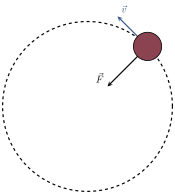
- Objects traveling in a circle need a force pulling them inwards
- The amount of force, size of the circle, and speed are related: \[ F_{in} = \frac{mv_{circ}^2}{R} \]
- For our orbits, the force must be gravity
Velocity Dependence
- We can work out how the velocity should vary with distance from the center: \[\begin{aligned} F_{grav} &= \frac{mv_{circ}^2}{R}\\ \frac{GMm}{R^2} &= \frac{mv_{circ}^2}{R}\\ \frac{GM}{R} &= v_{circ}^2 \end{aligned} \]
- For nicely symmetric mass distributions, \(M\) can be taken to be the total mass internal to the radius \(R\) \[ v_{circ}(R) = \sqrt{\frac{GM_{in}(R)}{R}} \]
Consistent Mass
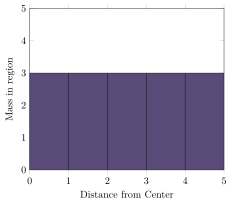
- Consider the mass distribution to the right
- How would the resulting velocity curve look as you moved away from the center?
Consistent Density
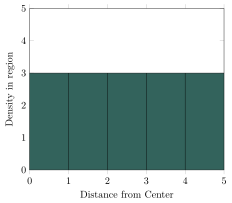
- Consider instead the spherically symmetric density distribution to the right
- How would the resulting velocity curve look as you moved away from the center?
Quiz Time!
Quiz 2
- You know the drill
- The rest of class today is set aside for Quiz 2 on exoplanets and galaxies
- You are free to leave when you are done!
Visualizing Rotation Profiles
Visualizing Rotations
Activity
- I am providing you with two density profiles below:
- Solar System-like (density in \(kg/au^3\))
- Galaxy-like (density in \(kg/ly^3\))
- For each, you can assume that the density beside a distance describes the density between that distance and the previous distance
- You task is to generate velocity curve profiles for each. You can assume a spherical distribution of the material.
- How do they compare (both to one another and the distributions we just looked at)?
Surprises
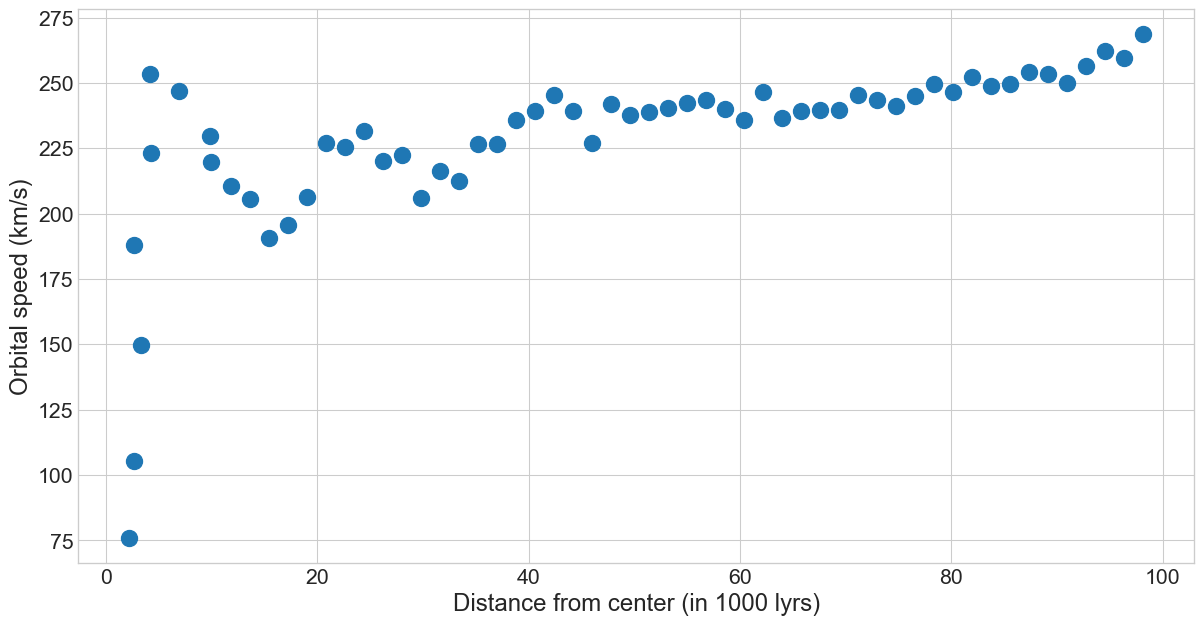
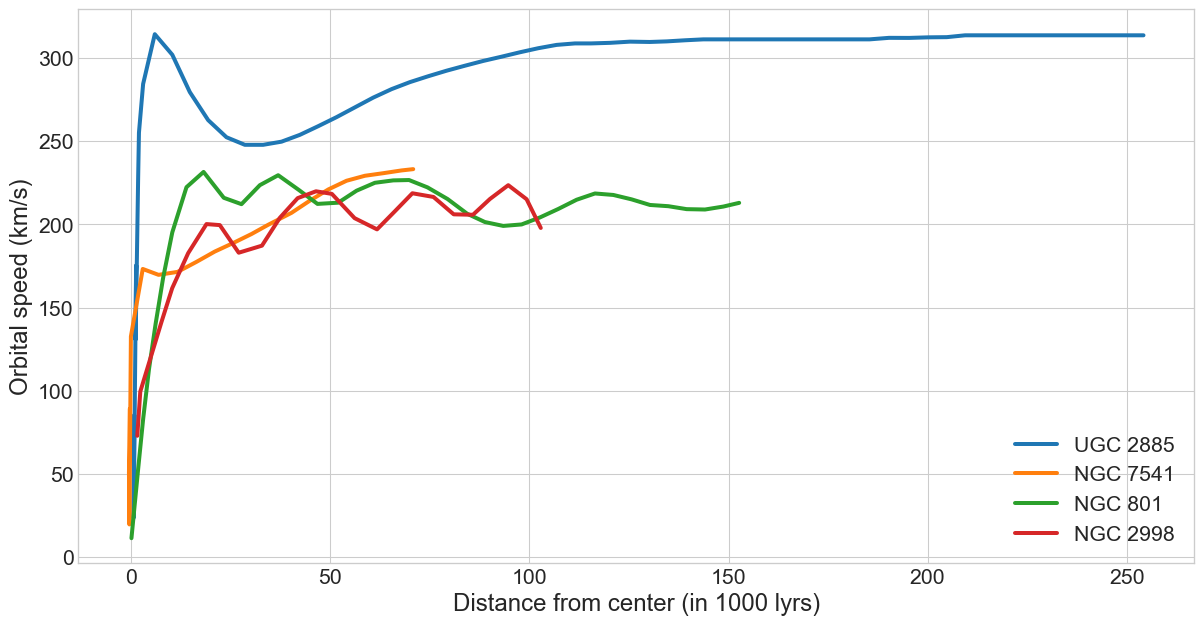
- The second velocity curve is what astronomers expected to see when
looking at the Milky Way and other galaxies
- Would be consistent with the visible light we saw from the galaxy and known star masses
- But instead…
Rotation Curve: Milky Way
Rotation Curve: Others
Possibilities
- Determining how to reconcile the mass that we see, with the mass that the rotation curves predict, has been an ongoing struggle
- Current estimates predict between 5-10 times as much mass as we see
- Spread somewhat evenly throughout the visible galaxy and far beyond
- Definitely does not seem to have the majority of mass concentrated at the center
- Are we missing dark objects?
Being MACHO
- What other forms of mass do we know of that would be faint / invisible?
- Could the halo of the galaxy be filled with faint, dead stars?
- Massive Compact Halo Objects?
- Brown dwarfs
- Neutron stars
- Black Holes
- How does one find an invisible object?
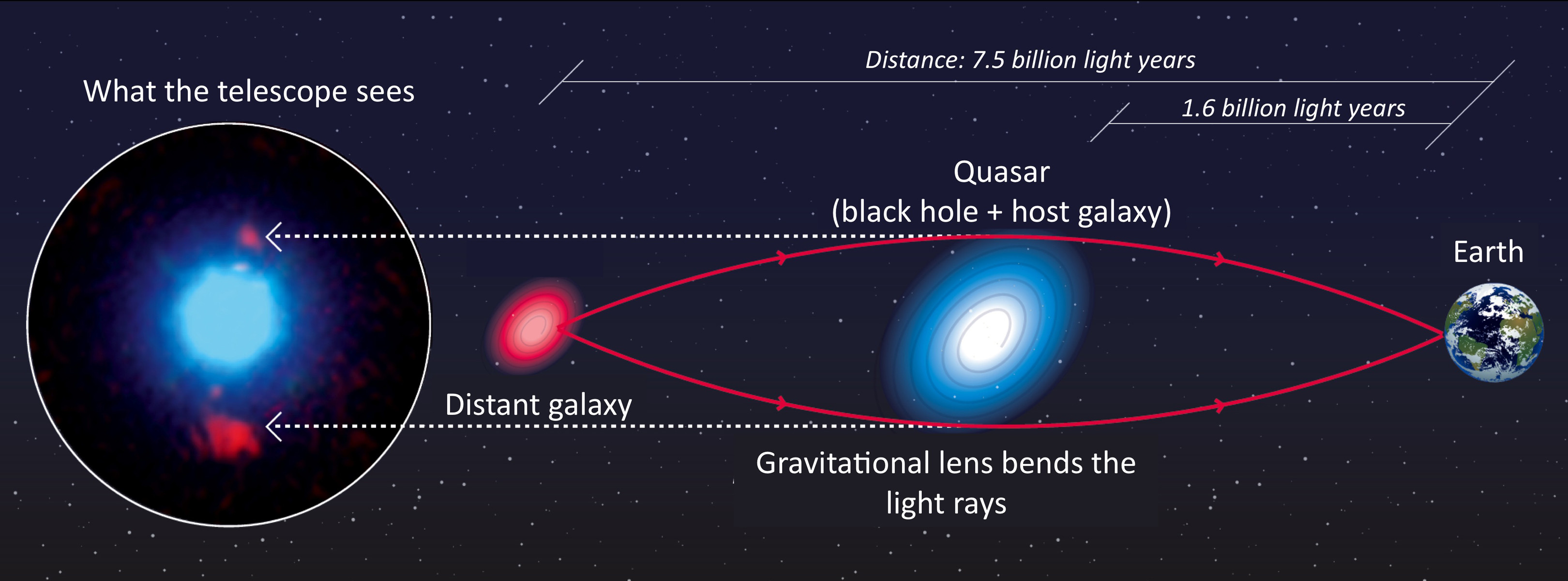
Gravitational (Micro)Lensing
- We look for their mass’s effect on nearby light
- Find that MACHO’s account for maybe 20% of the missing mass, at most
- Hence, the currently named dark matter