The Expanding Cosmos

Jed Rembold

April 17, 2025

Announcements

  • Unit 5 debriefing??
  • Lucky Homework 13 is posted!
    • Should have most of what you need after today
  • Quiz 2 handed back!
    • You can add 2 pts to the total written on your last page
  • Wednesday will be a short lecture, and then time to meet with final project groups
    • I do 10 minutes check-ins with all groups to ensure they have a good plan in place. Do you want to do those on Wednesday or next Monday? Or split?

Recap

  • Rotation or velocity curves measure the speed of orbiting objects as you move outwards from a central body
    • Commonly assume circular or largely circular orbits
    • Generally measured through Doppler shifts
  • The shape of a rotation curve tells you about the distribution of material throughout the region
  • The rotation curves of galaxies do not match what we would expect, thus leading to conjectures about dark matter

Today

  • Hubble’s law and implications
  • Ultimate Questions of the Universe
    • Is it infinite?
    • Is it curved or flat?
    • Is the rate of expansion growing or shrinking?

Going Further

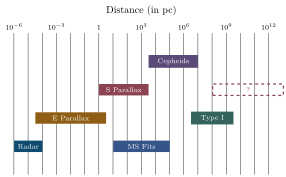
The Distance Ladder

A Red Tale

  • Vesto Melvin Slipher - 1912
    • While observing spiral galaxies, found that they all seemed to be redshifted by some amount!
    • This would imply that they are all moving away from us, which seemed somewhat odd
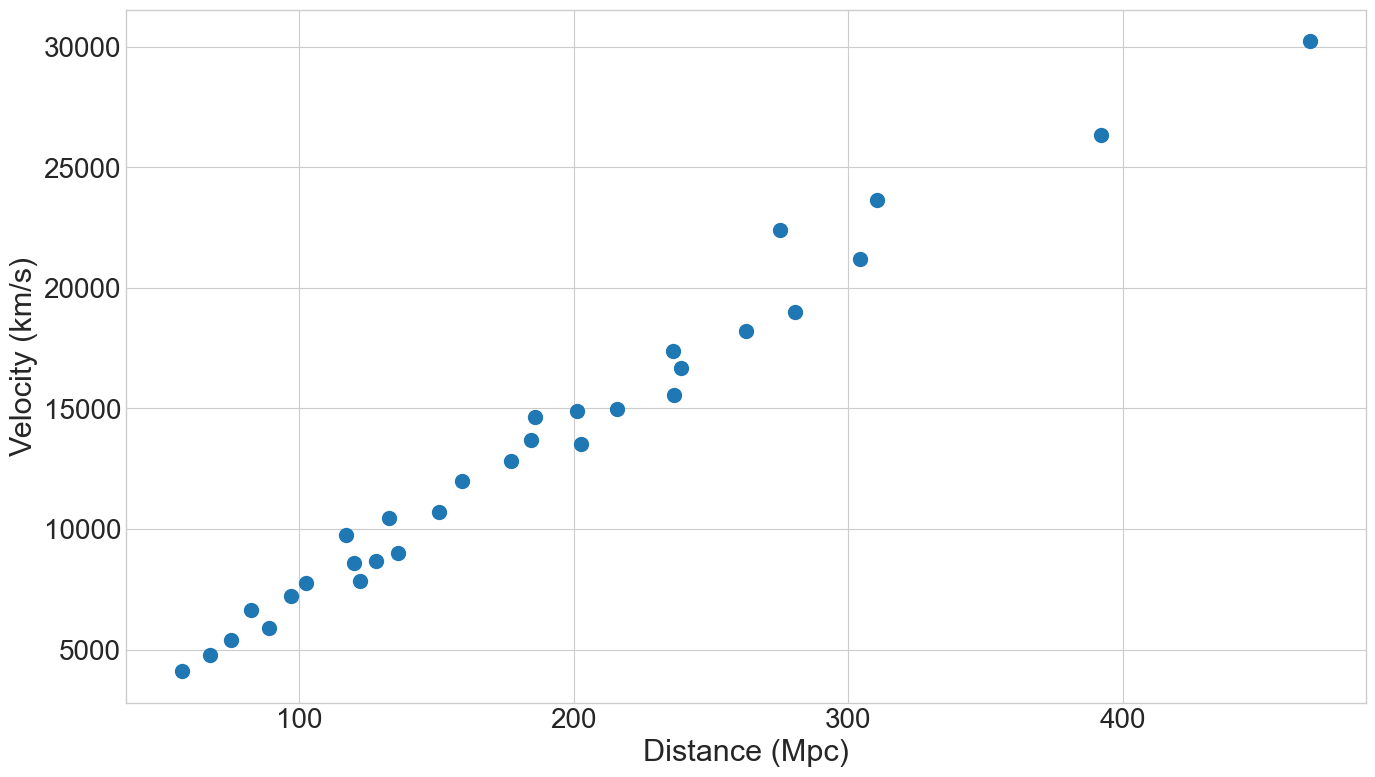
  • Edwin Hubble - 1929
    • Used Type Ia supernova to estimate the distances to distant galaxies
    • Found that the more distant galaxies were more redshifted

The more distant an object is, the faster it is moving away from us!

Hubble’s Law

The Hubble Constant

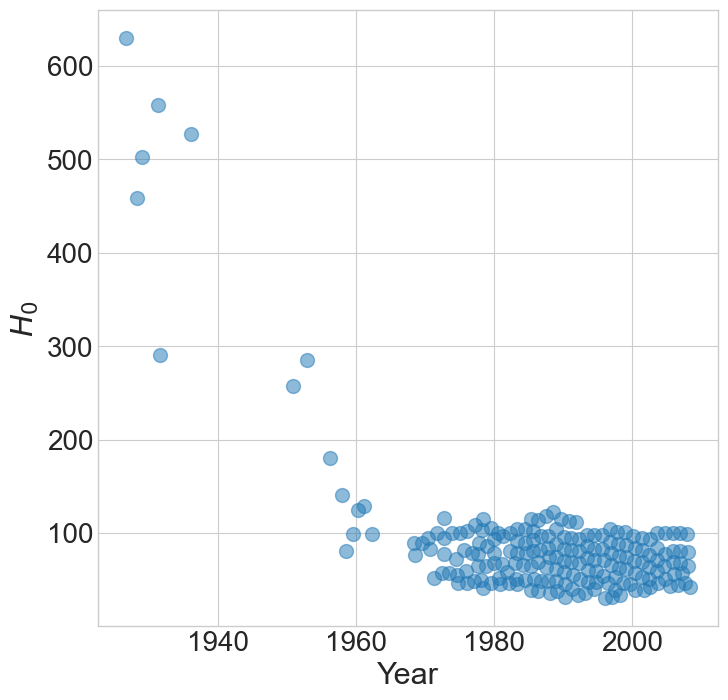
  • Has varied greatly throughout its history
  • Still empirically (experimentally) determined
  • Current estimates range between 65-78
  • In a bit of a crisis atm, as competing methods give very different answers
    • From stars: \(\approx 73\) km / s / Mpc
    • From CMB: \(\approx 68\) km / s / Mpc

Puffing Up

  • So all galaxies are moving away from us, but surely we aren’t actually in the center?
    • Nope!
    • But then again, neither is anyone else!
  • The Cosmological Principle: at a given cosmic time, the universe looks basically the same to all observers.
  • Everyone must see everything moving away because the entire universe is actually expanding!

They are a crusty bunch…

  • The Raisin Bread Analogy
    • Raisins are the galaxies (or stars)
    • The dough is space
    • At it rises and cooks, all the raisins move away from one another
  • Fails the cosmological principle though!
    • The creatures of the crust

Snakes on a @#$*&@ Plane!

  • Imagine yourself a smooshed interstellar snake, living on a flat sheet of paper
  • You can move around on the paper, but can not lift off or dig into the paper
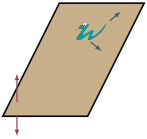
  • This is just the raisin loaf so far

Snakes on a @#%*^% Sphere?

  • Suppose now we connected the ends of the paper to make it into a perfect sphere
  • Now your “universe” has:
    • No center
    • No edge
    • Looks the same regardless of where you are at!
  • Inflating the sphere will increase all the distances
  • The Hubble constant measures how quickly the sphere inflates

Expanding Space

  • Galaxies appear to move only because the space between is expanding
    • Galaxies are just conveniently glowing marked points in space
  • Space was expanding long before there were galaxies though
  • Galaxies themselves remain largely the same size
    • Gravity holds them together and determines size
    • We only observe the effects of expanding space when looking over immense regions of space
  • Light is redshifted because the space expands, stretching the wavelength

Einstein’s Demon

  • Einstein’s general relativity + a homogeneous universe predicts either an expansion or contraction of space
  • Einstein hated this, and was convinced it couldn’t be true
  • Originally added an extra term, a “cosmological constant” to his equations to allow for a static, unchanging universe
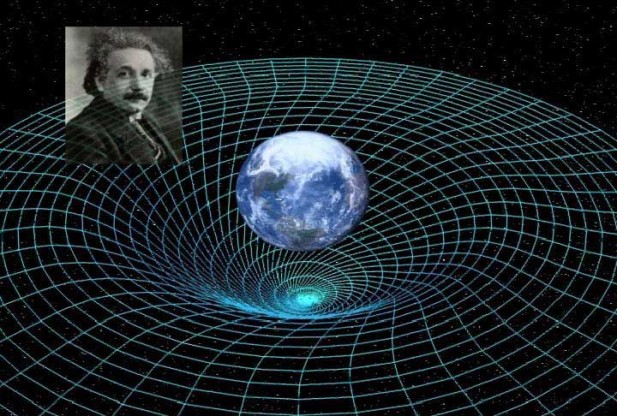
\[R_{ab}-\frac{1}{2}Rg_{ab} = -8\pi T_{ab} + \Lambda g_{ab}\]

Expansion and Age

  • If everything is expanding, we can reverse it to figure out how old the universe is
  • “Hubble Time” \[ t_H \approx \frac{1}{H} \]
  • Comes out to about 14 billion years with current estimates
  • Note that this is assuming the rate of the universe is constant!

The Mass Parameter

Mass: Always the Answer

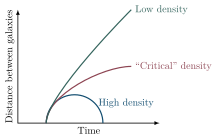
  • The simplest GR models predict that the expansion of the universe should be slowing
  • Big Bang caused an explosion of outward movement, but gravity slowly wins
  • Rate would be dependent on the mass density parameter (\(\Omega\))
Curved Geometry

  • The total mass density also determines the shape of the universe:
    • \(\Omega > 1\) implies a positive curvature
    • \(\Omega < 1\) implies a negative curvature
    • \(\Omega = 1\) implies no curvature (flat)
  • Later we will specify this more directly with an \(\Omega_k\) value, but the above holds for overall values of \(\Omega\)
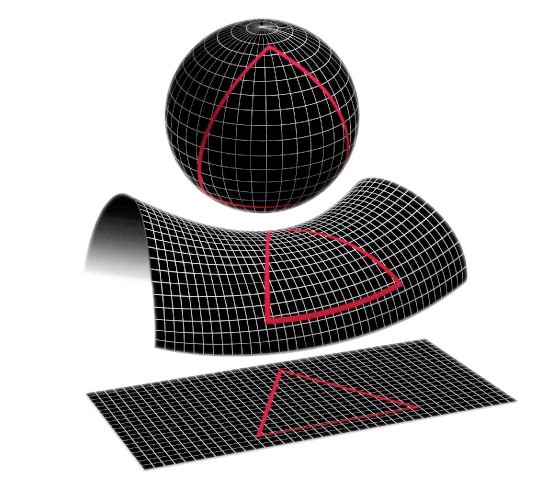
Different curvature geometries

Measuring \(\Omega\)

  • There are several approaches to measuring \(\Omega\):
    • Look at all the mass, and try to figure out the density parameter directly
      • From visible mass: \(\Omega \approx 0.02\)
      • Including dark matter: \(\Omega \approx 0.3\)
    • Try to measure very precise triangles and look for angles that add up to \(>\) or \(< 180^\circ\)
    • Look for changes in the expansion rate (Hubble constant)
      • This “deceleration parameter” is often denoted \(q_0\)

A Geometrical Conundrum!

  • Based on adding up all the mass we know of, including dark matter, we get a density parameter of \(\Omega \approx 0.3\)
    • This should imply a open, negative curvature universe
  • Recent(ish) results from Baryon Acoustic Oscillations (BAO) experiments though predicts the universe to be flat, to within 0.4% certainty!
  • Are we missing something? Or is some physical law flawed?

What does Hubble say?

Returning to Hubble

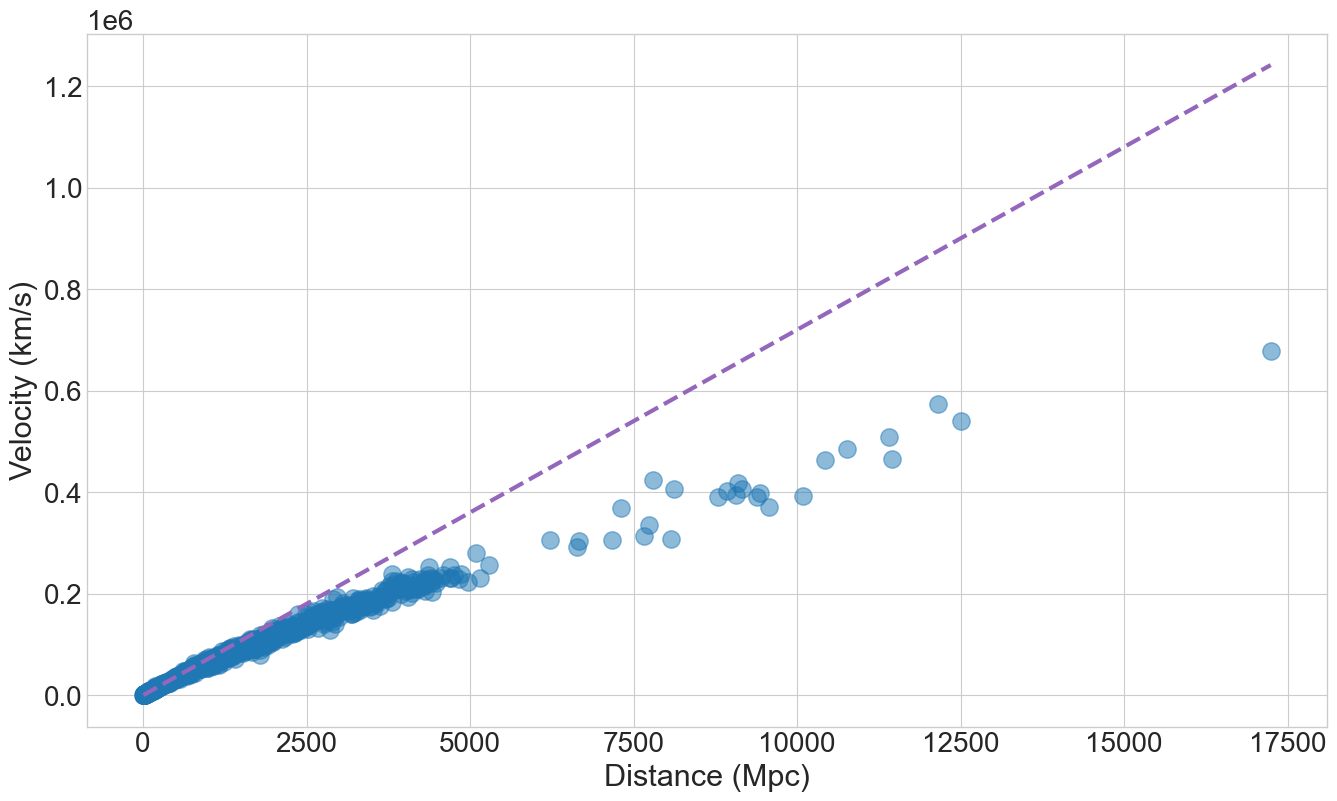
  • Simple GR models predict that gravity should slow the rate of expansion
  • Looking at the Hubble relation out to very large distances then, we don’t expect as straight line
  • Measuring that deviation from straight was a long-standing goal of observational cosmology
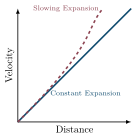
And the results are in!

  • So what did astronomers finally see?

Oh @#$%! What?!

  • Observations at the turn of the millenia suggest that the expansion of the universe is not slowing

    • The expansion rate is now higher than it was in the past!
    • \(q_0 < 0\)
    • Thus the universe may actually be older that the predicted Hubble time
  • Important to realize that none of the basic GR models predicted this. Everyone was taken completely off guard.

  • Was Einstein’s “cosmological constant” correct after all?

    \[ R_{ab}-\frac{1}{2}Rg_{ab} = -8\pi T_{ab} + \Lambda g_{ab}\]

Explanations?

  • For the universal expansion to be accelerating, we need something to be counteracting the attractive forces of gravity
  • The most obvious candidate would be for some excessive energy that is driving the universe outwards
    • Similar to how increasing thermal energy of a gas in a balloon pushes the balloon outwards
  • No idea yet of the source of this energy
    • This commonly called dark energy
    • Energies are tied to forces, but there are no known forces that would result in this invisible and excess energy!

Modeling all of this

How does Dark Energy help?

  • Current models break the density parameter up into various contributions:
    • \(\Omega_m\) describes the portion of the density parameter coming from light and dark matter
    • \(\Omega_k\) describes the curvature of the universe
    • \(\Omega_\Lambda\) describes the portion of the density parameter coming from dark energy
  • The sum of all contributions must sum to 1, indicating that we have accounted for everything
  • Currently GR models can solve for Hubble’s constant in terms of these parameters and the redshift \(z\): \[ H(z) = H_0\sqrt{\Omega_m(1 + z)^3 + \Omega_k(1+z)^2 + \Omega_\Lambda} \]

Revamped Hubble

  • Hubble’s constant changes with redshift (\(z\)), because when looking at objects further away, we are looking at them from a much earlier era of the universe!
    • The speed of light is constant, and thus the light we measure from extremely distant objects was emitted much earlier in the lifetime of the universe, when the expansion of the universe was different
  • Relating this back to the distance therefore requires taking into account all the historical values of the Hubble constant enroute to its current value
    • Mathematically, this means needing to integrate \[ d = (1+z)c \int_0^z \frac{dz^\prime}{H(z^\prime)} \]

Why (1+z)?

Galaxy (then) Earth (now)

Click to animate — click again to reset

Flat and Expanding

  • As you’ll see in the homework, fitting the density parameters to the data currently predicts:
    • \(\Omega_k \approx 0\), implying that the universe seems to be flat (in agreement with BAO measurements!)
    • \(\Omega_\Lambda \approx 0.7\), impling that dark energy makes up a very large amount of the universe
  • These results end up predicting an age of the universe that is very similar to the 14 billion years estimated from our constant expansion rate
// reveal.js plugins // Added plugins ,