Does Dark Matter?
Jed Rembold
April 12, 2026
Announcements
- HW11 due tonight
- HW12 posted: You have everything you need after today
- Final Project Groups sent out via email?
- No class on Wednesday! Go support your presenting peers!
- Presenters from this class:
- Yumi @ 2:20 in Ford 202
- Florian @ 3:10 in Ford 202
- Saul & Cody @ 11:30 in Ford 202
Recap
- Emcee or MCMCEnsemble can help in running MCMC analysis
- Both utilize algorithms that adapt the step-size on the fly
- I know you are tired of trying to optimize step-sizes by now
- Both also allow for running multiple walkers at once to check for
convergence
- The
corners library or
ggmcmc allow for easy creation of corner and
pairwise plots
Discussing Today
- Rotation Curves
- Intro to dark matter?
- Why do we think it exists?
- How can we measure it?
- What ramifications does it have?
Circular Speeds
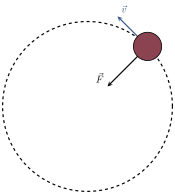
- Objects traveling in a circle need a force pulling them inwards
- The amount of force, size of the circle, and speed are related:
\[ F_{in} = \frac{mv_{circ}^2}{R}
\]
- For our orbits, the force must be gravity
Velocity Dependence
- We can work out how the velocity should vary with distance from the
center: \[\begin{aligned}
F_{grav} &= \frac{mv_{circ}^2}{R}\\
\frac{GMm}{R^2} &= \frac{mv_{circ}^2}{R}\\
\frac{GM}{R} &= v_{circ}^2
\end{aligned} \]
- For nicely symmetric mass distributions, \(M\) can be taken to be the total mass
internal to the radius \(R\), or \(M_{in}(R)\) \[
v_{circ}(R) = \sqrt{\frac{GM_{in}(R)}{R}} \]
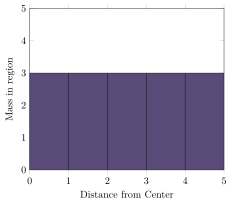
Consistent Mass
- Consider the mass distribution to the right
- How would the resulting velocity curve look as you moved away from
the center?
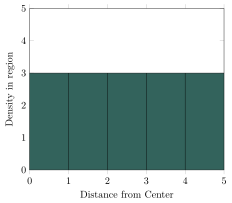
Consistent Density
- Consider instead the spherically symmetric density distribution to
the right
- How would the resulting velocity curve look as you moved away from
the center?
Activity
- I am providing you with two density profiles below:
- For each, you can assume that the density beside a distance
describes the density between that distance and the previous
distance
- You task is to generate velocity curve profiles for each. You can
assume a spherical distribution of the material.
- How do they compare (both to one another and the distributions we
just looked at)?
- If using dataframes, lag/shift, coalesce/fillna, and cumsum may be
helpful!
- Or you can just loop things
Surprises
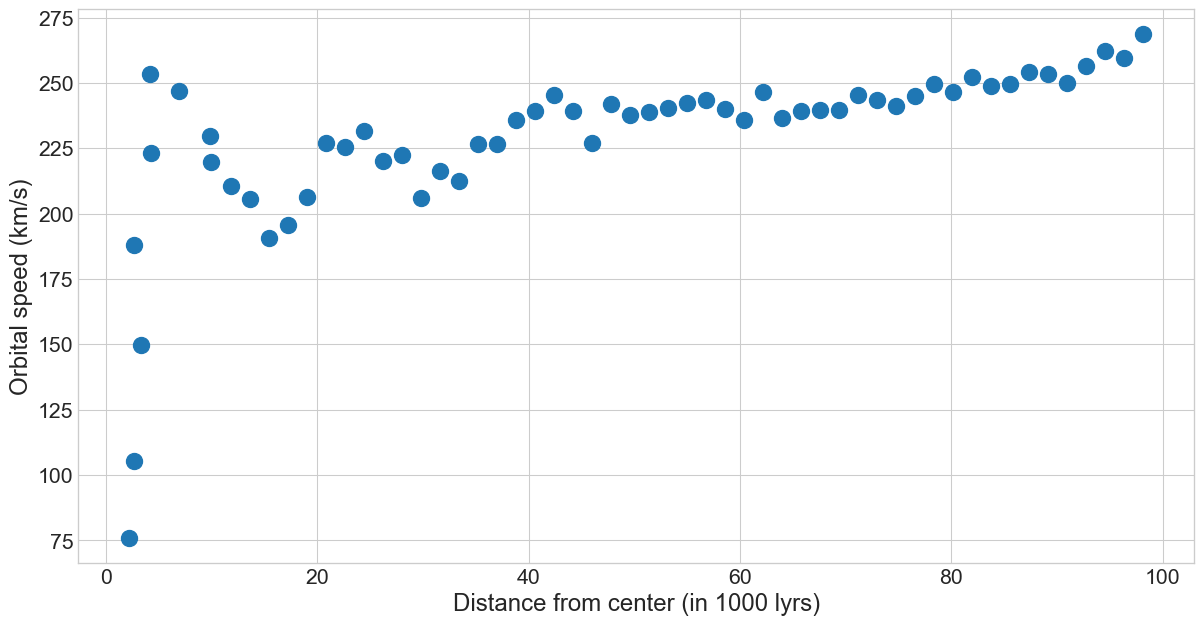
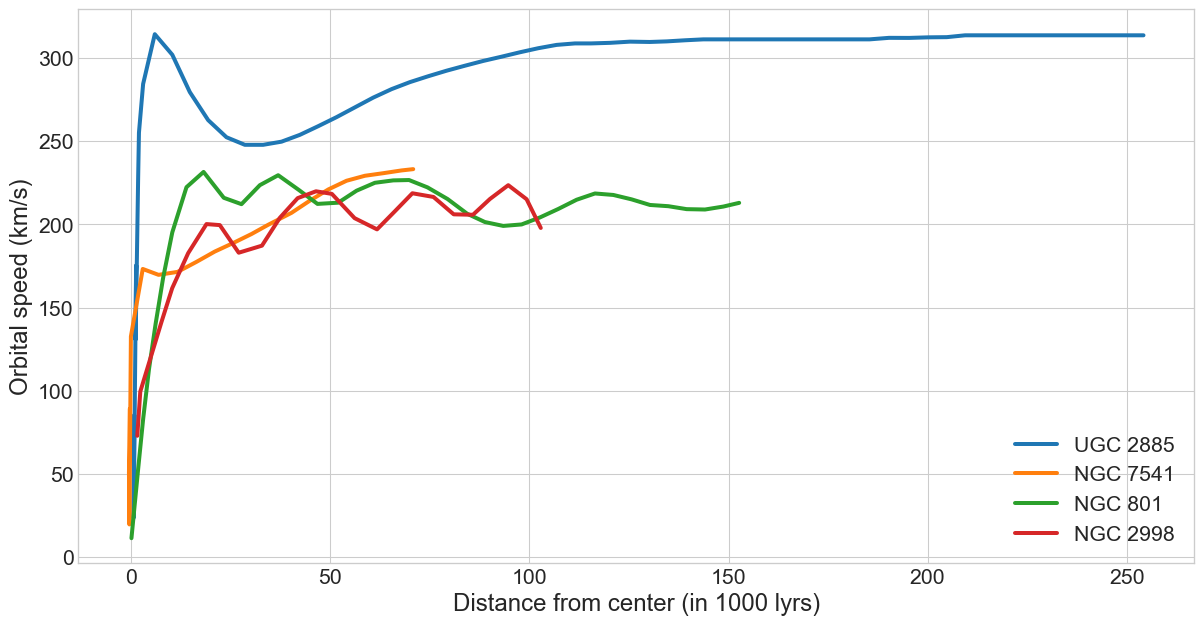
- The second velocity curve is what astronomers expected to see when
looking at the Milky Way and other galaxies
- Would be consistent with the visible light we saw from the galaxy
and known star masses
- But instead…
Rotation Curve: Milky Way
![]()
Rotation Curve: Others
![]()
Possibilities
- Determining how to reconcile the mass that we see,
with the mass that the rotation curves predict, has been an ongoing
struggle
- Current estimates predict between 5-10 times as much mass as we see
- Spread somewhat evenly throughout the visible galaxy and far
beyond
- Definitely does not seem to have the majority of
mass concentrated at the center
- Are we missing dark objects?
Being MACHO
- What other forms of mass do we know of that would be faint /
invisible?
- Could the halo of the galaxy be filled with faint, dead stars?
- Massive Compact Halo Objects?
- Brown dwarfs
- Neutron stars
- Black Holes
- How does one find an invisible object?
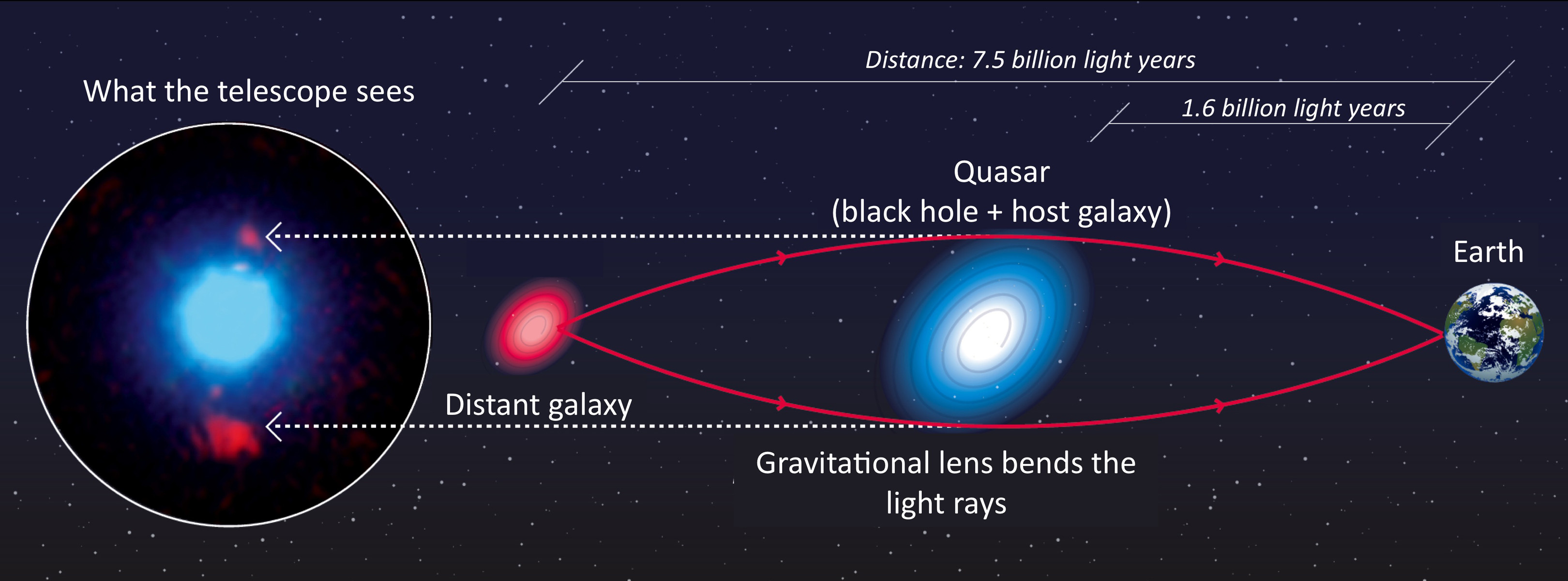
Gravitational (Micro)Lensing
- We look for their mass’s effect on nearby light
- Find that MACHO’s account for maybe 20% of the missing mass, at
most
- Hence, the currently named dark matter
![]()
Groups
- KJ and Morgyn
- Saul and Florian
- Mac and Deana
- Aby and Laken
- Lev and Ben
- Kaylee and Rebecca
- Yumi and Cody
- Liam and Normandy
- Jack, Cordelia, and Maiti
// reveal.js plugins
// Added plugins
,