Monday: Workday, for either project planning or homework. I’ll be in
this room for the usual time. Scheduled group meetings with me to
discuss project ideas
Wednesday: Quiz 3 at start, then workday
Wednesday, May 6th: Project presentations
Recap
Hubble’s law showcases a relationship between the distance something
is from us and the rate at which it is moving away from us
Primary explanation is that the universe as a whole is
expanding
Hubble’s constant gives us information about the rate of
expansion
We can think about things like the shape and eventual state of the
universe by looking at the mass density parameter
Can be split into \(\Omega_m\),
\(\Omega_k\), and \(\Omega_\Lambda\)
\(\Omega_\Lambda\) is the dark
energy contribution for an accelerating expansion of the universe
\(\Omega_k\) is the shape/geometry
contribution
\(\Omega_m\) is the mass
contribution, from both light and dark matter
Today
What do we know about the Big Bang?
Worktime
Looking back even further…
Taking it Back
Long ago the universe was denser
And hotter
Can we look back far enough to “see” this “era”?
How far back COULD we see?
Assuming perfect and huge telescopes, how far back could we
see?
Early universe was very very hot
Hot enough for fusion
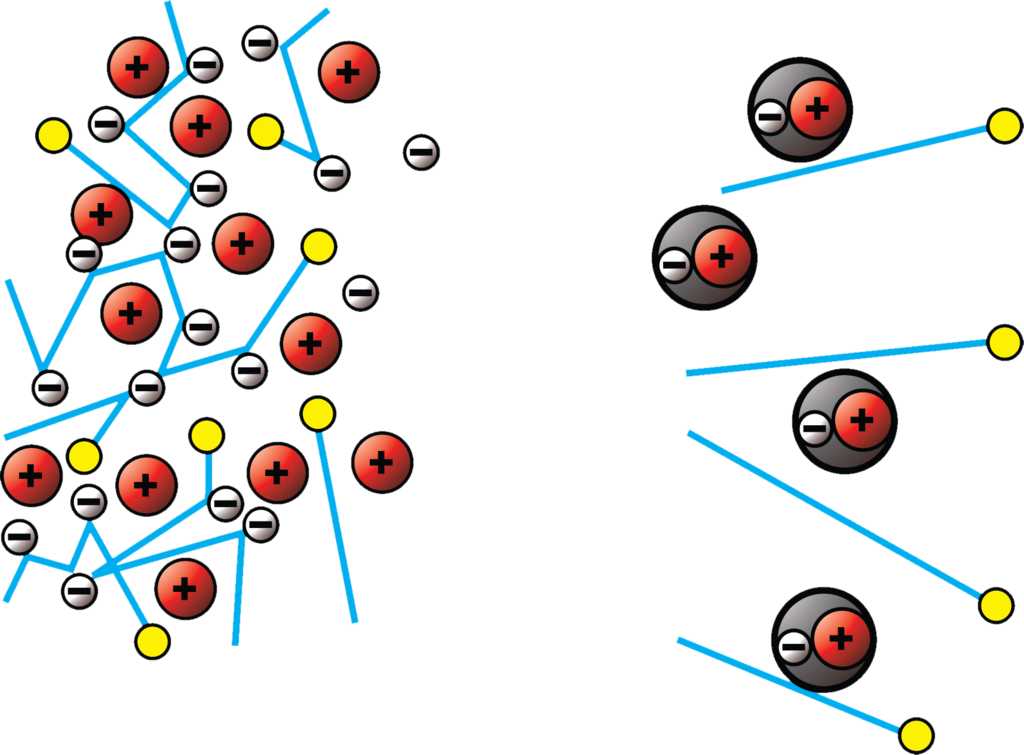
Hot enough that particles are charged (ionized)
Fusion releases radiation that interacts with charged particles
Light gets scattered \(\Rightarrow\) opaque
Once the universe cooled enough for non-ionized atoms to form,
radiation no longer interacts
Can travel long distances without scattering, becoming
transparent
The transition called Recombination
Recombination
Recombination is when the universe cooled to a point that atoms
could become un-ionized
Allowed photons (radiation) to pass through unhindered
Allows the universe to become transparent (mostly)
Models predict recombination should have happened several hundred
thousand years after the big bang
Background Radiation
Such an age would predict a great distance from us, and thus a very
high redshift (\(z\approx 1100\))
If the universe was originally as hot and glowing as a star:
light should be redshifted all the way into microwave wavelengths
these days
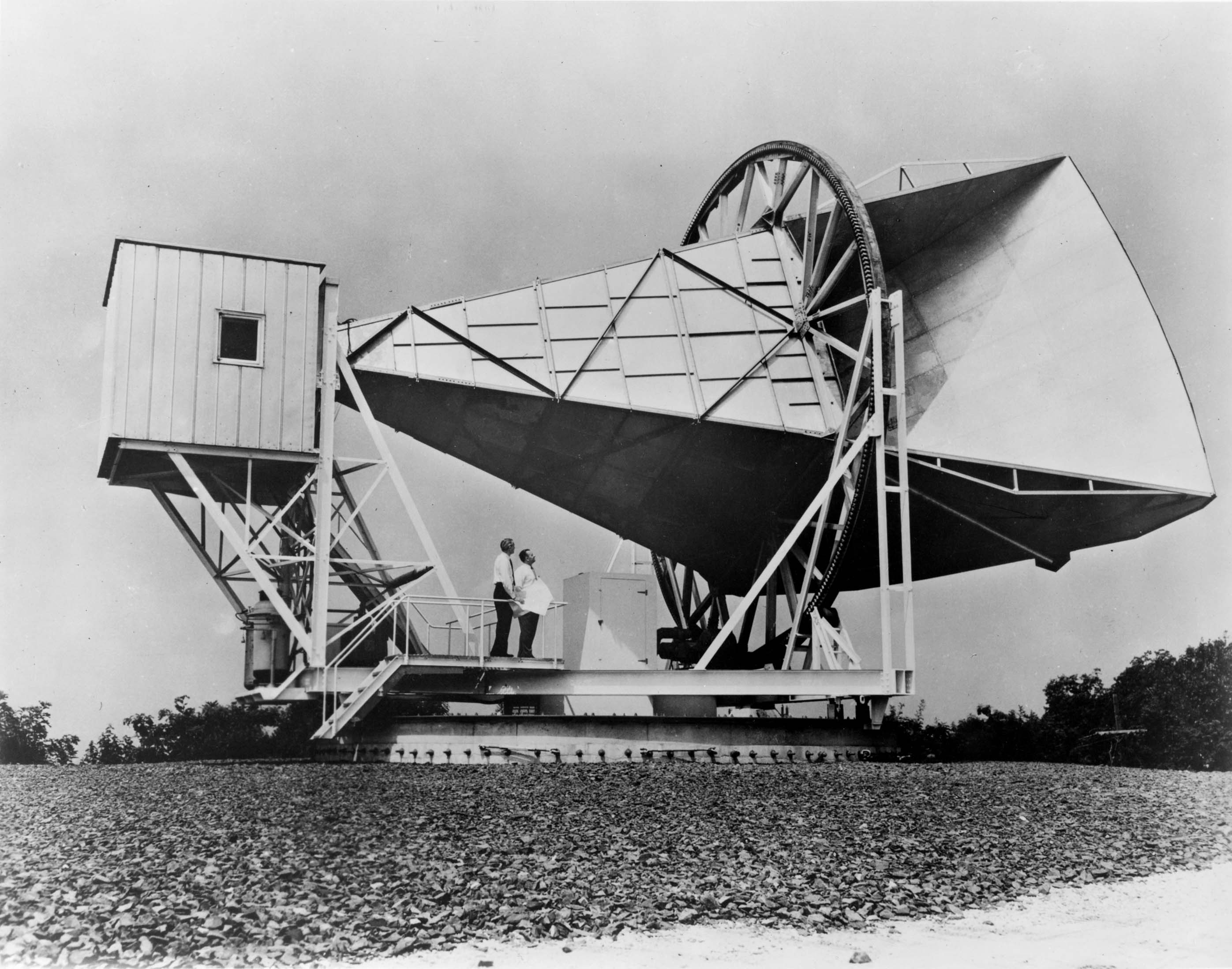
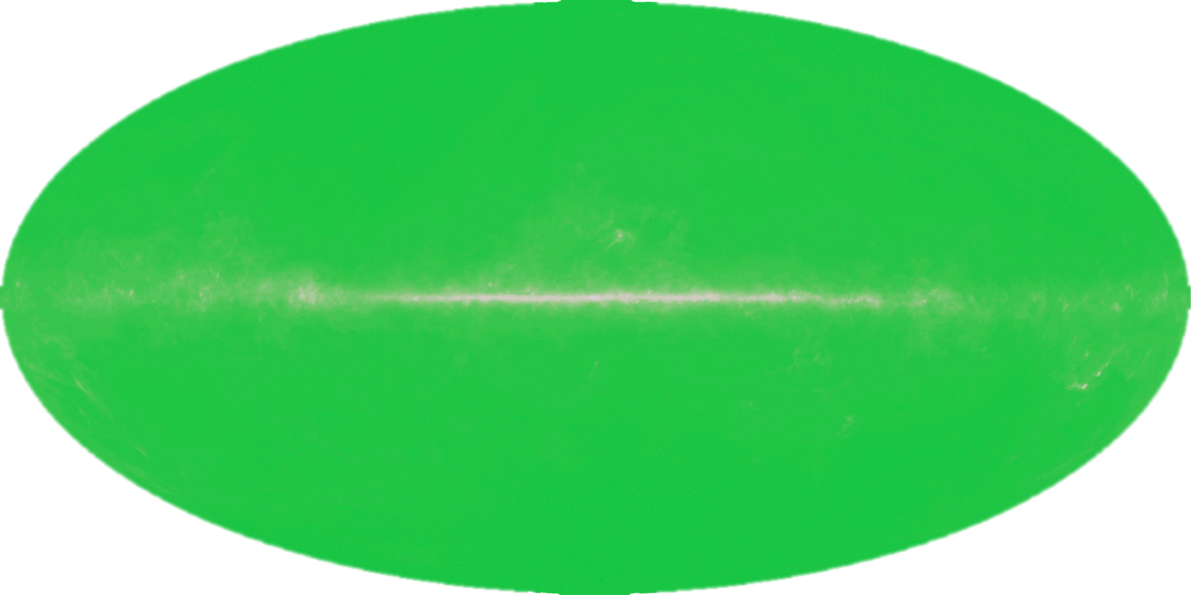
1965: Found a weird radio signal coming equally from all parts of
the universe
Like a background noise
Cleaning or calibrating their telescope couldn’t get rid of it!
Now known as the Cosmic Microwave Background, or CMB
The Cosmic
Microwave Background
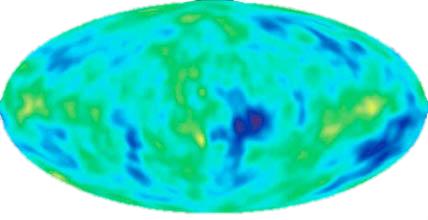
1965 Image
The Cosmic
Microwave Background
Cobe Satellite Image (2006)
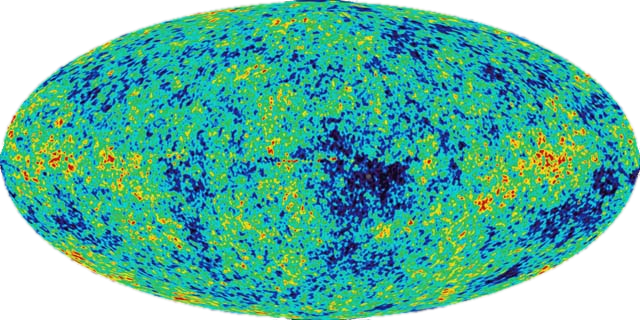
The Cosmic
Microwave Background
WMAP Satellite Image (2013)
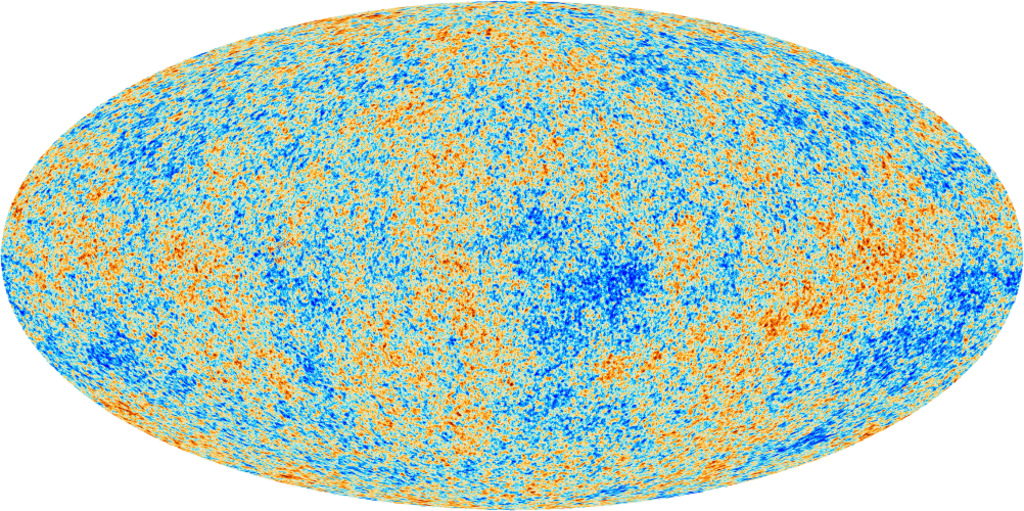
The Cosmic
Microwave Background
Planck Satellite Image
(2016)
CMB Observations
Originally about 3000K, now about 2.7260K
The different colors indicate different temperatures
Differ by less than \(1\times10^{-5}\)K!
Incredibly smooth
This is the furthest we can look back directly
CMB Conclusions
The early universe was much smoother than it is today
We see temperature variations of thousands of kelvin, not \(10^{-5}\)…
The early universe was still not perfectly smooth
Some matter was still clumped before stars and galaxies began to
form
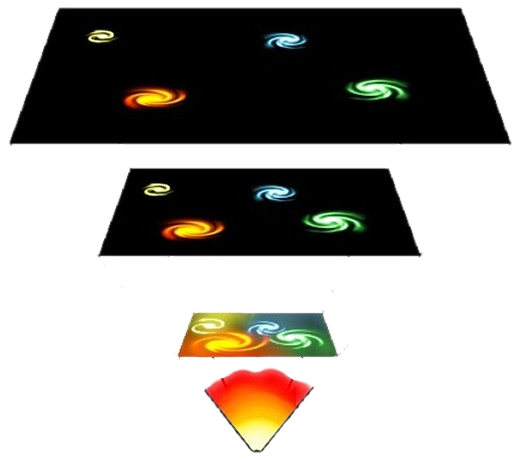
The sizes of these hot and cold patches serve as a valuable tool for
model fitting
Peering Past the CMB
Could we peer back further than the CMB?
Not using radiation, for sure, but other methods?
Neutrinos
Can we observe enough coming from that time to make a reasonable
picture?
Gravity Waves
Recently confirmed to have been observed
Fluctuations in space-time, so “opacity” wouldn’t matter
How can we best use them? Still extremely new (and exciting!)
Questions from the CMB
There are some issues the CMB data raises that need to be answered
The Lumpy Problem (Anisotropy): Why is the universe so smooth on
large scales but so lumpy on small scales?
The Flatness Problem: There are infinitely more
ways to be curved than flat, so what are the odds that we ended up with
a flat universe?
The Horizon Problem: Things on opposite sides of the universe look
similar, but they should have had no way to “communicate”, so how did
they stay similar?
Inflation! A issue since day 1…
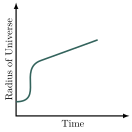
Theorized that there must have been a period of
extreme expansion in the very early
universe
Growing by approximately 58 orders of magnitude in maybe \(10^{-32}\) seconds…
Solves all three issues:
Anything curved looks flat when large enough
Opposite sides of universe could “talk” before inflation,
equalizing
Quantum fluctuations in the early universe got smeared out in the
expansion
Work Time!
Group Work
The rest of today is for you to meet with either your project groups
or your HW13 partner to make progress and be productive
I’d probably suggest at least touching base with your project group
to see where people’s interests and ideas might be at.
Ideally when you meet with me on Monday, your group has at least a
general theme/direction/data set that you are thinking to work with
Past Project Themes
Comet Composition from Spectra
What types of stars have exoplanets?
Are there any trends in the types of stars in different
constellations?
Using readings from Stellar Spectra to Classify Stars on the HR
Diagram
Light pollution and the decline of visible stars in Salem
Finding exoplanets using TESS light-curves
Where are the supergiants in our HR diagram?
The CMB and the Power Spectrum
Using Main Sequence Fitting to determine distances to star
clusters
Using unsupervised learning to predict star classifications
Predicting quasars in GAIA data
Can we plot the Milky Way’s spiral arms?
Estimating the mass of black holes in Sagittarius A*
Estimating the Sun’s distance from the center of the Milky Way using
Globular Clusters