Computer Supported Study Skills for the
Purple Person
by John L. Tenny, Ph.D.
Abstract
This article is a discussion of the range of
attributes of individuals sometimes identified as learning disabled
or dyslexic, focusing especially on a description of their
considerable abilities, and how the computer may be used to support
and enhance their thinking abilities. The descriptor multivariate,
nonlinear is used to identify the complex and integrated processing
capabilities of "Purple People", a term generated to provide a
neutral label for this group of learners. The capabilities of the
Macintosh based program Inspiration are described as useful in
allowing manipulation of concepts, easy movement between different
documents, and viewing concepts from both a text and graphic
representation.
Biography
John Tenny is a Faculty Emeritus
in the Master of Arts in Teaching Program at Willamette University, Salem, Oregon.
He teaches study skills to children and adults; and encourages and advises all
manner of Purple People.
Introduction
I am a Purple Person. You can't tell by looking at me as being
Purple doesn't really show. It does, however, affect my behavior;
what I can do and what I can't. I reverse words and numbers; confuse
right and left, can't spell worth a hoot and my handwriting is nearly
illegible. It is almost impossible for me to memorize by rote and I
often have to reread things to understand even the simplest of ideas.
Sounds confuse me when they come from more than one source at the
same time and my office is a mess - piles of paper everywhere and
clutter on the floor.
When I was younger, I received lots of well-meaning advice.
Teachers commented on how bright I was and how school would be much
easier if I only tried a little harder. "You spend more effort
getting around a task than you would by just doing it." I heard that
more than once, but found it hard to stay focused on a single idea or
project. Report cards described me as "easily distracted".
From these descriptors, most educators today would label me as
learning disabled or dyslexic, but there are other descriptors that
apply equally well. Instead of emphasizing my deficiencies, they
illustrate my abilities. I'm good at finding solutions to problems,
even in domains where I have had little formal training. Solutions,
good solutions, seem to come out the air, and they frequently come
all at once, in a flash. When I'm working in groups I'm often the
person who thinks of things the others have overlooked; the "Yes, but
what about this" person.
I can, and usually do, work on more than one thing at a time. For
example, I frequently write on two completely different topics
concurrently, moving from one to the other as ideas flow in and out
of my consciousness. When speaking, I can switch conceptual tracks
quickly, moving from one topic of conversation to another, sometimes
in midsentence.
My desk is a mess, but I can usually locate what I need easily.
There isn't any order to the piles but I can sense which pile an item
is in, and how deeply it is buried. I don't exactly "remember" where
I put something; I seem to "feel" where it is located. When I think,
concepts have shapes and relate to other concepts in
three-dimensional structures. To remember or communicate these
structures, I will very often sketch a drawing of the connections I
see. Although rows and columns of numbers are often meaningless to
me, subtle relationships will suddenly emerge when I translate them
into graphs.
Both sets of characteristics describe the "Purple Person". Why
purple? Because the term has no pre-established value; you don't know
if being purple is good or bad. Labels, although convenient, are too
often derived from a single (usually negative) perspective. It's not
that the description of things I don't do well are untrue, but that
there is more to me than my deficiencies. A label I like and one that
seems to describe my abilities as well as my deficiencies is
multivariate, nonlinear thinker.
"Multivariate" refers to the fact that I tend to process multiple
variables at the same time and use these variables to make decisions
and solve problems. When I am dealing with a question, lots of
contributing factors will come into play, and I generally strive to
increase the number and complexity of these factors so that I arrive
at the most comprehensive answer possible. For example, when I help a
youngster who is struggling to read, my determination of what to try
next is based on the difficulty of the materials, how interesting
they are, where the child came from before seeing me, what time of
day it is, how healthy the child is, what the family's culture and
background is, the student's knowledge of phonics and comprehension
skills, and how we get along. I combine this with information about
who the regular teacher is, how I feel that day, how much time I
have, statements by the student that reveal self image and his or her
perception of power and its place in human interaction. These
variables are then combined with others that I am not conscious of,
but, once a conclusion has been reached, can be identified as having
been part of the decision making process.
"Nonlinear" refers to the fact the I don't start at the
"beginning" and work step-by-step in a linear fashion toward a
solution. I may begin with a hypothetical solution, and then analyze
it for errors and problems. I may begin with a clear statement of the
problems which triggers a memory of a similar problem from the past
and then I might work on both problems at the same time, moving back
and forth to compare likenesses and examine differences. I may
actually abandon the current problem and pursue another one, start
something new and then later, in the midst of something else, return
to work out a conclusion to the problem I started with. This sounds
confusing for people who think, learn, and work in a more linear,
organized fashion, but as a Purple Person this process is both
efficient and effective. Return to Top
Computer-supported
Studying
The purpose of this article is to describe how the computer can
be of assistance in supporting the study process for Purple People,
i.e. multivariate, nonlinear thinkers. Although the computer can't
help Purple People change their way of learning, Purple People can
learn to use the computer as a tool in their own efforts to increase
their knowledge and understanding. In this article the computer isn't
viewed as the "fixer of problems" but rather as a tool to support the
learner's strengths, while bypassing his or her deficiencies.
Imagine for a moment that you are trying to teach science or
social studies to someone who fits the description of a Purple Person
- one who has major difficulties in processing print, but who also
possesses the potential for complex, integrated, high-level thinking.
The instructional goal should be the development of the learner's
potential to think meaningfully about science or social studies,
focusing on the need to process print only when necessary. The
situation is similar to that of a great basketball player who can't
tie his shoes. You wouldn't tell him he can't play basketball until
he can tie his shoes - you would tie the shoes for him or get velcro.
So it is with Purple People. To advance their potential, adaptive
measures and tools are in order and the computer can function as one
of them.
Thinking is never done in print. Information to be processed is
often provided in print, and the outcomes of thinking are often
turned into print to facilitate communication. The thinking, however,
is done within the human being. For the person who has difficulty
processing print, but who can mentally manipulate the information in
complex advanced ways once it is received, an effective support
strategy is to provide tools that can help bridge the gap between
print and the human mind. The computer has a unique potential to
serve as that intermediary medium.
For the computer to act as an effective intermediary tool between
the problem (print) and the intended outcome (high level thinking),
three things need to occur. First, the computer should support the
learner's need to manipulate information. In every area of thinking,
introducing a new variable can often restructure the understanding of
a problem. In dealing with complex issues, the greater the number of
related variables that can be processed the more likely the utility
of the result. Computer-based outlining programs, for example, enable
the multivariate, nonlinear thinker to start with a basic structure
and, as new thoughts or information emerge, quickly reorganize the
information to reflect a new conceptual structure. The simplest of
outlining programs allow (a) quick entry of ideas in a hierarchal
structure, (b) insertion of additional topics at any level and (c)
easy reorganization to match a more complex or updated perception of
the task. In addition, most outlining programs permit headings to
expand into text windows at any point in the outline. This feature is
especially useful for Purple People because it supports their ability
to think concurrently about more than one facet of a problem,
recording thoughts as they come rather than trying to work through a
topic sequentially from beginning to end. As a practical example,
consider the learning that occurs when a student outlines a chapter
from a history text, adds related information from outside sources
such as economics or psychology, and then electronically rearranges
the outline to depict alternate views of the critical influences on
social action. This integrated processing is the natural tendency for
Purple People and is greatly enhanced by the computer's ability to
manipulate information easily.
Second, the computer should support the learner's need to move
easily from one body of information to another. The Purple Person
frequently deals with multiple unrelated thoughts at the same time.
While a single problem may be the conscious focus, other unresolved
questions are frequently being processed subconsciously, and insights
will emerge at unpredictable moments. The Purple Person can enhance
the complexity and soundness of their conclusions by supporting this
ability with the computer. For example, word processing programs that
permit multiple documents to be open simultaneously extend the Purple
Person's facility for current development of multiple ideas. If two
or three seemingly unrelated topics are continually intermingling in
a writer's consciousness, it is more effective to open a window for
each one, and move to the appropriate document as significant
insights emerge. Thoughts can be recorded quickly, and refined or
rearranged at a later time. Word processing programs with a built-in
spelling checker and thesaurus are extremely useful, and relieve the
tension that the Purple People feel when dealing with print, as well
as increasing the acceptance of the finished document.
And third, the computer should support the learner's need to view
the information being studied from multiple perspectives. Part of the
nature of the multivariate, nonlinear thinker is that they seldom
view a problem or issue in isolation from the rest of the world; bits
of data are relevantly unimportant while relationships and
interaction between one area of knowledge or thought and another are
constantly examined. For myself, and the other Purple People I have
worked with, the opportunity to view a concept in multiple forms
permits the intricacies of the relationships to emerge more rapidly.
Therefore, computer programs that allow for the translation of data
into alternate forms have been very useful. Included in this category
are graphing programs, the latest wave of math manipulation programs
(e.g., Mathematica), and enhanced outlining programs that allow a
typical hierarchical outlines to be viewed in graphic form (e.g.,
MORE II and Inspiration). Return to Top
A Special
Tool: Inspiration
Of the many computer-based outlining programs currently on the
market, one of them has some unique capabilities that make it
especially useful for Purple People. In a manner similar to all
outlining programs, Inspiration (Ceres Software) supports the
learning efforts of multivariate, nonlinear thinkers by enabling easy
text entry and manipulation. Instead of requiring the user to enter
text in outline format, however, Inspiration allows easy entry in
either a text mode or a graphic mode. (For greater detail see
Inspiration Review, Tenny, 1990)
The text mode has all the features of other advanced outlining
programs. Once the main heading is entered it is easy to add topics
and subtopics, move them around, hide and show the levels and
sublevels, and attach notes to any of the headings. As the outline
becomes more complex, you can "focus in" on a subheading, temporarily
making it the main heading. As is typical of outlining programs, if a
topic heading is moved or deleted, all of its subheadings go with it.
Early Cultures in America
I. The Mayas achieved a most complex civilization
A. Two main periods
B. Cities were trade and religious centers
C. Excelled in many fields
II. The Aztecs conquered much of central Mexico
A. Build a great city
B. Ruled large empire
C. Education important
D. Religion and war were dominate
III. The Incas controlled a vast empire in South America
A. Unified an extensive empire
B. Life carefully regulated
C. Had many occupations
IV. Indians had distinctive customs
A. Religious important
B. Group living stressed
C. Achievements varied
D. Enriched world culture
V. American Indian cultures developed over many centuries
A. Probably from Asia
B. Had a variety of cultures
C. Pueblo Indians lived in cities
D. Farming changed Indian life
Figure 1. Hierarchical outline generated from a high school
history text using the software program Inspiration.
The graphic or "diagram" enables users to operate in a less
structure manner and is what makes Inspiration an exceptional tool
for Purple People. In the diagram mode, Purple People can enter ideas
in a manner that more closely resembles their visualization process.
Instead of having to translate mental imagery into text, the diagram
mode allows multivariate, nonlinear thinkers to create a graphic that
illustrates or represents the interrelationship of ideas and concepts
as they see them. Once created, portions of this graphic can then be
labeled with text. For a person who has difficulty translating
thoughts to text, the ability to record thoughts in a more graphic
medium greatly increases the process of communication.
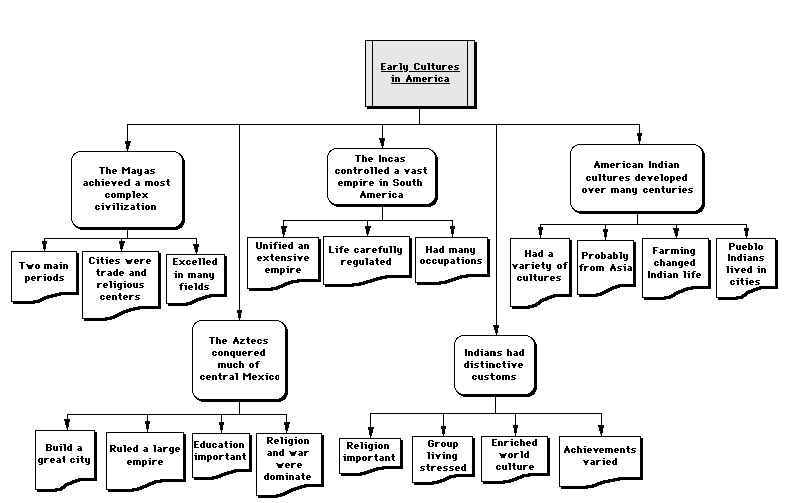
The process of using the diagram mode is simple and
straightforward. A rectangle symbol appears in the center of the
screen containing the label "Main Idea". Entering text into the main
idea symbol is as easy as clicking on the symbol and typing. Once the
center symbol is labeled, connected symbols can be added with ease. A
mouse controlled palette of position choices is provided, but using
the command key and the number pad will automatically supply symbols
in any of the eight surrounding positions without reaching for the
mouse. Once entered, the position of the symbols can be changed using
a simple click-and-drag. Directional arrows connect the parent symbol
with the sub-symbols, and stay connected even if the location of a
symbol is changed. The arrows can be straight or have ninety degree
corners.
Figure 2. A top-down graphical representation of an
outline generated from a high school history text using the software
program Inspiration.
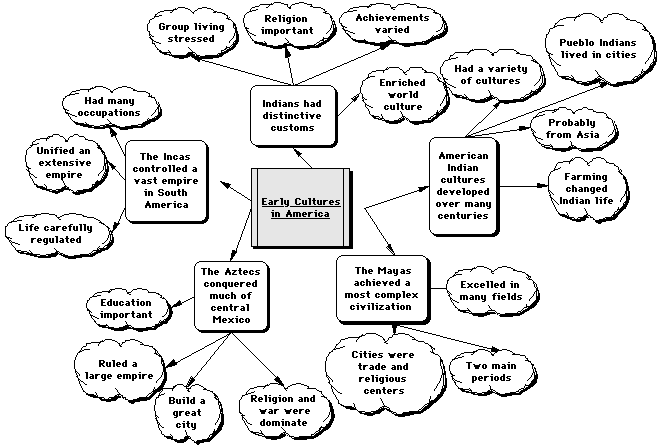
Each sub-symbol can have lower level symbols added to it. Nearly
40 different shapes can be selected for the symbols in order to
distinguish between levels and identify relationships among ideas. In
addition, there are several designs that can be selected for
structuring the ideas and concepts recorded. If none of the available
designs are suitable, a freeform entry mode can be used. I generally
operate in the freeform mode as it facilitates getting my thoughts
into the open, allowing a brainstorming session to produce divergent
responses that are visually connected to the idea that spawned them.
Once generated, the symbols and their contents can be evaluated and
rearranged.
Figure 3. A clustered graphical representation of an
outline generated from a high school history text using the software
program Inspiration. Return to Top
A Tool
For Managing Information
A learner, even a Purple Person, can drift into a state of
passive interaction with material if the primary mode of interaction
is receptive, even when the structure of the material is in line with
his or her preference. One of the greatest strengths of the computer,
and especially when using Inspiration, is the ability to manage and
manipulate information. The ability of the learner to change the form
of the concept from sentence/paragraph to hierarchical outline is a
common and effective method of information management. Given the
additional power, through Inspiration, to transform the text or
hierarchical outline into a graphic representation of the concept
with minimum effort adds a needed dimension of concept manipulation.
In addition, separate outlines can be combined, new connections
drawn, layout of the graphic changed (top-down, bottom-up, etc) - all
without becoming buried by cumbersome computer requirements. The key
to the effectiveness is not in simply providing a format that is
agreeable to the style of the learner, but in the act of manipulation
of information. Caine & Caine, recent investigators into the
functioning of the brain, state, "The brain attempts to discern and
understand patterns as they occur and give expression to unique and
creative patterns of its own....When the brain's natural capacity to
integrate information is acknowledged, vast amounts of initially
unrelated or seemingly random information and activities can be
presented and assimilated (1990)." The capability to develop patterns
and relationships within and between concepts that were previously
hidden in straight text, greatly enhances the process of knowing.
Return to Top
A Tool For
Self-Testing
Almost all computer-based outlining programs have the capacity to
expand and contract (hide and show) the headings and subheadings
which comprise the outline. When expanded, subheadings are visible
and when contracted, subheadings cannot be seen. This feature can be
used as a study tool by learners to self-test their knowledge of the
information in the outline. (For more information see Anderson-Inman
& Tenny, 1989 and Anderson-Inman Redekopp, Horney & Adams,
1990). The hide and show capabilities of Inspiration operate in both
the text and diagram modes. In the diagram mode the learner can hide
or show all sub-symbols attached to a selected symbol. This enables
visual learners to use graphic representations of ideas as tools for
monitoring and self-testing their comprehension. Once an idea
(consisting of central symbols, connecting sub-symbols, and notes)
has been entered into the computer, the student hides everything
except the central symbol. Looking at that symbol, the student tries
to recall the number and content of the connected sub-symbols. Using
the hide and show keystrokes, learners can test and confirm their
understanding and recall of the information contained in the diagram.
The process is then moved to the sub-symbol level where the student
self-tests for recall of the notes taken under each sub-symbol. This
process of comprehension checking has been found to be very effective
in increasing retention of information (Tenny, 1988).
Return to Top
A Tool For
Communication
Communication problems often make it difficult for Purple People
to succeed in the world of education. There is frequently
communication friction between teachers (who often function well with
hierarchical, sequential, text-based representation of concepts) and
multivariate, non-linear thinkers (who function best with visual
representation which emphasize the relationships between ideas and
concepts). Inspiration allows both types of thinkers to work n their
areas of strength. and then to translate the result into a form
easily understood by the other. Imagine for a moment the
communication difficulties between a "concrete sequential" teacher
and an "abstract random" student, where the teacher operates
comfortably within a structure, hierarchical organization composed
primarily of lists and sub-lists. The student, on the other hand,
sees the world through a nonlinear, inter-relational web of concepts.
Both cognitive approaches are valid, but communication between them
is difficult and fraught with misunderstanding. Using the power of
Inspiration, both types of thinkers can develop their ideas in a mode
that is compatible with their thought processes and then share their
views by converting their "outline" to the alternate mode. Each can
make additions or changes to the information in the mode that is most
comfortable, and with a couple of mouse clicks convert it to the
alternate view. Inspiration is a unique tool for teachers and
learners with divergent cognitive styles, enabling them to work
together with decreased frustration and an increased efficiency of
communication. Return to Top
The Real
Students
During the last year, I identified three students as Purple
People according to the above description-dyslexic type attributes on
one hand, high level processing abilities on the other. Together we
explored trying to succeed at schoolwork using the philosophy and
approaches to studying previously discussed.
Tom
Tom loved Chemistry and had since third grade. He had
experimented with chemistry kits and the contents of his parent's
cupboards; he had survived science in the elementary school and done
surprisingly well in high school chemistry classes. Now, in college,
in spite of great interest in the subject and a respectable knowledge
base and experience with chemistry concepts, he was flunking
Chemistry 105. "Too much reading; everything is going too fast. I do
fine in the lab, but can't remember when it comes to quiz or test
time." Tom had spend hours trying to memorize the myriad of new
vocabulary terms presented in the text, reading and rereading the 50
page chapters in the text at a 2 chapter per week pace, recording the
important points of the lecture (and memorize them), doing the
required experiments in the lab and completing the lab manual which
included writing a few paragraphs on the results of the experiments
and how they correlated with the theories proposed in the lecture and
text. And he wasn't doing well. With tears in his eyes, he talked
about loving chemistry and his thoughts of quitting, of how he had
always known he had trouble with reading but in spite of those
difficulties, he thought he really understood chemistry - but now he
just couldn't keep it all together.
In an effort to gather some informal baseline data and to
convince him that he could indeed learn the information to the
detailed level required by the course, I had him identify 12 unknown
chemistry terms and put them on flashcards. Then, using the technique
he had been using up to that point (which consisted of looking at the
term, looking at the definition, looking at the term and reciting the
definition, then checking for accuracy), he studied the 12 words
until he had 100% immediate recall. I then had him self-test at
specific intervals and record the number of words/definitions
retained: 15 minutes (10 words), 45 minutes (8 words), 1 hour and 45
minutes (5 words), and 2 hours and 45 minutes (3 words).
The informal treatment consisted of using the Inspiration program
in the diagram mode to outline the next assigned chapter from the
chemistry text. The structure began with the most global concept
contained in the chapter and developed in an expanding cluster format
to finally include the important terms. "Note" windows were opened
for each term where definitions were stored. The total recorded
schema of the chapter was studied, beginning with the center symbol
which contained the chapter title. When looking at the symbol
containing the chapter title, Tom worked to first recall the number
and positions of attached symbols and then their contents. Then each
sub-symbol was taken in term and the process of recalling the
attached symbols and their contents continued, until reaching the
level of important terms and the hidden definitions. The time to
learn and self-test for retention of the structure of the chapter
including the terms and definitions was, according to Tom, less than
the amount of time it took him to learn the contents of the 12
flashcards. In testing for delayed recall of the terms and
definitions, Tom was allowed to draw the structure of the chapter
from memory. From that point he was able to not only able to recall
the definitions, but was able to provide the 12 terms without further
prompting. The record of delayed recall was as follows: 15 minutes
(12 words), 45 minutes (12 words), 1 hour 45 minutes (11 words), 2
hours 45 minutes (10 words), 23 hours (8 words).
Tom had perceived the required task to be one of rote
memorization, a task especially difficult for the Purple Person. When
the emphasis was shifted through use of the outlining program to
building a structured understanding of the chemistry concepts, he
could reliably supply the concept, from main idea to the important
terms and definitions, from memory. He continues to use Inspiration
and has decided to add a second major in business. He now believes he
has the tool to tackle economics.
Valerie
Valerie was enrolled in two upper-division history courses, both
of which included assignments to write several papers during the
semester. She came to me with the complaint that she found it
impossible to concentrate, to stay on task. It was clear from her
schedule of deadlines that she was required to investigate multiple
topics with differing goals during the same time span. She had done a
diligent job of attending class and gathering information, and should
have been adequately prepared to write her papers. When I asked her
if thoughts of one writing assignment ever interfered with her
ability to progress with a second writing assignment, she responded
with an emphatic "Yes, but I try to push it out of my mind!" Further
discussion revealed that she spend considerable effort not only
trying to stay singularly focused on the initial topic, but also had
to deal with "mental rewrites" of the first paper when trying to work
on the second assignment. This multivariate, nonlinear person was
trying to operate in a strictly linear fashion, and it wasn't
working.
Using Inspiration, we opened two outlines in the diagram mode and
moved to which ever one was predominate in her thoughts. At first,
there were rushes of ideas on one topic, with small intervening
bursts of work on the second topic. At other times the concepts
developed in small alternating steps, a little progress on one
outline and then a little progress on the other. In the end, both
papers were well outlined.
We split the screen between the two outlines, and she was
encouraged to move at will between the two. Her first comment was
that it was very difficult because she was "thinking of everything at
once", but she quickly was able to expand both outlines, again with
alternating steady progress and bursts of insight. She returned the
following morning, sleepless but beaming. Prior to working with
Inspiration she had spend the previous five days trying to write and
had produced only four pages. Now, in less than twelve hours and with
the assistance of the outlining program, she had completed over
thirty coherent pages on two separate topics. She said that when she
realized it was alright to just "let the thoughts happen" she
couldn't stop writing. After some rearrangement and refinement, her
papers were returned by her history professors. One with a B+ and the
other an A.
Robert
Robert came to me with the announcement that he was dyslexic (as
identified by his high school teachers and counselors). He had
apparently done well in high school and wanted to know, as a freshman
in college, what else he might do to increase his learning ability
and grade point average. He already used a computer to write papers,
check spelling, and organize his schedule. He always had others
proofread his writing and test his knowledge prior to exams. On the
surface he seemed fully prepared for college work, but as
conversation progressed it became clear that he had a problem with
self image. Although Robert was able to successfully cope with
academic work, he viewed himself as a deficient human being, hoping
to limp through advanced study by extraordinary commitment of time
and energy. Over the two years that I worked with him, he was able to
increase his facility with the computer and its support for his
multivariate, nonlinear thinking; maintain a strong GPA; examine some
career goals and life plans; and finally graduate from college - but
never to change his basic view of himself. He had been taught by
loving teachers how to focus and cope with his inabilities, and had
devoted such effort to overcoming his "deficiencies" that he was
never able to view himself in another perspective.
Return to Top
Discussion
The computer should be viewed as a tool to augment the learner in
his or her efforts to acquire and process new knowledge. Useful
learning will not take place where the computer is used to supplant
the processing that should be done within the learner's system of
storage and retrieval. Specifically the computer should support the
learner's need to manipulate information, to move easily between
areas of information, and to view the information from multiple
perspectives.
Manipulating information
There is considerable support for the notion that manipulation of
information by the learner is beneficial to understanding and recall.
Barron and Stone (1974) found that student constructed overviews were
more effective than embedded structured overviews in learning
vocabulary relationships in social studies texts. Davis (1981) and
Clary (1986) found schema development through mapping activities to
be an effective method of comprehending lecture materials. Graphic
organizers have been found useful by Luiten (1979), who found in a
meta-analysis study that most studies show advance organizers to have
facilitative effect on learning and retention; Ruddell (1984), whose
mapping groups scored higher on essays, used a greater number of
cohesive ties, and wrote longer essays; and Bean (1983), working with
students who developed graphic representations of text based
information stated that
"Students developed an awareness of text structure features that
contributed to their graphic representation of historical events and
more importantly, the results of these events. Rather than simply
listing major ideas and subordinate details in a linear outline,
students in the graphic organizer groups had to sort and reconstruct
text concepts in order to depict their interrelationships. This
process required higher order thinking and encouraged integration,
retention, and retrieval of text concepts."
These activities are not only supported by programs such as
Inspiration, but are enhanced through the program's capability to
easily manipulate the graphic representation in ways that would be
awkward, if not impossible, with pen and paper.
Anderson (1978) viewed studying not as a "series of mechanical
steps, but as an interactive process..." while others promote a shift
in emphasis from a concentration on instruction aimed at improving
student performance per se to the emphasis on instruction aimed at
improving students' self-control and self-awareness of their own
learning processes. A number of researchers and writers have viewed
the computer as a primary source of support for learners. Pea (1985)
identified the role of computers as changing the tasks we do by
reorganizing our mental function, not only by amplifying it, and
supports the thought that outliners are more than another way to
record efficiently, but also provide a new way of thinking, one that
directly supports the abilities of the Purple Person. An early
experiment concerning computer based notetaking (Hebron,1977)
included symbols to illustrate the relationship between concepts,
accomplished by Inspiration through labeling of the connecting arrows
in the diagram mode.
Some experiments, notably those by Jenkins et al (1986) and
Balajthy, Bacon, and Hasby (1987), have found that poorer readers
have not improved when working with computers; it is important to
note that these experiments specifically dealt with text based
materials, without the intermediary function of a graphic
representation of a concept. The point must be made that
comprehension of the concept or thought should be the primary goal,
and not the lower function of recall of text. Purple People will
readily admit that they process text poorly, but maintain that that
is a format-of-materials problem, not one of ability.
Moving between areas of information
For the multivariate, nonlinear thinker moving from one body of
information to another, either to gain new data or to record one's
thoughts, is not a random, helter-skelter process. In a world of
especially complex relationships among ideas, even the most seemingly
disconnected thoughts are often connected and will generate new
insights. The computer's ability to open multiple documents, copy
information from one to another, and alter the design of the display
as desired provides an improved tool for learning. Kintsch & Van
Dijk (1978) propose a text processing model based on the semantic
structure of texts. This model begins with the organization and
condensing of the meaning of the text into its "gist". The third part
of their model, which identifies operations that "generate new texts
from the memorial consequences of the comprehension processes", could
be interpreted in light of the multivariate, nonlinear thinker. If
the comprehension process is as complex as has been described, the
new "texts" might well be an interrelated structure of thought,
including not only the concepts at hand, but also other themes only
vaguely related. A deeper involvement with both concepts being
studied and the related text materials is seen beneficial by number
of current researchers (Best & Bronzo,1985; Brown et al,1981; and
Ruddell, 1984). Weinstein & Mayer (1986) view the learner as an
active participant in the teaching-learning act and suggest that "the
effects of teaching depend partly on what the learner knows, such as
the learner's prior knowledge, and what the learner thinks about
during learning, such as the learner's active cognitive processing".
For the Purple Person, the active cognitive processing frequently
includes the multivariate, nonlinear flow of thought into extremely
complex structures. The computer should be used as a support tool for
such thinking, not only in an effort to accommodate such thinking
prowess, but also to enhance it. This is accomplished through the
ability to search through documents for a selected word or phrase,
merge outlines or parts of outlines, and to view and copy text from
multiple documents in the process of rearranging recorded information
to align with new insights and perspectives.
Viewing from multiple perspectives
From the very beginning of the history of one person teaching
another, learners have benefited by the information being presented
from different perspectives. Socrates lead his students to the brink
of a definition, only to disrupt that strain of logic by presenting
the problem from another perspective. Every teacher knows that when a
student isn't quite "getting it", shifting perspectives is most often
a much more effective tact than plowing ahead with the first efforts.
Ausubel (1960), in his work with advanced organizers, brought into
focus the concept of presenting an alternate view of verbal material.
The effectiveness of advance organizers established by Ausubel has
been supported by numerous researchers across multiple settings
(Luiten, 1979; Barron, 1969; Earle, 1973; Baker, 1977); the view of
multiple representations of a concept as supporting effective
learning was further supported by research dealing with student
generated overviews, commonly called "mapping" (Ruddell, 1984; Brown
et al, 1981; Bean, 1983). Clary (1986) in researching study
techniques for Learning Disabled students found that efforts
combining multi-modality learning and structured overviews (mapping)
resulted in increased schema development for comprehension. The
computer, to effectively support learning (and especially by the
Purple Person), provides for convenient restructuring of a concept to
reflect a different perspective through its ability to easily
rearrange the sequence of information, and to add or delete data at
will.
The ability to rearrange a recorded thought is not the only
benefit of the computer in affecting perception of a concept. Using
the computer to view the physical representation of a concept into a
variety of graphic structures is also effective and powerful. Each
reader viewing the figures included in this article reacts from an
individual perspective, and one of the representations will strike a
stronger response than the others. Being able to move freely between
various modes of representation not only enhances our communication
with those different from ourselves, but leads us to a state of
meta-cognition. Meta-cognition, as defined by Marzano (1988), is
"being aware of our thinking as we perform specific tasks and then
using this awareness to control what we are doing." Pauker (1987)
defines meta-cognition as "neither a thinking process nor a skill,
but an attitude, a point of view and a way of being aware." Both of
these descriptions accurately describe what a Purple Person does once
they are made aware that the multivariate, nonlinear processing is
acceptable and not to be degraded in favor of the more difficult (for
the Purple Person) top-down, sequential thinking.
Finis.
Postscript:
As an illustration of how a Purple Person
thinks, the following thought popped into my head somewhere during
the third or fourth restructuring of the graphic representation of
this article. It is somehow related, but doesn't exactly seem to fit.
Nonetheless, I believe it to be of value, and am sure that it will
re-emerge within some future thought. I share it with you as both an
insight into how I think and as a seed for new thoughts of your
own.....
What happens to the perception of the
individual (by both self and others) when the category is shifted
from learner to thinker. The difference between "What kind of learner
are you? {how do you gain new knowledge?} and "What kind of thinker
are you? {how do you process information?} could be an important
distinction between the knowledge/ comprehension and synthesis/
evaluation extremes of the cognitive taxonomy. The term thinking
doesn't seem to apply to memorization, nor does learning apply to
evaluation. Hmmmm?! Return to
Top
Bibliography
Anderson. M. (1978). Study Skills and Learning Strategies
(Technical Report NO. 104). Urbana, Illinois: Illinois University,
Center for the Study of Reading, Bolt, Beranek and Newman, Inc. (ERIC
Document Reproduction Service ED 161 000)
Anderson-Inman, Redekopp, Horney & Adams (1990). The Computing
Teacher, 16 (8), 33-36.
Anderson-Inman, L. & Tenny, J. L. (1989). Electronic Studying:
Information Organizers to Help Students Study "Better," Not "Harder".
The Computing Teacher, 16 (8), 33-36.
Ausubel, D. (1960). The use of advance organizers in the learning
and retention of meaningful verbal material. Journal of Educational
Psychology, (5), 267-272.
Baker, R. (1977). The effects of informational organizers on
learning and retention, content knowledge and term relationships in
ninth grade social studies. Research In Reading In The Content Areas:
Third Year Report, Syracuse, New York: Syracuse University Press.
Balajthy, E., Bacon, L., & Hasby, P. (1987). Comparison of
computer-based and traditional practice exercises for development of
content area vocabulary at the college level. In W. C. Ryan (Ed.),
Proceedings of the 1987 National Educational Computing conference
(pp. 213-216). Eugene, OR: International Council for Computers in
Education.
Barron, R. F. (1969). The use of vocabulary as an advance
organizer. Research In Reading In The Content Areas: First Year
Report, Syracuse, New York: Syracuse University Press.
Barron, R. F. & Stone, V. F. (1974). The effect of student
constructed graphic post organizers upon learning of vocabulary
relationships from a passage of social science content, in P. Nacke
(Ed.), Interaction: research and practice for college-adult reading.
Clemson, South Carolina: The National Reading Conference.
Bean, T. (1983, November). Direct instruction in metacognitive
strategies: Cumulative instruction in summarization and graphic
organizer construction vs. graphic organizer alone vs. an outlining
strategy in 10th grade world history. Paper presented at the
seventeenth Annual Meeting of the California Reading Association.
Sacramento, CA.
Best, P. A., & Bronzo, W. G. (1985). Current research on
studying: A qualitative analysis (Report NO. 85-09). Atlanta,
Georgia: Georgia State University, Division of Developmental Studies.
(ERIC Document Reproduction Service NO. ED 263 534)
Brown, A. L., Campione, J. C., & Day, J. D. (1981). Learning
to learn: On training students to learn from texts. Educational
Researcher, 10 (2), 14-21.
Caine, R. N., & Caine, G. (1990). Understanding a Brain-Based
Approach to Learning and Teaching. Educational Leadership, 48 (2),
66-70.
Clary, L. (February, 1986). Six study techniques for
reading/learning disabled adolescents. Journal of Reading.
Davis, A. & Clark, E. (1981). High Yield Study Skills
Instruction. Paper presented at the Annual Meeting of the Plains
Regional Conference of the International Reading Association (9th,
Des Moines, IA) (ERIC Document Reproduction Service NO. ED 208 373)
Earle, R. A. (1973). The use of vocabulary as a structure overview
in seventh grade mathematics classes. Research In Reading In The
Content Areas: Second Year Report, Syracuse, New York: Syracuse
University Press.
Hebron, C. (1977). Teaching students to make notes by machine.
(ERIC Document Reproduction Service NO. ED 160 001)
Inspiration (1988) [Computer program]. Lake Oswego, Oregon: Ceres
Software.
Jenkins, J. R., Heliotic, J., Haynes, M., & Beck, K. (1986).
Does passive learning account for disables readers' comprehension
deficits in ordinary reading situations? Learning Disability
Quarterly, 9 (Winter) 69-76.
Kintsch, W. & Van Dijk, T. A. (1978). Toward a model of text
comprehension and production. Psychological Review, 85 (5) 363-394.
Luiten, J. (1979). The advance organizer: a review of research
using Glass's technique of meta-analysis. Paper presented at the 63rd
Annual Meeting of the American Educational Research Association.
Marzano, R. J. (1988) Dimensions of Thinking: A Framework for
Curriculum and Instruction. Alexandria, Virginia: Association for
Supervision and Curriculum Development.
Mathematica (1988) [Computer program]. Champaign, Illinois:
Wolfram Research.
MORE II (1989) [Computer program]. Cupertino, California:
Symantec, Inc.
Pauker (1987). Teaching Thinking and Reasoning Skills: Problems
and Solutions. Arlington, Virginia: American Association of School
Administrators.
Pea, R. D. (1985). Beyond amplification: Using the computer to
reorganize mental functioning. Educational Psychologist, 20 (4),
167-182.
Ruddell, R., & Boyle, O. (1984). A Study of the Effects of
Cognitive Mapping on Reading Comprehension and Written Protocols.
Technical Report No. 7. Learning from Text Project, Riverside, CA.
Tenny, J. L. (1988). A study of the effectiveness of computer
mediated and rereading study procedures. Unpublished dissertation,
University of Oregon, Eugene Oregon.
Tenny, John L. (1990). Inspiration Software Review. The Computing
Teacher, 18 (2), 46-49.
Wallbank, T. W., Schrier, A., Maier, D., & Gutierrez-Smith, P.
(1984). History and Life: The World and its People. (2nd ed.)
Glenview, Illinois: Scott, Foresman.
Weinstein, C. E., & Mayer, R. E. (1986). The teaching of
learning strategies. In M. C. Wittrock (ed.), Handbook of research on
teaching (3rd ed.) New York: Macmillan.
CONTACT(S):
Inspiration Software, Portland Oregon
John Tenny, Flowing Thought Educational
Solutions
Return to Top Return
to Home Page
Updated January 3, 2002