Japn 314 Two Scenes from the Genji
1. Consider the opening lines of Ch. 7, "Beneath the Autumn Leaves," where she writes about how,
Captain Genji danced 'Blue Sea Waves." His partner, Tô-no-Chûjô , certainly stood out in looks and skill, but beside Genji he was only a common mountain tree next to a blossoming cherry, As the music swelled and the piece reached its climax in the clear light of the late-afternoon sun, the cast of Genji's features and his dancing gave the familar steps an unearthly quality. His singing of the verse could have been the Lord Buddha's kalavinka voice in paradise. His majesty was sufficiently transported with delight to wipe his eyes, and all the other senior nobles and Princes wept. When the verse was over, when Genji tossed his sleeves again to straighten them and the music rose once more in response, his face glowed with a still-greater beauty. (128-129)
Wow! The author captures this moment of grace and beauty that was so moving to the aristocrats that they could not help but weep. Genji brought everything: his robes, his moves, his steps, his voice; his sheer presence in the moment. He is transcendant--he rises above the circumstances as his "features and his dancing" lent him an "unearthly quality." At the end, he flips his sleeves over on themslves in a stunning, triumphal move.
OMG!! No doubt, the guy is a rock star!
As the text says, he transported the emperor and the senior nobles to another world where they almost felt as though they were hearing the sounds of the Buddha's voice in paradise. And the emotions of the moment are incredibly intensified becaus of Lady Fujitsubo's presence, the lady whom Genji loves and has had an affair with, and she is now pregnant with his child.
But she is his father's consort, his concubine. She sits there next to Genji's father, the Emperor, who does not know he has been cuckolded, watching this young man put his heart on display. It must have been a beautiful, passionate, emotionally charged moment to experience...but of course, it is permeated with tension and emotional angst. Deep stuff. Of course, this is fiction so the moment only occurred in Murasaki Shikibu's imagination. But she makes it real to her readers. That is what fiction can do when executed properly.
2. Another similar moment occurs at the end of abridged version of the Royal Tyler translation, in the "E-Awase" or "Picture Contest" chapter (Ch. 17). The two sides at court--the Left and the Right--are in a heated contest to see which side can produce the best paintings or illustrations for their poems. They are at Court, in the presence of the Emperor, each side's srcolls resting in beautifully carved wooden boxes off to the side which were brought out and the paintings unrolled for proper and solemn viewing.
The author describes the climactic scene as follows:
The contest remained undecided on into the night. The Left [Genji's side] had one more turn, and when the Suma scrolls appeared, To-no-chujo's heart beat fast. His side, too, had saved something special for last, but this, done at undisturbed leisure by a genius at the art, was beyond anything. Everyone wept, Prince Hotaru, the first among them. Genji's paintings revealed with perfect immediacy, far more vividly than anything they had imagined during those years when they pitied and grieved for him, all that had passed passed through his mind, all that he had witnessed, and every detail of those shores that they themselves had never seen. He had added here and there lines in running script, Chinese or Japanese, and although these did not yet make it a true diary, there were such moving poems among them that one wanted very much to see more. No one thought of anything else. Emotion and delight prevailed, now that all interest in the other paintings had shifted to these. The question answered itself: the Left had won. (316-317)
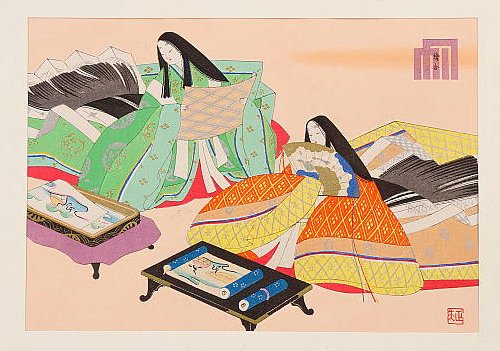
Once again, we see what Genji brings to the table: only he can convey through his art, his calligraphy, his poetry, the immediacy of what he experienced while in exile in Suma. He brought the landscape and his emotions to life for all to see and like the moment when he danced "The Blue Sea Waves" above, the courtiers were reduced to tears. Game over. Genji wasn't called "the Shining One" for nothing!
He was everything that the author wanted to see in her lead male character: handsome, graceful, talented, emotionally deep, sensitive, capable of transmitting his vision, what he felt deep in his heart, to others. In the world of the Heian Period, there was really no higher accomplishment imaginable. He personified grace, beauty, sensitivity and deep insights into the transitoriness, the ephemerality, the impermanence of human life and emotions.
It is all very and intense when it happens, but all this must pass, too. Time does this to all of us, and let us not forget that the Tale of Genji unfolds over a 50 year period encompasing two generations of characters. No mean feat, especially since there was no model for this kind of approach to prose narrative writing anywhere in the world at the time. And even if there were, islolated on the Japanese archipelago, it is unlikely that Lady Murasaki would have known anything about it.