Japn 314 Thoughts on Mieko for Masks
What are some things we can say about Mieko?
From the Text:
1. There is more to her than meets the eye. She is a woman of far greater complexity than we imagine. If Yasuko was in front, Mieko was always behind her with the "serene composure" of a silent, seated figure. (5)
2. If Yasuko is the medium, Mieko is the spirit itself. Is she like a shamaness? (13)
3. Yasuko is an ordinary woman; she is just not on Mieko's scale. The two are like an old painting in which the main figure is twice the size of her attendants.
4. She has that deeply inward look of women from the olden days of the Heian court with their energies turned inward. Could this be the power of a woman’s hatred? (26-27)
5. She is like a quiet mountain lake with her face like a Noh mask, wrapped in her own secrets. (30-31)
6. The secrets inside her mind are like flowers in a garden at nightime, filling the darkness with perfume. But her posing as a poet is just her costume. (32)
7. She was married at 19 into the Toganô Family, an old-very wealthy, land-owning, feudal type of family. (84ff)
8. She was wronged by her husband and then his lover, Aguri, tripped her coming down the stairs when she intentionally left a nail sticking up. The fall causes her to have a miscarriage. (84-86)
9. She decided not to end the marriage and stayed put where she has no aura of heroic self-sacrifice. (86, 91)
10. Mieko was always an undemonstrative person, able to take things in stride. (Dr. Morioka, p. 86)
11. Yasuko's sensuality may come from Mieko...There's something awfully suggestive about the relationship between those two(88)....Something deep and powerful [is] holding those two together. (89)
12. Despite numerous encounters, Mikame has no clear mental image of her face. Mieko has a face like a Noh mask though it creates the impression of even greater obscurity and elusivness. Mikame had no memory of ever seeing her expression coming alive. (90-91)
13. Mieko's heart was as secretive as a garden of flowers at night. This echoing a Tang Dynasty poem. (92)
14. It is suggested that there is something devious going on in her mind. Somehow, Minoru Shimojô's painting of Mieko captures both her strengths and the most deeply-hidden parts of her. (107-08)
15. Mieko has a vision of an ancient goddess (like Izanami) dead in the underworld, putrid with maggots and sores. A woman’s love is quick to turn into a passion for revenge—an obsession that becomes an endless river of blood, flowing from one generation to another. (127)
16. She is identified with two masks: One, the Ryô no onna mask, the vengeful spirit of the Rokujô Lady or Haven who, embodying the archetype of men’s fears of women, was like a Loyal Sister to Mieko.
17. So, Mieko uses the Rokujô Lady as a device to talk about herself.
18. Ego suppression and shamanism are both forms of women’s power with which to challenge men.
19. Two. The second mask identified with Mieko is the Fukai Mask—the Deep Well (深井)/ or the Deep Woman (深女) Mask—an older woman’s heart has the depth of a bottomless well; it is a mask for Mothers, or a mature woman with an exceedingly deep heart, i.e. one with both Experience and Understanding yet is filled with a Lonely Solemnity. (138-139)
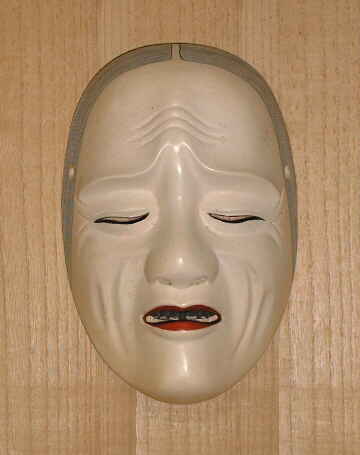
20. Yû, the servant, sees all Mieko’s plotting and scheming and finds they are too shameful to bear the light of day—next to her, what the Master and Aguri did was nothing at all! (123)
21. At the end of the text, Mieko kneels on the floor in the fading light of day, and holds the Fukai mask up to her face. The dwindling light reflects off of the mask and onto Mieko's face so that the two faces were like "twin blossoms on a single branch." "The mask seemed to know all the intensity of her grief at the loss of Akio and Harume." (141)
22. Then, she hears the baby cry and the mask slips from Mieko's hand. As though caught in a trance, she reaches out to cover the face of the mask with one hand while her right arm becomes frozen, immobile in space. Does this mean she is having a stroke? Is she "frozen"? Possibly paralyzed? Or is she possibly dying or having a seizure?
23. What are we left with here? Mieko, Yasuko and the baby will be leaving the Toganô house in Meguro and moving an hour outside of Tokyo to lovely Kamakura, where they will be on their own with no more ties to the Toganô family, which is a bastion of a phallocentric or male-centered existence. What does that tell us?
Instructions