J 314 Kokoro
Notes On The Deaths of Emperor Meiji and General Nogi
There has always been the issue of how the Meiji emperor's death, and especially that of General Nogi, somehow liberated Sensei to take his own life. How does that work? Does it operate as a signal illuminating the end of an era? Does it reduce Sensei to becoming an anarchronism with his older, out-of-fashion values?
On July 30, 1912 at 12:43 am, the emperor died of uremia complicated by diabetes.
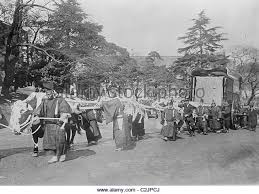
On September 13, 45 days later, on the military terrain in Aoyama, the funeral was held. At 7:00 pm the body was carried from the palace and placed in a gold and lacquer decorated chariot drawn by five oxen.
The chariot was followed by 300 persons carrying torches, drums, gongs, banners, bows, shields and lances. The streets had been covered with sand and decorated with white and black cloths and lanterns, and soldiers lined the roadway.
At 10:00 pm the procession arrived at the site of the ceremony. At 11:15 last rites, salutes, offerings and funerary eulogies started.
During this late hour of the night General Nogi and his wife committed suicide against the backdrop of his sovereign's funeral rites. Most likely, this is what Sôseki was referring to when he has Sensei recall on p. 246 that:
A month had passed. On the night of the Imperial Funeral I sat in my study and listened to the booming of the cannon. To me, it sounded like the last lament for the passing of an age. Later, I realized that it might also have been a salute to General Nogi. Holding the extra edition in my hand, I blurted out to my wife, “Junshi! Junshi!”
This is a powerful passage. We can hear the booming of the cannons that signal the end of an age, the passing of an era, and this becomes a "trigger" for Sensei. He no longer feels that he belongs--if he ever did feel that way. It is why he and this work are so closely associated with the Meiji-seishin, or the "Spirit of the Meiji Era," to which Marvin Marcus refers.
The deaths of Emperor Meiji and General Nogi act as "intertexts" in that they come into Kokoro and recreate for readers the very feeling of those moments, those deep emotions that accompanied the end of the era. And no reader in Japan at the time would have missed those references!
Sôseki was focusing his readers' attention on a specific point in time, something which took place in the world, outside of his novel. He takes his readers back to the night of September 13, 1912. Sensei writes that a month had elapsed, and that would be about right.
In Part II of the novel, when "I" recalls the Emperor Meiji's death, he comments that “The incident was still fresh in our minds when, to my surprise, a telegram arrived from Sensei” (109), and it seemed to me that it was only a few days later that another telegram arrives from Sensei; and then, only a few more days after that, Sensei’s bulky letter arrives which includes his recollections in his Testament of the night of the Imperial funeral.
Therefore, I was a bit skeptical, at first, that the timing could be correct; the timeframe seemed too compressed. News of the emperor's death is first mentioned on p. 91 when the narrator rushes out to buy black crepe. This is when he goes back into his room and starts thinking about "far-off Tokyo," picturing it immersed in gloom, with Sensei's house standing out in his mind as the "one light shining" in the great metropolis. (92)
It seems like the next series of events cascade and flow into one another. But actually, at the bottom of p. 92, a new paragraph opens with the lines: "Some time toward the middle of August, I received a letter from a friend of mine..." So, now, the narrative present has been advanced by a couple of weeks. Then, on the bottom of p. 97, "I" writes that "at the beginning of September, I had decided to go to Tokyo."
Then, two days before he was to leave for Tokyo, his father fainted again so he postponed his departure; then, another 3-4 days went by and his father fainted again. His "father's conditon remained the same for a week or so" (102), he tells us, so that means that another week has elapsed.
Then his brother arrives and more time passes. Next, they read the news of General Nogi's death in the newspaper (108), which would have been the night of September 13th, and "the tragic news touched us like the bitter wind which awakens the trees and the grass sleeping in the remotest corner of the countryside," perhaps alluding to how widely the news spread and how deeply its impact was felt.
It is at this point that the first telegram from Sensei arrives, then two days later, the second one. As his father, who had become delerious, falls into a coma, and loses his power of speech, the heavy, bulky letter from Sensei arrives.
So then I was wrong! Sôseki did actually successfully make the timing fit his narrative. He has carefully crafted his narrative in Part II of Kokoro so that when he has Sensei write of hearing the cannons boom and thinking about both the emperor and General Nogi and the whole phenomenon of "junshi," the timing works.
That night of the funeral in Tokyo, when the fictional Sensei was listening to the booming of the cannons, two special trains left for Kyoto carrying the emperor's body. The trains left at 1:00 am in the morning of September 14. At 7:00 pm, the body was placed in a sarcophagus surrounded by haniwa inside a burial mound situated to the south of the ancient capital, Kyoto. The next day, on September 15, the last funerary ceremony was conducted there.
454 × 324 - commons.wikimedia.org
640 × 480 - alamy.com
Notes on On General Nogi's Suicide
Below is an excerpt from General Nogi's suicide note, as reported in the English-language press in Japan at the time. Supposedly, the letter was written the preceding night (so, on the 12th of September 1912) and consists of the following:
I am now going to kill myself and follow my Emperor. Pardon me, please. Ever since my losing the regimental flag in the civil war of 35 years ago [i.e., the Satsuma or Saigô's Rebellion of 1877] I have always intended to sacrifice myself, but the favours showered on me by the late Emperor and the want of a fitting occasion have prevented the execution of my wish. As I am growing old, I feel sure I shall not have any further opportunity of rendering special service to the state. The august Emperor's death has caused me deep sorrow. I have made up my mind to take the step.
The newspaper accounts go on to discuss the responses of foreigners living in Japan at the time:
It is interesting to notice how varied the views of foreigners are according to their knowledge of things Japanese. The following may illustrate this: "I have been studying the Japanese language these two or three years," says a certain military attache, "and have come to understand literary treatises fairly well. With most foreigners I believed that 'harakiri ' existed only where one's master had been insulted. I was surprised to see this morning's paper reporting General Nogi's death and explained it away as being in accordance with the ancient custom of 'junshi.' Before reading the explanation I thought naturally that he had died because he held himself responsible for the immense loss of life at Port Arthur. Indeed this is the first time I have ever known anything of the old custom so prized by the true samurai, General Nogi."
Now in my opinion, these two cases of 'harakiri' mean nothing at all. The Japanese do not know that the relation between emperor and subject is nothing more than that of common individuals, and not of kith and kin. Granting for the moment that what they say be true, why do not those most loyal subjects serve their succeeding master with the same loyalty? We have no instance of a subject killing himself in order to follow his dead sovereign. But I cannot but doubt whether the 'junshi' is valued by the present Japanese generally whose mind and conduct are steadily being influenced by European ideas. They will surely think it better to serve the new Emperor with the same devotion they felt towards the late Emperor." General Nogi's death must be an extraordinary instance of exceptions.
Indeed, Sensei himself thought junshi was an echo, a vestige, from a distant path. He writes to "I," his young disciple: "Perhaps you will not understand why I am about to die, no more than I can fully understand why General Nogi killed himself. You and I belong to different eras, and so we think differently. There is nothing we can do to bridge the gap between us. Of course, it may be more correct to say that we are different simply because we are two separate human beings." (246)
An interesting equivocation. Maybe it is not the generational differences that are decisive, Sensei admits; it might just come down to the fact that is always an enormous challenge for any two people at any time, in any place, to truly KNOW and UNDERSTAND each other, and to COMMUNICATE effectively. Bridging that communication gap between human beings, especially in modern times, is no easy matter.
What do you think?


