J314 SPUTNIK SWEETHEART II, Middle Part pp. 54-96
Is there something about this middle portion of Sputnik that resembles the middle section of Kokoro, "My Parents and I"? In Kokoro, the venue changes from Tokyo to the narrator's hometown in the countryside, providing the occasion to contrast the modern urban lifestyle with the more rustic and traditonal rural one.
In Sputnik, there will also be a significant change in venue when the action of the novel shifts to a small Greek island at the end of this middle section. This points up how different the world has become, how it is much more internationalized, globalized and integrated.
Ch. 5
I have always loved the way this chapter opens with the line:
"It's time to say a few words about myself." (54)
So, we are finally going to learn something about the narrator! Yay! It's about time!
"I'm the one one whose eyes the story is told through--the tale of who Sumire is and what she did--and I should explain a little about the narrator. Me, in other words."
Great! We are wanting to learn more about the narrator. But, alas, all too soon he is equivocating:
"I find it hard to talk about myself. I'm always tripped up by the eternal who am I? paradox." (54)
Of course, the "who am I" question is central to understanding the human experience, so it must be addressed. But what kind of answers we get, may vary quite a bit.
And by the top of the next page, the narrator has seemingly decided to drop his musings about himself.
"The more I think about it, the more I'd like to take a rain check on the topic of me." (55)
OK, that didn't take long! He doesn't like talking about himself, so he is done.
But, he claims that,
What I'd like to know more about is the objective reality of things outside myself. How important the world outside is to me, how I maintain a sense of equillibrium by comng to terms with it. That's how I'd grasp a clearer sense of who I am. (55)
So, the old inside-outside dilemma continues to raise its head. While there clearly is something going on inside each of us, the narrator is thinking that studying "objective reality" outside himself is the best way to get at it. Interesting idea...
This is how he begins to tell us about his early years, his family, and about how, unlike his older sister, he never cared about getting good grades or going to Tokyo University. He's kind of a loner. He enjoys playing soccer and reading novels. Not writing them, mind you.
So he studied History in college but lacked the desire to become an academic. Nevertheless, he winds up becoming a teacher by "process of elimination," only to discover "a deeper respect and affection for the profession than I ever imagined I'd have. More accurately, really, I should say that I happened to discover myself." (57)
Ah, hah! So it is about the process of self-discovery that we all go through!
And there is no better thing in life than learning about yourself. One of the great ways to do that is to study history, to learn how things became they way they are, the way we find them.
He explains how this whole process worked for him:
I'd stand the front of the classroom, teaching my primary school charges basic facts about language, life, the world, and I'd find that at the same time I was teaching myself about these basic facts all over again--filtered through the eyes and minds of these children. (57-58)
He finds this "refreshing" and even "profound."
So this is a kind of epiphany for him--indeed, as it is for anyone who "teaches" at any level--that in order to teach, we have to learn and, in this case, he is learning more about "language, life, the world" every day.
Does it get any deeper or more meaningful than that? Isn't exploring language, life, and the world what it is all about?
As someone who taught language, literature, history and film myself for forty years, I can definitely relate to this insight! It has absolutely been my experience!
"Still," he acknowledges, "the basic questions nagged at me. Who am I? What am I searching for? Where am I headed?" (58)
Of course, try as he might, he is not getting away from these important questions that human beings are always asking themselves. But, he quickly adds that,
The closest I came to answering these questions was when I talked with Sumire.
So, it comes down to how we speak to and treat one another in our relationships for this is how we learn about ourselves.
We have already been offered glimpses of how K and Sumire talk, how they open up to each other and try to answer important questions for which they seek answers. More importantly, the narrator learns to listen to Sumire and how to become a good sounding board for her.
"Unlike other people she honestly, sincerely, wanted to hear what I had to say. I did my best to answer her, and our conversations helped me open up more about myself to her--and at the same time, to myself.
We used to spend hours talking. We never got tired of talking, never ran out of topics--novels, the world, scenery, language. Our conversations were more open and intimate than any lovers'." (58)
When K talks about Sumire "honestly and sincerely"wanting to hear what he had to say, it reminds me of the narrator in Kokoro wanting to get to know Sensei in order to learn from him!
And they learn about each other and about the world by just talking, for hours and hours, exchanging ideas and views of things. This seems much different than any characters in Kokoro except maybe K and Sensei when they talked philosophy and religion.
"I did my best to answer her, and our conversations helped me open up more about myself to her--and at the same time, to myself....Our conversations were more open and intimate than any lovers."
The conversations were so important to both of them; it provided them an intimacy usually reserved for lovers, which they could not be.
And he cannot help but wonder
"how wonderful it would if indeed we could be lovers." But alas, "Sumire had no such romantic feelings for me, let alone sexual interest." (58)
He goes on, though:
"Still, the time I spent with her was more precious than anything. She helped me forget the undertone of loneliness in my life." (59)
So, it sounds like the some of that loneliness that plagued the characters in Kokoro has still not dissipated eighty years later!
Doesn't this suggest that Murakami could be intentionally echoing or referencing Sôseki? Like he wants us to keep Kokoro in mind as we read Sputnik? Why not? It's that old Intertextuality that Burch suggested is intrinsic to Japanese literature.
Meanwhile, Sumire has been going through a lot of changes herself: a new job, new responsibilities, new wardrobe, new hairstyle...but she can no longer write like she used to.
Is she starting to lose her sense of self?
The narrator suggests that she may be positioning herself in a "new fictional framework." (62)
"I think most people live in a fiction."
He offers up the metaphor that fiction exists in relation to the world outside of ourselves, much the way a transmission functions in a car:
"Think of it in terms of a car's transmission," he says. (62) It
stands between you and the harsh realities of life. You take the raw power from the outside and use gears to adjust it so everything's all nicely in sync. (62-63)
Murakami never shies away from talking about the nature of writing or of fiction in his works. He is not afraid to acknowledge his process.
Here, this taking of "the raw power from the outside" may be like taking the bleached bones of ancient warriors and sprinkling them with blood in order to forge a link between the world on this side to the world on the other side.
This is how we get to"fiction," or how we construct our novel.
But what is the problem Sumire is currently facing?
The narrator offers this advice:
"The biggest problem right now is that you don't know what sort of fiction you're dealing with. You don't know the plot; the style's still not set. The only thing you know is the main character's name. Nevertheless, this new fiction is reinventing who you are. Give it time, it'll take you under its wing, and you may very well catch a glimplse of a brand new world. But you're not there yet. Which leaves you in a precarious position."
To which Sumire responds,
"I understand what you mean by precarious. Sometimes I felt so--I don't know--lonely. The kind of helpless feeling when everything you're used to has been ripped away. Like there's no more gravity, and I'm left to drift in outer space. With no idea where I'm headed."
"Like a little lost Sputnik?"
"I guess so." (63)
I think the introduction of the word precarious in italics is significsnt.
Precarity, loneliness, feeling helpless, adrift, uncertain--this is the postmodern dilemma in a nutshell!
In place of order, rationality and certainty we find precariousness, contingency and loneliness. Gravity has lost its hold and Sumire finds herself adrift and filled with uncertainty.
The narrator helps Sumire to move apartments. As they sit around after working hard, K feels instense desire for Sumire. He fantasizes about them having sex but Miu is the only one she wants. (66-67)
She offers to buy him dinner sometime soon, "Maybe next week." But, as the narrator says,
"In the end, like so many beautiful promises in our lives, that dinner date never came to be." (68)
Instead, on August 1, he received a long letter from Sumire posted from Rome.
So ends Ch. 5.
Ch. 6 mainly consists of Sumire's letter from Rome which includes her allusion:
I have this strange feeling that I am not myself anymore. It's hard to put into words but I guess it's like I was fast asleep, and someone came, disassembled me, and hurriedly put me back together again...The me sitting here and the image of me I have are out of sync....
Again, we find a character who feels like she is no longer herself, or at least no longer the self that she was. Instead, she experiences a sort of reawakening when someone "disassembled" her only to hasitly put her back together again. The essence of strangeness.
To interject a brief comment fron NYT reviewer Daniel Zalewski,
To some readers, such talk of ''the other side'' will sound like the musings of a fortuneteller, not a novelist. But Murakami has an unmatched gift for turning psychological metaphors into uncanny narratives. Haven't we all felt, at moments of emotional upheaval, that we were not the same person we were yesterday? And found refuge from daily life in our dreams? In Murakami's books, the quiet rumblings in the back of our minds are allowed to erupt; his stories delicately track the lava flow.
That's a pretty nice, graphic description of what can happen to our minds in "moments of emotional upheaval" when it feels like we have been transported to somewhere strange, like the "other side."
Sumire's letter continues:
There is one thing I can say for sure: I wish you were here. Even though I have Miu with me, I'm lonely being so far away from you. If we were even farther apart, I know I'd feel even more lonely. I'd like to think you feel the same way. (71)
A P.S. says that Sumire expects to be back home around August 15 and promises to have that dinner together before summer ends.
Five days later, a second letter arrives announcing that the August 15 return date is probably out now. She and Miu are going to Greece for a little vacation. An Englishman they met in France owns a villa there and invited them to stay at his place as long as they please.
They both like the idea. Sumire writes:
We need a break from work, some time to just kick back and relax. The two of us lying on the pure white beaches of the Aegean, two beautiful sets of breasts pointed toward the sun...Doesn't that sound wonderful? (76)
Meanwhile, the narrator spends time with his married girlfriend, the mother of one of his students, but knows he cannot really be in love with her. The kind of natural intimacy he experiences with Sumire just isn't there. Instead, there is a barrier between them, a "thin transparent veil."
"Awkward silences came on us all the time. That never happened with me and Sumire." (78)
He concludes:
"Being with this woman confirmed one undeniable fact: I needed Sumire more than ever." (78)
Then, the narrator receives an international phone call from Greece, but it was not from Sumire. It was from Miu.
Something is up. Sumire has disappeared like smoke.
Oh, dear.
End Ch. 6
Ch. 7
It's 10 days before the start of a new school term but the narrator knew that he had no choice but to get on a plane and fly to Greece. He packs a few things, including a swimsuit and two Joseph Conrad novels, and heads for the airport on the Narita Express.
He will fly from Narita--to-->Amsterdam---to--->Athens--to--->Rhodes where he then boards a Ferry for the two hour ride to the little unnamed island where Miu and Sumire were vacationing.
Miu was not there to meet him at the harbor so he wanders around. While he waits for her, he reads a pamphlet about the island and learns that,
Englishmen found the island particularly charming (the British are a bit eccentric) and, in their zeal for the place, built a colony of summer cottages on a rise near the harbor. In the late 1960s several British writers lived there and wrote their novels while gazing at the blue sea and the white clouds. Several of their works became became crirtically acclaimed, resulting in the island's garnering a reputation among British literati as a romantic spot. (90-91)
The island in question is known as Spetses or sometimes, also, Spetsai.
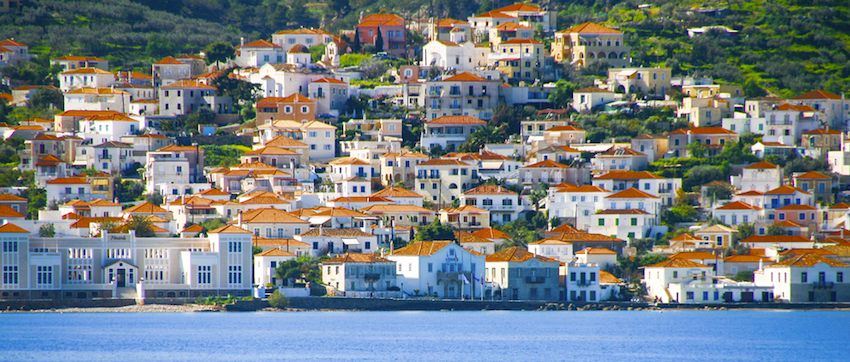
As far as I can determine, the only British writer from the 1960s who earned any such critical acclaim was John Fowles, author of such classics as The Magus, The Collector and The French Lieutennant's Woman. And he earned quite a bit of acclaim. The Collector and The French Lieutennant's Woman were both made into highly successful motion pictures. The Magus, as well.
It seems very probable that Murakami was thinking of Fowles when we was constructing the Greek portions of Sputnik Sweetheart, especially The Magus which is the only one of his novels actually set on this island. Much of The Magus deals with strange warps of reality leaving people with the feeling that they are not the person they once were! It became a cult classic and was also made into a film starring Michael Caine as the young Englishman and Anthony Quinn as the mysterious Mr. Conchis.
For more thoughts on the island and The Magus, please click here.
As one writer describes the island of Spetses,
...[It] is both cursed and blessed by its assets; being too pretty and too accessible have made it too popular. The last of the Argo-Saronic islands that include Aigina, Poros and Hydra off the northeast coast of the Peloponnesos, Spetses was so green in antiquity that it was called Pityoussa – covered with pines. Cruel winds rarely buffet it, yet every midday in summer a delicious breeze springs up to cool it. Although it has to import water, bougainvillea, hibiscus, plumbago, jasmine and trumpet vines thrive in the mild climate, spangling white walls with pink, mauve, red, baby blue and orange petals. Handsome mansions dominate the seafront between the Old Harbor (Paliolimani) and ∏-shaped Dapia, where sea taxis and kaikis huddle under cannons left from the War of Independence. Adjoining the modern jetty, where the hydrofoils dock, stands an ochre elephant of a hotel – the grand Posidonion Hotel, where Athenian gentry holidayed a century ago.
A stone’s throw to the left [of the hotel], the mansion built by Sotirios Anargyros at the turn of the last century hints at another story. Like so many Greeks, he left for the US penniless and returned a millionaire. You can see from its overly ornate façade and rather important size that he wanted everyone to know about it. But he poured money into the island, too. Not only did he build the luxurious Posidonion Hotel, he founded an elite boarding school (at the edge of Kounoupitsa) and organized a reforestation campaign to replace the pines that had been cut for firewood and masts. Generations of boys whose families worked in Africa, the Middle East and even Athens hated the English type discipline but got an excellent education. In the 1950s, its most illustrious teacher, John Fowles, wrote his best seller The Magus there and launched Spetses into a literary limelight not matched until Corelli’s Mandolin drew readers (and then moviegoers) to Kefallonia in the 90s. (https://www.greektravel.com/greekislands/spetses/)
Now I tend to get really excited about making thse kinds of connections or discoveries while I am reading. It somehow opens up, deepens and enriches how I read Sputnik Sweetheart.
Alas, though, digging deeper, I find that Spetses doesn't quite fit the bill in one important way: it is not a 2-hour ferry ride from Rhodes. You would have to take a couple of different ferries to get there from Rhodes. No worries. Writers possess that infamous "poetic license" to take some liberties, right?
Murakami definitely mentions the little colony of British ex-pat writers of which Fowles was the most prominent, and Spetses is definitely the setting for The Magus. That's been pretty thoroughly investigated and even the old school is still there!
The town of Spetsai was prosaic enough, at least to the extent a Greek fishing village is capable of being prosaic. There was a small shipyard and a lighthouse along with a cluster of sparkling whitewashed stucco. The Anarghyrios and Korghialenios (Lord Byron) School was just as Fowles had described it a large compound of hulking gray buildings a little to the west of the port; looking more like an army barracks or a phson than a center of learning.
...Some time later I wrote Fowles to tell him what the island was like now, more than 20 years after his sojourn there. The last line of his reply showed me, however, that Spetsai hadn't really changed at all since his time, and I feel certain now that for me as well as him, it never really Will.
“It was,” he wrote in a quiet valedictory, “such a lovely lost place in the old days.”
https://www.nytimes.com/1975/08/24/archives/the-isle-of-the-magus-the-isle-of-the-magus.html
A "lovely lost place" would be a perfect spot for Murakami to imagine his characters Miu, Sumire and later K enjoying the stunning beauty while trying to solve Sumire's mysterious disappearence, and watching things transform and disappear before your eyes only to be partially found--or at all.
So let's just say that Murakami took inspiration from Fowles and Spetses but also took a few liberties with its location and how you get there. He might have been inspired by an island called Halki (or Chalki). Or, perhaps it was Symi.
In fact Murakami did travel to Turkey and Greece and wrote a travel memoir in Japanese but it has never been translated into English.
It was called was Uten Enten (雨天炎天), and it is a road essay by Japanese author Haruki Murakami, about his travels in Greece and Turkey. The essays were first published in Japanese in 1990 by Shinchosha as two separate volumes, the first volume covering his travels in Greece, and the other his travels in Turkey. A popular edition collecting both volumes was published in 1991. In 2008 a renewal edition was published with some new photographs.
(https://en.wikipedia.org/wiki/Uten_Enten#:~:text=Uten%20Enten%20(雨天炎天,other%20his%20travels%20in%20Turkey.)
K finally does meet Miu and finds her stunningly beautiful. They repair to a taverna for a nice meal and then they walk up the hill to the cottage where Miu and Sumire were staying.
Miu says she will tell him the story of their travels up to four days ago, when Sumire disappeared "just like smoke." (96-97)
End of Ch. 7