Japn 314 Yoshimoto Banana's Kitchen
Sakurai Mikage loves kitchens, she loves food and the warmth it brings. Her family has dwindled over time down to just her and her Grandmother, and when her grandmother dies, she is alone in the world and has trouble coping with that reality.
My family had steadily decreased one by one as the years went by but when it suddenly dawned on me that I was all alone, everything before my eyes seemed false. (4)
Although she appears to be stuck, unable to move forward, rescue comes from an unexpected direction. The apartment door bell rings and it is Tanabe Yuichi, the young man who worked part-time at Mikage's grandmother's favorite flower shop. He looked out for her grandmother and came to care for her deeply.
He will become Mikage's friend and somewhat surprisingly, out of desperation, she accepts his offer to move into their 10th floor apartment with Yuichi and his mother, Eriko, a beautful woman who was actually Yuichi's father.
He became transgendered when Yuichi's mother, his wife, died of cancer. But Eriko lives on the margins, works in a gay bar, and is suddenly murdered by a man who was stalking her. Enraged that she is not the beautiful woman he had believed her to be, he viciously attacked her with a knife. Fatally stabbed, she manages to kill her assailant with a barbell in the struggle. In other words, she goes down fighting. A lesson for us all?
Yuichi and Eriko's apartment has a wonderfully huge sofa and a kitchen which Mikage adores. She feels right at home. And then there is Eriko who "Dumfounded" Mikage. She "was truly beautiful."
I couldn't take my eyes off her...--the whole of her gave off a marvelous light that seemed to vibrate with life force. She didn't look human. I had never seen anyone like her. (11)
"She made me want to be with her again," Mikage tells us.
There was a warm light, like her afterimage, softly glowing in my heart. (12)
While her grandmother was still alive, Mikage was painfully "aware that my family consisted of only one other person." (21) Now, all her family has gone.
Does Kitchen try to offer us lessons? Is there wisdom to be found in this text? Certainly it addresses how grief can affect us and how we can cope with it.
When was it I realized that, on this truly dark and solitary path we all walk, the only way we can light is our own? Although I was raised with love, I was always lonely. (21)
But Eriko and Yuichi's friendship helps light her path; it warms her and "Little by little, light and air came into my heart. I was thrilled." (21) She continues to live with the Tanabes but when an old boyfriend, Sotaro, contacts her and lets her know that the whole school knows of her living arrangements and that Yuichi's girlfriend even slapped him in the cafeteria over Mikage's presence, Mikage begins to feel precarious. She realizes that she needs to move out and live on her own.
On the bus ride back from meeting Sotaro for tea, a little girl and her grandaughter are seated near her. Watching them together, she is painfully reminded that she will never see her grandmother again. Tears pour down her cheeks and eventually, after she gets off the bus, she weeps uncontrollably, sobbing and realizing she had never had "a proper over my grandmother' death." (35) She moves from despair to hope, and implores the gods to let her live!
That night, she sleeps deeply and has a dream. She is cleaning out her old apartment. Yuichi is with her and they sing a song they both know by Kikuchi Momoko, "Futari no Naito Doraibu" (The Two of Us on a Night Drive). (37-38)
A lighthouse in the distance
To the two of us in the night
The spinning light looks like
Sunshine through the branches of trees.
[Note, the singer-songwriter here is KIKUCHI Momoko, NOT Sakuchi Momoko!]
They are in harmony and they both feel like eating some ramen noodles. Then she awakens and the dream is over. But Yuichi also awakens from a dream with a hunger for ramen....a strange, but still, very real connection between the two--through music and dreams!
Still, though, Mikage knows she must move out and move on. She knows she will hit rock bottom and suffer along the way but she will just have to get back up and keep going. "I will not be defeated. I won't let my spirit be destroyed." (42)
One thing that strikes me is the way Mikage learns once she embarks on her journey. It seems that several of the texts we have read this semester have to do with learning, growing, taking things away from life experiences. It is how Mikage learns, or how Yoshimoto writes about it, that interests me.
She learns to cook one summer preceding Eriko's death in late autumn. The three of them--Eriko, Yuichi and Mikage--live together and Mikage prepares the meals. She worked as though she was in a cooking frenzy; she tried everything, every kind of dish. That was the only way she knew how to learn. "I tried making anything and everything, and I tried to do it right."
For her, "doing it right" meant paying "attention to detail."
When she finally learned how to calm herself, and to take note of what she was doing, to learn from each mistake, she became more self-aware, "it was truly as if I had somehow reformed my own slapdash character. Or so I thought." (自分の性格まで直ちゃった見たいよ! ...と思った. p.58, 81 in Kadowa Bunko Japanese language edition.)
This is kind of profound. It is about learning how to be present in what you do, learning how to be centered, to be able to cook the same way that a tea master performs the Tea ceremony--with every ounce of his/her being. With fullnness of spirit, and with total concentration and complete attention to detail.
Chapter 2 opens up with the startling news that "Eriko died late in the autumn," (44) though Yuichi could not bring himself to call Mikage and tell her.
Eriko left a will in which she tells Yuichi there is no other family. Just Mikage.
...taking Mikage in!! That was the most fun of all. I yearn to see her again. She, too, is a precious child of mine. (53)
Mikage ponders why she loves kitchens so much.
"Perhaps because to me a kitchen represents some distant longing engraved on my soul. As I stood there, I seemed to be making a new start; something was coming back." (56) New beginnings!
***
"That summer I had taught myself to cook," she writes on the top of the next page. (57)
Thus begins the story of her journey, how she found a pathway to transformng herself and making herself live a life with a new sense of purpose. This pathway showed her how to experience "joy" in her life, a type of joy that others in her cooking classes simply could not. Why not? Because they had been taught "probably by caring parents, not to exceed the boundaries of their happiness regardless of what they were doing."
As Mikage perceives it, "Their happiness," meant "living a life untouched as much as possible by the knowledge that we are really, all of us, alone." (59) For the others, "Dressed in their aprons, their smiling faces like flowers..." that's fine. "They fall in love and marry."
Not Mikage. She has taken it further. She now understands the value of experiencing the joy of discovery and creativity, of making and doing, and "Having known such joy, there was no going back." (59) Sure, she has moments of regret, "But--that one summer of bliss. In the kitchen. I was not afraid of burns or scars; I didn't suffer from sleepless nights. Every day I thrilled with pleasure at the challenges tomorrow would bring." (59)
She goes on to say the following:
No matter what, I want to continue living with the awareness that I will die. Without that, I am not alive. That is what makes the life I have now possible. (59-60)
And this includes seeing the moonlight. "Beauty that seems to infuse itself into the heart: I know about that." (60; italics mine)
To live with the awareness of one's death is very Zen; it is very spiritual and also very difficult. Easy eough to say, but much harder to actually do.
Yoshimoto is subtle here; she is not hitting us over the head with a sledgehammer; but she has looked deeply into the darkness that often surrounds us in life and found the light. And she discovers a kind of beauty that can "infuse itself into the heart." That is really something noteworthy!
Moreover, she finds a way to act and to be in the world; she finds a way to learn, to grow and to transform herself, to "reform" her "slapdash character." In changing herself and in learning and growing, she has found a way to heal from the wounds life has inflicted upon her. It gives her hope.
One could say that learning how to cook, and learning how to grow and heal is all that we can do in this world. Supposedly, when Freud was once asked what people should do to make their lives more meaningful, he replied, rather succintly, that there were two important keys to human happpiness: "To work and to love."
Sounds simple enough, right? Find a job, get married, have a family, etc. But I think he meant something different, something much more profound.
"To work" entails being productive, being alive and creative in your work, and making the world a better place.
And "To love" means not just to experience the rush of powerful emotional attraction, the dizzying heights of being swept up in the "tornado" like Sumire was; but it also means to be sufficiently grounded and centered in your own life that you CAN actually love another person; you have a real, authentic self which is capable of offering something to someone else.
Once again, easy enough to talk about, but rather hard to actually pull off.
Circumstances threw Mikage and Yuichi together; she is not sure exactly what she thinks about him but when she first saw him she perceived a light around him; she couldn't tak her eyes off him. "I think I heard a spirit call my name." (6)
When he asked her "don't you think that seeing such a beautiful moon influences what one cooks?" Mikage's "heart faltered for an instant. He spoke as if he knew my very soul." She starts to feel that "If Yuichi is with me, I need nothing else." The two of them seem to have forged a bond, "just the two of us...orphans alone in the dark." (61-62)
The day they first met, "He seemed to glow with white light." (7) She said, "I couldn't take my eyes off him....[I]t was like I was possessed...I felt I could trust him...I saw a straight road leading from me to him." (6-7) So there was more than just a little spark there between the two!
Though Yuichi asks Mikage to move back in, he cannot decide on what basis. Lovers? Friends? Somehow, without Eriko, they are adrift.
Even though we are standing side by side, even though we are closer to each other than to anyone else in the world, even though we're friends forever, we don't join hands. No matter how forlorn we are, we each insist on standing on our own two feet...[A]lthough we have always acted like brother and sister, aren't we really man and woman in the primordial sense, and don't we think of each other that way? But the place we are in now is just too dreadful. It is not a place where two people can create a life together. (66)
This sounds like a tough deal. Like K and Sumire, they have something special, something precious: a spark, a bond, a connection. It could be moved forward into a love relationship...but not as long as the place they are in is so dreadful.
Can they move forward somehow? Is there an avenue open to them? Can they find it?
Mikage is washing the dishes after the incredible meal that she prepared for them, while Yuichi sleeps off his drunk, and she cries. And cries and cries inconsolably.
I was crying for having been left behind in the night, paralyzed with loneliness. (67)
Oh, Hello. Our old friend Loneliness.
Two people become close, so very close, yet they cannot find that bridge to reach out and connect with one another, to become joined, Or, if the bridge is there, they cannot manage to cross it. Yet.
Mikage has to go to Izu for her work and Chika, Eriko's friend, lets her know that Yuichi is going off somewhere by himself, and he may be in trouble. "She made me realize," Mikage notes, "that the human heart is something very precious." (86)
On her trip, Mikage has a realization, or as she put it, "a thrillingly sharp intuition":
In the gloom of death that surrounded us, we were just at the point of approaching and negotiating a gentle curve. If we bypassed it, we would split off into different directions. In that case we would forever remain just friends.
I knew it. I knew it with absolute certainty. (91, emphasis mine)
Could they become like Murakami's satellites, "Lonely metal souls in the unimpeded darkness of space, they meet, pass each other, and part never to meet again. No words passing between them. No promises to keep"? (179)
Perhaps. Unless Mikage can do something.
Death weighs heavily on them; they have seen too much of it in their young lives. They feel the pull of the darkness but know they have the awareness to avoid the abyss and to do what is right.
Mikage has learned how to pay attention when she learned to cook. In doing so, she learned how to be herself and to be aware of herself in the world. No small feat.
So Mikage does manage to do something. She acts. Somebody had to do something or the precious moment would pass them by. It falls to Mikage. She is the active force in this drama, she is the agent; she is more yang than yin.
What does she do? She goes to find Yuichi by taxi late at night to bring him the most delicious katsudon imaginable.
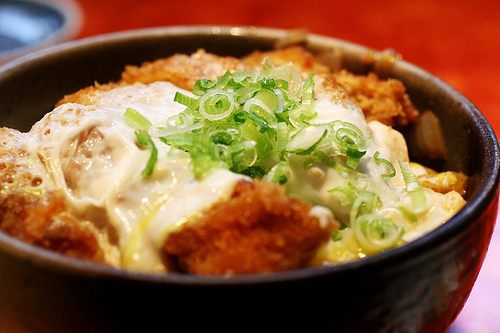
This gesture somehow makes her feel good, even encouraged. "My spirits began to lift," she says.
I had done all I could. I knew it: the glittering crystal of all the good times we'd had, which had been sleeping in the depths of memory, was awakening and would keep us going. Like a blast of fresh wind, the richly perfumed breath of those days returned to my soul...Truly happy memories always live on, shining. Over time, one by one, they come back to life. (100, italics mine.)
Two things stand out and they are linked:
1. Action: she has done something. In fact, she has done all that she could, and she knows it. No uncertainty:
"I knew it with absolute certainty." (91)
She did her part. But, if the results do not turn out as she hopes, she will still be OK because she has something else, the second thing:
2. Her Memories, her shining memories which come back to life one by one. When she speaks of truly happy memories that live on, it sounds like she is at peace. Her wounds are healing.
She is able to reach out to Yuichi and she clearly hopes for the best; but if the best is not to be, that seems to OK, too. She can live with the precious memories if she has to.
She tells Yuichi how much she does not want to lose him. Right there, even by itself, that is something significant. She expressed herself clearly and forcefully, the kind of things Sôseki's characters could never quite manage.
Was Yuichi on the brink of sinking into an abyss, perhaps taking his own life in his room at his inn? Did Mikage's gesture save him?
Mikage says clearly that "I had an uneasy premonition and it didn't prove wrong." (95) So perhaps that was exactly what Chika was trying to alert her to.
And then, when she saw Yuichi at his inn, she thought
Yuichi was not in this world now. His cold eyes frightened me. (99)
Once inside, Mikage
became aware of the heavy atmosphere in the room. I felt that I was inside Yuichi's nightmare, and that if I stayed there too long I, too, would become a part of it, destined to be snuffed out in the gloom. (99)
Inside his nightmare? All of this sounds rather ominous. Perhaps Yuichi was on the verge of giving up. But Mikage had already indicated that, for her, "to cease living" was not acceptable. People need to get up and move on.
So, was her act a kind of intervention?
An imporant difference between Mikage and Yuichi at this point is that she knows something. She has learned things; she has grown. She is much more of an adult than he is. She has figured some things out for herself. More importantly, she understands how to go about this process of learning and knowing.
Mostly, she acquired her knowledge about life from learning how to cook. But she also learned from both Eriko and Chika just how precious life can be.
Here she is in Yuichi's room, in that dark place, which tells us that she was capable of acting in a situation that was otherwise dreadful and fraught with risks. She was willing to take the risk. She has reached out to him.
Moreover, she accepts what she has discovered to be true.
[T]here will be so much pleasure, so much suffering. With or without Yuichi. (104)
This sounds very much like resignation. Many say there is Buddhist quality to Yoshimoto's work.
If things work out, it will be worth it; if they don't, it will still be worth it. She is resigned in the sense that she now accepts; she accepts that Eriko is no more and that she has to get up and "begin another day....[Because] Over and over, we begin again." (103)
She had already stated that,
...we live like the lowliest worms. Always defeated--defeated we make dinner, we eat, we sleep. Everyone we love is dying. Still, to cease living is unacceptable. (82)
So, the Sensei solution is not on the table!
Can we take comfort in this? Sometimes, the thought of facing thousands of new days without the people we love in them, is daunting. People cannot always face up to that reality.
But, each day also brings the chance to learn, to grow, to become whole. Is there enough hope here for us to grab onto?
All we know for sure is that Mikage truly feels. And that is something. At the end, she feels "strange, sweet sadness...[at the awareness that] there will be so much pleasure, so much suffering. With or without Yuichi." (104)
A bit of uncertainty, to be sure; but Mikage feels like she can survive either way. There is hope that both of them will be healed and become healthy and whole. And be able to love each other.
But in order to take the step that she did, to grab the katsudon and head for Yuichi's inn, she had to risk a lot and she could only do so if she were prepared to accept the consequences.
We are always making choices she has noted, but not always consciously. But this had to be a conscious decision on her part, one made with individual agency.
It appears to have paid off. Yuichi calls her the next morning to say he will meet her train when it arrives in Tokyo and a feeling of warmth permeates her room in Shimoda (Izu). He sounds more normal, less despondent.
The warmth comes from the tea kettle with the boiling water for her tea. But it also comes from the warmth of her heart.
Unlike Sumire's last call to K in Sputnik, Yuichi is not in some other dimension or on some other plane of existence. He is not part of a dream. He, too, is now back in the world, in the same present as Mikage, even though when she first saw him in his room, he did not appear to be here in this world. Rather, he was in some dark place. By himself. All alone, not really connected with anyone else.
But, now, finally, he has done something, too. It was not easy to get her number there in Izu but he did it. It may not sound like a huge accomplishment, just something small. But it is something. It is a start. It is a new beginning.
And then he called Mikage, he reached out to her.
The bad news is, this is what we have to do all the time in our lives: scratch, claw, battle; fall down and get back up. And start over. But it seems like Yuichi has taken that first step--albeit, a baby one.
Like "I" in Kokoro, Mikage will be on a train heading back to Tokyo. But she already knows that she has done all that she could do: she reached out to Yuichi and whatever happens on the road ahead, will happen.
No doubt, both pleasure and suffering lie on that road, as she has indicated. There is no certainty in the ending; we don't know for sure that they will face that road together, hand-in-hand. Perhaps they won't. But there is ample room for hope.
And warmth. And the memory of a wonderful katsudon that they shared.
And that is something. Maybe it is even enough.