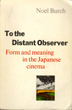
Noel Burch's book, To the Distant Observer, is
actually a book about Japanese film. But he wants to alert his readers to possible
differences in the Japanese "eye," the way Japanese see the world, that may
be attributed to linguistic and cultural differences.
For example, he cites
two "CONTRADICTORY TRAITS," two stereotypes about Japan that are widely accepted:
1. Japanese people have faculty for assimilation;
2. But they also have a strong
sense of tradition which have an important subtext for westerners. That is, westerners commonly believe that the Japanese
a) Lack Originality and b) are culturally Stagnant and Conservative.
But what does Burch argue?
This fails
to recognize, he claims, that many scholars who are steeped in Japanese studies want to defend Japan and to argue that Japanese don't just copy things--such
as the writing system from China, or Buddhism, or governmental institutions--but adapt them creatively. Is there a problem with this argument?
Well, he also points
out that whichever way you see it--whether you think Japanese are a nation of copiers or, alterntively, highly creative "adapters," you are relying on a certain ideological base, the one that
rests on the belief that originality is a fundamental virtue. He argues that this is not
widely shared in Japan where the whole social system works against the very idea of
originality.
What lies behind this perception of Japan,
he asks?
In his first chapter, "A System of Contradictions," Burch discusses these two contradictory traits that often come up in discussions about Japan, the “faculty for assimilation” and its “lack of originality” (depending on the writer’s inclinations), and rightly calls them stereotypes that mystify the culture, and he intends to reveal the underlying ideological assumptions behind such claims.
Whether Japanese are adept at assimilation and transformation (“making things uniquely Japanese” as it is often put) or are mired in stagnant conservatism (miming China before and the United States in the postwar period), each notion invokes the value of originality. However, Burch argues that in Japan originality has never been a virtue.
Before the Meiji Restoration and the entrance of capitalism, Burch contends, artists were not the sole creator and proprietor of their work. There was no concept of ownership or intellectual property rights, hence no plagiarism. Tied to this are the terms superposition and supersession. In the West, one period replaces another. In Japan, Burch identifies a fixative effect in which different types of art did not supplant each other, but co-existed to the present day (superposition). These factors are crucial for understanding the development of cinema in Japan. For more see here.
So there is a focus in Burch's book on the tendency in the bourgeois, capitalistic west to reify
individualism and therefore originality, tending to place the Artist in
the central position of Creator and Proprietor of works of art. Such a
view, Burch contends, really makes no sense in Japan where the whole
social system denies the concepts of individuality and originality, favoring instead an
open acknowledgment of "the material reality of the circulation of
signs," (p. 32) which serves to undermine the very foundation of the Judeo-Christian idea of the Creator, the Artist-God, and the Book and the Word! (32)
Does this make sense?
Quoting Kato Shuichi, he notes that "different types
of art. . .did not supplant each other, but co-existed and remained
more or less creative from the time of their first appearance up to
our time." Western art, by contrast, is more absolute and is
regulated by the law of supersession. The classical age is superceded by what comes next where new techniques and design sensibilities govern the world of art and architecture.
Is there a viable explanation for why Japan tends to borrow, or adapt creatively,
and to sustain or even recycle cultural and artistic forms?
Yes! As he alludes in Ch. 2, it may have something to do with
the writing system in Japan. Hmm....What do you think? What is it about the writing system that he notices?
He likes to underscore the unusual coexistence of phonetic and non-phonetic writing in Japan. He finds this very unique!
In the west--where logocentrism has come to prevail--the spoken word has always been seen
to come first ("In the beginning, there was the Word and the Word was God")
and the written word is therefore derivative. For the Japanese, the picture
is more obscure because both written and spoken word are seen to be coterminous.
Burch finds that the "Japanese writing system occupies a privileged middle ground.
. .afford[ing] access to both a linear mode of linguistic representation,
such as that in the west, and to an 'oriental' mode which it is legitimate to
regard, in a theoretical perspective, as a 'practical' critique of linearity." (p. 40)
OK, so Japanese have access to a double way of experiencing reality that is very different from the
west where the linear mode led to modern, rational (linear) ways of thinking
which ultimately generated the growth of science, the industrial revolution,
etc. Now, the western scientific worldview, with the rise of the industrial
revolution and the creation of what we call "modernity," ultimately comes to
dominate societies everywhere and, indeed, Japan was the first nonwestern nation
to have a successful industrial revolution and generate a variant of western
capitalist society on its soil. But Burch wants us to consider that this doesn't
necessarily make Japanese people just like westerners and they may, indeed,
embrace very different ways of perceiving and representing reality in art works.
See a review/discussion of Burch's book here.