In Ran Kurosawa studies the technological, and social, amplification of violence. Once again, he uses the period of the Sengoku Jidai to construct historical metaphor. The civil wars, the political instability, and the endemic patterns of ambition and betrayal that typified that period are used to offer a commentary on what Kurosawa now perceives as the timelessness of human impulses toward violence and self-destruction. (p. 284)
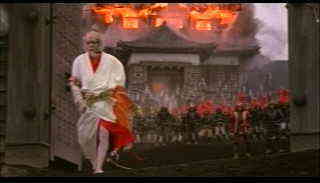
[Seeking retirement, Lord Hidetora bequeaths the family headship to his oldest son, Taro; Jiro and Saburo will retain control of the second and third castles and must pledge to assist Taro.] Saburo, the only son who truly cares for his father...tells his father that his plan of unification is folly and absurdity, pointing out that the three sons are all children of the age, schooled in violence and power-seeking. ["In what kind of world do we live? One barren of loyalty and feeling."] As such, how does he expect them to honor loyalty and live in peace? Hidetora interprets these words as an implicit threat against himself and the other sons and banishes Saburo. This speech, and the subsequent events it prophesies, illustrate the power that Kurosawa now accords to karma and the environment. The self can no longer transcend its age. . . .Kurosawa's view of the human character is at its bleakest and most unsparing, and history has given way to a perception of life as a wheel of endless suffering, ever turning, ever repeating. (285-87)
The problems to be addressed, Kurosawa now believes, are spiritual ones. The once-compelling issues of political and social reform have now been revealed as illusory, like the gestalt of producing a cloud of fireflies on a moonlit night. The man whose films once proclained that willpower could cure human ailments now professes that the world is impervious to reform nd the artist shackled in his or her ability to compel such change. "I believe that the world would not change even if I made a direct statement: do this and do that. Moreover, the world will not change unless we steadily change human nature itself and our very way of thinking. We have to exorcize the essential evil in human nature, rather than presenting concrete solutions to problems or directly depicting social problems." Kurosawa adds that he did not think in these terms when he was young and that is why he could make such films back then. "I have realized, however, that it does not work. The world would not change." (289-90)
--Stephen Prince, The Warrior's Camera
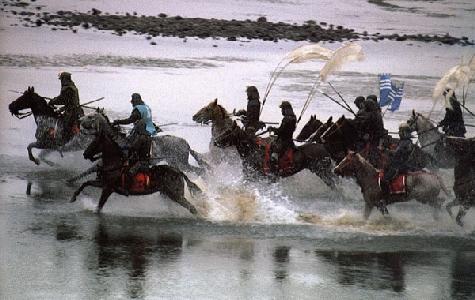
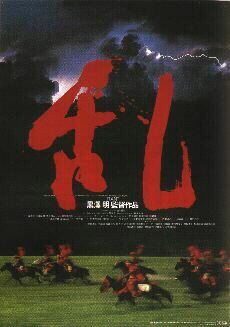
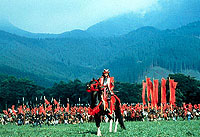
In Ran, Kurosawa creates a series of magnificent visual tableaux by transforming reality into symbols and abstract patterns. The names of the three sons, Taro, Jiro, and Saburo, mean "first son, "second son," and "third son." These names, therefore, transform the individuality of each son into his hierarchical position in the family system. In a similar vein, the film uses color schematically. Taro, Jiro, and Saburo are respectively clothed in yellow, red, and blue, and their soldiers also carry yellow, red, and blue banners and pennants. The number of horizontal lines on the soldiers' pennants--one, two, and three--corresponds to their leaders' names and familial positions. The troops of Fujimaki, Sabruo's father-in-law, are in white, and those of Ayabe, who attacks the first castle at the film's end, are in black. The scarcity of close-ups and the extensive use of long shots render even principal characters abstract figures and, by preventing the spectators' identification with them, create a sense of detachment that positions the spectators as distant observers of a drama of mass destruction. . .Without any ilusion of psychological depth, they are mere types, used only to as part of the pattern of a magificent tapestry...These abstract signs and designs tend to flatten and transform the film into a transparent surface without any depth. . .
The extreme generalization and abstraction make the film's story, which is already too predictable without any twists, ultimately not significant. The film's pessimistic outlook has in the end only secondary importance compared to the perfectly composed visual tableaux. Among Kurosawa's work, Ran is probably the best example supporting Masumura Yasuzo's characterization of Kurosawa as a "magnificent yet tragic genius" who makes a gargantuan effort to present dynamic and perfect images on the screen.
Mitsuhiro Yoshimoto, Kurosawa, p. 357-8.
****************
Tanaka Chiyoko, Kinema Junpo, July 1985 (913), p 36 http://www.stanford.edu/~brucey/AL75.00/ran1.html
Cast:
|
 |
Orion presents a film directed by Akira Kurosawa and produced
by Serge Silberman and Masato Hara.
Screenplay by Kurosawa, Hideo Oguni and Masato Ide. Photographed by Takao Saito
and Masaharu
Ueda. Music by Toru Takemitsu. Running time 160 minutes. Classified R.
Copyright © Chicago Sun-Times Inc.
Ran You are not worthy.
No, I'm serious.
This is Ran we're talking about here.
Ran, man. Ran.