Rhapsody in August (1991)
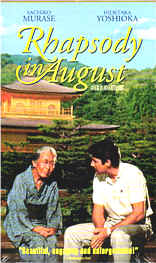
A Film Review
by Edwin Jahiel
RHAPSODY IN AUGUST (Japan, 1991) ****. Written and directed by Akira Kurosawa.
Cast: Richard Gere, Sachiko Murase, Hisashi Igawa, Narumi Kayashima, et
al. An Orion Classics release. 98 min. Japanese with subtitles.

On May 7, 1945, Germany capitulated and on May 8, V.E. Day ended the war
in Europe. On August 6 the U.S. dropped an atomic bomb on Hiroshima. On
the 9th another fell on Nagasaki. Japan surrendered on August 14. World
War II was over.
Among the fiction features on Hiroshima, one masterpiece stands out, HIROSHIMA,
MON AMOUR (1959), by Frenchman Alain Resnais, a complex movie that covers
more ground than Hiroshima proper and stresses the pain of remembering ,the
pain of forgetting and the need for responsibility. Nagasaki finally gets
its world-class fiction movie with RHAPSODY IN AUGUST. It shares much with
HIROSHIMA, MON AMOUR, notably themes of pacifism and of memory, but is otherwise
a very different, simple, quiet and elegiac work of moods and feelings.
Its maker is the great Akira Kurosawa ( b.1910) who is often said to be the
most western of Japanese directors yet still profoundly Japanese.
The unhurried first part exudes a perfect rural vacation feel. In the summer
of 1990, two pairs of youngsters, first cousins, are staying with their
aged, sweet and old-fashioned grandmother Kane (86-year old Sachiko Murase)
in the countryside near Nagasaki. Their parents have gone to Hawai'i to visit
Suzujirô, a terminally ill relative (one of Grandma's many brothers) who
had moved there back in 1920, married a Caucasian-American and made a fortune.
This is the first contact ever between the Japanese families and their Japanese-American
kin.
The sick man in Hawai'i wants to see his sister, Kane. Grandma is reluctant
to go. Her selective memory has dimmed with the years, and she isn't even
sure that Suzujirô is really her brother. The children however are anxious
for her to establish contact with their exotic, American relatives. Wearing
bluejeans and T-shirts with American logos, behaving like perfectly normal
and nice teenaagers, the grandchildren treat the old lady with affection
as well as amused (sometimes bemused) tolerance. Far from Granny dumping, we get Granny nurturing here.
A trip to neighboring Nagasaki gives the youths (and the audience) a sudden
awareness of the 1945 bombing. They contemplate the twisted metal of a
jungle gym in the school yard and learn that this is where Granny's husband, a schoolteacher, was killed. They visit the point-of-impact memorial,
a stark slab of granite bearing only the inscription of the day and time: 8. 9. 11:02. Nearby are sculptures sent by most nations -- except the
USA. All this is quiet, low-key and poignant.
Back at Grandma's the consciousness of Nagasaki increases through the old
lady's tales, some factual, others like fanciful myths or fairy tales. The
family stories, in bits and pieces, intrigue, puzzle--even scare--and move the impressionable youngsters.
Back from Hawai'i, the parents are anxious for Grandma to accept the invitation,
mostly to cement a potentially profitable link with the rich Hawaiian family.
The mildly opportunistic attitude of the middle generation alienates somewhat
both the children and the grandmother, but Kurosawa, wisely and subtly,
does not make a production of it. Nor does he engage in gloppiness in the
tightening bond between granny and the kids. Throughout, the film's attitude
remains natural, calm, pared down to essentials, and all the more affecting.
This unadorned thoughtfulness is leavened by gentle humor. It extends to
Clark (Richard Gere), the son of Suzujirô, when he flies to Nagasaki. To
the film's credit, Clark looks just like Gere, with no attempt made to orientalize
his features. Clark speaks halting Japanese. (Gere learned his lines phonetically,
which is uncannily like the Japanese protagonist of HIROSHIMA, MON AMOUR who spoke French also learned by sounds.) Clark--like the youngsters--has
just learned that Grandma's husband had died in the 1945 bombing. The grownups
illogically worry that as a touchy American he is there to break relations,
while in fact, the quiet, sensitive Clark has come to share the sadness
of his Japanese family. A wonderfully warm rapprochement takes place between
him and his relatives, before he has to fly back suddenly when his father
dies. The movie ends with a lyrical thunderstorm sequence which affects
the befuddled Grandma.
Kurosawa 's film is neither accusatory nor defensive film nor apologetic.
The fingers points simply at the notion of war. Without any didacticism,
the movie speaks (just as HIROSHIMA, MON AMOUR had done) of the tragedy
of the past, meaning war as the source of unhappiness, and of the sadness
of the present, which is the forgetting of the past. To this Kurosawa brings
his acute sense of observation, his painterly eye, touching visuals some
immediately accessible (two old women visiting each other and communicating
in total silence), some poetic ( a pair of charred trees), others metaphorical
(a procession of ants invading a flower).
The sophisticated plainness of this movie is a big asset. It will surprise
those viewers who are mostly familiar with the grand, sweeping style of
Kurosawa's historical epics. Like those films, RHAPSODY must be treasured,
on a different level. The understated, gently spacy performance of Sachiko
Murase is perfect. Richard Gere's part is relatively small, but it has much
discreet feeling and makes you forget that the man is a star. It is his
most likable role until now.
[Pub. 3 April 1992]
We meet three generations in this film:
1. Kane = the Grandmother. Her elder brother, whom she barely knew and cannot remember, emigrated to Hawai'i in 1920. Suzujirô. He is now dying at his home in Hawai'i where he attained considerable wealth operating a pineapple plantation.
2. Her children, Tadao, her son, who is married to Machiko; and Yoshie, her daughter,who is married to Noboru. These folks are the middle generation. They are middle-aged, working people with families.
3. The 4 Grandchildren, whom we meet first: Tami, Minako, Tateo, and Shinjirô.
Part of what this film is about is how these different gnerations look at the past and how they talk about it.
Two aspects of the film were especially inflammatory.
One occurs during the extended scene in which the grandchildren visit
the Nagasaki memorials to the bombing victims. . .A montage shows the
memorials contributed by other nations, and a substantial number of
these are from former Eastern Bloc and communist countries: Czechoslovakia,
Poland, Bulgaria, China, Cuba and the Former USSR. Shinichirô, the youngest
grandchild, points out that there is no memorial from the United States,
and his elder sister, Tami, replies, "Of course not, they're the
ones who dropped the bombs." The politcal evasions here are quite
severe. . .
The second offending incident in the film involves Clark
(Richard Gere)'s visit to Japan where he learns of the death of his
uncle in the Nagasaki bombing, whereupon he visits the site and expresses
remorse over the bombing. American critics tended to construe
this an an apology for the bombing. In fact, though, Clark is exhibiting
a humane response to the evident destruction and loss of life, not a
political judgment about the use of the bomb. In a subsequent scene,
he apologizes to Kane for not knowing of his uncle's death. Many critics
found this, too, to be offensive.
Stephen Prince, The Warrior's Camera, pp.
320-321.
Since this sense that somehow Rhapsody in August operates
as a critique of the U.S. decision to drop the bomb is fairly widespread,
it may be fruitful to look at just what Clark does say in the film.
See my transcription below where I look at two scenes in particular:
1. A scene at the school when the older community people come to maintain
the memorial to bomb victims:
Shinjirô: These people. . .they scare me!
Tateo: Because these people witnessed something terrifying.
Clark: Seeing these people. . .Nagasaki. . .on that day. . .I can feel
it.
(Kono hitotachi miru, ano hi no Nagasaki....yoku wakaru!)
Literally: Seeing these people, I can really understand Nagasaki on
that day.)
2. Clark speaking with his aunt Kane whom he calls "Obasan" (Auntie):
Clark: I am sorry that we did not know about (what happened to) Uncle.
(Ojisan no koto o shiranakute, hontou ni sumimasen deshita.)
Kane: That’s all right (Yokatta wa).
Clark: You were born and lived in Nagasaki, yet we did not think of Uncle.
That was wrong. We should have thought of him.
(Obasan wa Nagasaki no hito. Sore nan no ni, watashitachi
wa ki ga tsukanatta. Warui desu. Watashitachi wa warukatta desu.)
Kane: That’s alright. (Yokatta desu yo.)
Clark: My father told me, "Clark, you go and do whatever you can
for your aunt."
(Chichi, watashi ni iimashita: Clark, itte, Obasan no koto, dekirudake
shi nasai.)
Kane: That’s all right. (Yokatta desu yo). That’s just
fine. Sank you bery much. [Broken English]
She takes Clark’s hand and they stand up, facing one another, with a
full moon behind them.
Clark says in English:
No, thank you very much. You have made me very happy. Very,
very happy.
Shinjiro runs to tell the rest of the children what he saw. He describes
the handshake and says:
Shinjiro: "I feel like I saw something really nice."
(Nandaka totemo ii mon mita to ki ga suru.)
There is one scene in which Kane, the Grandma, does vent her frustration and anger toward the US. She observes:
I don't see what is wrong with writing the truth. They did drop the atom bomb, and now they resent being reminded of it? If they don't like it, they don't have to remember it! But I can't have them pretending ignorance.
They claim they dropped the "pika" to stop the war. It's already been 45 years now but the flash hasn't stopped war. They're still kiling people.
But you know war is to blame. People will do anything just to win a war. Sooner or later it will be the ruin of us all.
The frustration over America's refusal to come to terms with the decison that they made--even after all this time--may be related to the debacle that would occur a few years later over the Smithsonian's planned exhibition on the Enola Gay that was sabotaged by conservatives. Conservatives, veterans groups, etc. were outraged that pictures of the damage and the human cost of dropping the bombs would be put on display at a national museum in the US capitol. They wanted no part of it.
The Smithsonian Director was summoned to the hill and threatened with budget cuts if he did not act. The result was a very limited exhibition featuring the refurbished aircraft itself and very little about the decision to drop the bomb and the impact the bomb had on human beings. The controversy sparked a defense of the Smithsonian by a number of distinguished historians but politics ruled the day. In the end, the exhibition, as originally conveived, never came off. It was clear that at least some Americans were not ready to have that kind of conversation, to go through the experience of seeing and learning what happened to the citizens of Hiroshima. Apparently, when Kurosawa made Rhapsody in August in 1991, Americans were still not prepared to handle that kind of discourse; and this became part of the subject of the film's discourse: before all memories are lost, people need to remember and to speak to ne another before it is too late.
[Of course, in more recent days in the US, it has become clear that many Americans do not want to hear about History if it's going to make them feel uncomfortable. Thw history of slavery, for example, does not paint a pretty or flattering portrait. So, in some locales shcool boards have refused to include portions of historical reality in school curricula. Most historians fail to see how this can be a productive course of action. It is how we learn about the past and, yes, it can be how we avoid repeating this mistakes of the past. - My Note.]
However, when Kane says that if the Americans don't want to remember it, they don't have to, she is referring to a choice that maybe Americans have the luxury to make but Japanese do not. At least not without consequences. But that is one of the themes of this film, I think: how do/will younger generations in Japan remember the bomb? What do they know about it? How much can they even talk about it? Is discourse possible on this topic? Probably Kuosawa was discouraged about the proposects for these kinds of conversations taking place either in Japan or in the US so he wanted to make a film that might spur Japanese to think about the situation. As Roger Ebert opines below, Rhapsody in August may not be "one of
his great films, but [it] shows him thoughtfully trying to come to peace with the
central event of his times." (see review below)
After her little outburst, Kane equivocates somewhat when she says that is really war that is to blame. While this may sound like a bit of a cop-out, we should realize that it is also a subtle reminder to Japanese viewers that they, too, have issues about war responsibility that they need to address. But, in the film, Kurosawa is not afraid to have Kane say that it is an historical fact that the US dropped two atomic weapons on Japan and for anyone, including the US, to try to avoid coming to terms with that fact is absurd. Perhaps this is why many American critics did not care for this film.
******************
Mitsuhiro Yoshimoto also has a very clear "take" on these scenes
in and on the controversies sparked byRhapsody. Noting that some critics take exception to the scene involving
the grandchildren at the memorial park and Tami's remark that of course the
US didn't send a memorial because they dropped the bomb, Yoshimoto points
out that it wasn't just Eastern Bloc countries like Czechoslovakia, Poland,
Bulgaria, China, Cuba and the USSR that sent monuments, but it was also countries
such as Italy, Holland, Brazil and Portugal:
Therefore, there is nothing to acknowledge here, except perhaps
the relevant fact that the Occupation, which encouraged democracy, never
allowed any reference to the atomic bomb in Japanese films through its strict
censorship. . .
As ambiguous as his broken Japanese is, Clark clearly speaks
as an extended family member, not as an American. He admits his family's
and his own failure to realize what kind of pain the grandmother has been
suffering from her husband's death by the atomic blast. They didn't make
a connection between the death of Kane's husband and the location of her
home, Nagasaki.
Instead, they talked only about themselves without paying
attention to Kane's circumstances. By urging her to come to Hawai'i as soon
as possible, they were even unintentionally asking her to miss the anniversary
of the Nagasaki bombing and memorial services for her dead husband. This
is the reason why Clark apologizes to Kane; it is not at all the case that
he apologizes for the American attack on Nagasaki with the atomic bomb.
Thus the misconstrued description of the apology scene reveal more about
the critics' understanding of the dropping of the bomb over Nagasaki as
a historical fact than the film's representation of this historical fact.
Critics who are surprised by what they perceive as Kurosawa's unjustifiable
criticism of the United States in Rhaposdy in August have probably
never understood his films, including such postwar masterpeices as Stray
Dog, No Regrets for our Youth, and Rashomon. . .(368)
Rhapsody in August is about the possibility of talking
about and remembering as much as the fact of the Americans' atomic destruction
of Nagasaki on August 9, 1945. The film does not re-create the scenes of
the atomic explosion and its aftermath. Instead, the dropping of the bomb
is only indirectly represented by a melted jungle gym in the schoolyard
where Kane's husband presumably died and some stone statues of angels damaged
by the radioactive blast. Human witnesses to the atrocity remain silent
about their experiences, which no words can describe adequately. The elderly
people who survived the bomb as school children come to the melted jungle
gym, which is preserved as a memorial, and silently clean and decorate it
with young plants.
One of Kane's friends, who also lost her husband to the
atomic bomb, comes to see her once a month. According to Kane, the friend
comes to talk about her atomic bomb experience, yet the film shows them
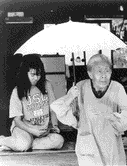
just sitting on the wood floor without saying a word to each other. To the
doubtful grandchildren, Kane says that people can talk to each other silently,
too. Without uttering any words, the two elderly women can understand each
other's feelings and pain and together mourn for the dead.
In Rhapsody in August, the present is haunted by the past. . .Kane is an unpretentious storyteller, who, drawing on her memories, vividly tells strange and gripping tales. The grandchildren are so captivated by her stories that as we have seen, they end up re-enacting those stories. Kane maintains a critical distance from her memories until the last sequence when she finally remembers who Suzujirô is. Kane's recognition of her elder brother is traumatic because the missing memory returns to her only when it is too late for her to see him. The untimely recovery of the memory is so shocking that she becomes delusional and mistakes the death of Suzujirô for the death of her husband. As Tateo says, Kane's mental clock starts moving backward to the day when her husband was killed by the atomic bomb. It is not clear whether she suffers from just a temporary mental lapse or from a more permanent illness. What is clear is that the final sequence is consitent with the rest of the film. Kane's medical status is in the end not important because the film's last scene is not at all a realistic scene. Kane is no longer a character but an allegorical figure ("
a painfully tragic poem"), whose quixotic march in the storm looks
as if she is fighting against the atomic blast. As Kane forces her way in
the heavy rainstorm, a gust of wind turns her umbrella inside out, making
it look like a rose.
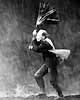
At
this point, all realistic sound effects are replaced by a children's choir
singing the Schubert song "Heidenroselein," reminding us of Tateo's
successful repair of the grandmother's out-of-tune pedal organ, with which
he plays the Schubert song several times in the preceding scenes, and a
swarm of ants climbing up petals of a brilliantly red rose that captivated
Shinjiro and Clark during the memorial service. Kane is
now not a mentally confused woman but a brave warrior whose struggle against
the rain and wind transforms her into an allegorical icon affirming the
dignity and preciousness of life. (369-71, emphasis
mine)
Mitsuhiro Yoshimoto, Kurosawa, pp. 367-69.
Another Review
By Roger Ebert
Akira Kurosawa is in his early 80s now, and there are those who think he is
losing his touch, that the vision that made him one of the greatest of directors is fading at last. In
his 70s he gave us late masterpieces like "Ran," but his "Dreams"
(1990) was not well-received, and "Rhapsody in August" was considered
a disappointment when it premiered at Cannes in May, 1991. It is not one of
his great films, but shows him thoughtfully trying to come to peace with the
central event of his times.
The movie takes place during one summer in the life of a very old woman (Sachiko
Murase) whose husband was killed by the atomic bomb dropped on Nagasaki. Her children and
grandchildren have come to visit her, and there are reports from the deathbed
of her brother, who immigrated to Hawaii many years before, prospered, and took
an American wife and American citizenship. Now he is mortally ill, and while
the old woman decides whether to answer his call for a last meeting, a reconciliation,
he dies.
Not long after, her nephew (Richard Gere), the man's son, comes to Japan to
visit. He is half Japanese, half Caucasian, and around him the subject of her husband's death is discussed
only gingerly; perhaps he would not like to be reminded that the bomb was dropped
by Americans. He speaks Japanese, is polite and interested, and eventually learns
the story of his uncle's death. And there is a scene beyond all words in which
the old lady and another woman friend, equally old, gather to remember their
dead.
There is no dialogue; they need no speech for their memories.
Kurosawa has always been a director of great images, and in his old age he has
permitted himself more fanciful, less realistic ones. There is a great eye which
opens in the sky in this movie, and which symbolizes, I suppose, the light that
flowered in the sky when the bomb dropped on Nagasaki. There is a rose, engulfed
by ants, which may have something to do with those who fled from the devastation
of the bomb. There is the twisted jungle gym of a school playground, left the
way it looked after the heat of the bomb melted it into a grotesque sculpture.
And there is the image of the old woman, walking in wind and rain, her umbrella
defiantly offered against the elements.
These images and the dialogue about the bomb are counterpointed by the daily
lives of the grandchildren, who are rather one-dimensional, chattering creatures,
used to show how the younger generation does not much remember or care about
the great events of the years before they were born. Gere, as the nephew, is
more attentive, and eventually he offers his apologies for the death of his
uncle, and the old woman forgives him.
This sequence in particular was criticized at Cannes, where one journalist cried
out at a press conference, "Why was the bomb dropped in the first place?"
and when the film played at the Tokyo Film Festival, critics of Japanese militarism
said Kurosawa had ignored the historical facts leading up to the bomb. Kurosawa's
response was simple: He wanted his film to say that war was between governments,
not people. The use of a Japanese-American character was deliberate. It is as
if, at this point in his life, he wants to close this particular set of books
- at least as far as his art is concerned.
Another veteran Japanese director, Shohei Imamura, has made a recent film about
the bomb which is more disciplined and pointed. His "Black Rain" (1989,
not to be confused with the Michael Douglas thriller) is about the social aftermath
of the bomb in Japan, where those suspected of radiation poisoning became less
attractive marriage prospects. His film has edge and bite. The Kurosawa film is more
of a sigh, a letting-go, but interesting because of that very quality. Seeing
that twisted playground artifact, I was reminded of another playground, in Kurosawa's
great "Ikiru" (1952), which is the story of a dying bureaucrat who
devotes all of his waning energies to getting a city playground constructed,
and then dies there, sitting on a swing in the snow.