This class will be different from mathematics courses you've had in the past - especially high school math courses. To survive, the student must be a much more active learner (as opposed to a passive learner). To help you cope with all that, we present
|
Spend about 30% of your study time organizing the material, and 70% of your time doing actual homework problems. Note 1) Organizing the material should consume paper and ink: think of writing an outline. |
This "learning area" is similar to learning the vocabulary in a language course. You have to spend some time doing the memorization.There is, though, more than just memorizing the words (or definitions): you need to know how things fit together.
For example, take the concept of a linear function. You need to know the definition, of course:
| DEFINITION: A function f defined on the real numbers is linear if f(x) can be written in the form f(x) = ax + b for some constants a and b. |
...but you also need to have digested this. Knowing just the verbatim definition above won't help much with a question like "Give examples of three distinct forms that a linear function can take".
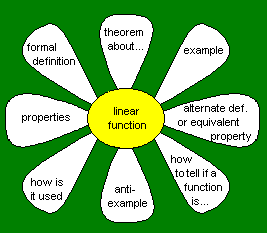
In addition to the formal definition of something, one should know:
Most importantly, you need to know how all this fits together. First of all, that's what mathematics is all about - how things fit together - which mathematicians call the structure of something. Secondly, psychological research shows that it's far easier to remember something that has some cohesive organization than something that is made up of lots of unconnected pieces. So think about how your examples and anti-examples illustrate the definition or properties, for instance. Here's a metaphoric image to give you the idea:
[Most of the ideas in this section come from a talk given by David Lay of the University of Maryland at the Joint AMS/MAA Meeting in 1998. In particular, the flower-metaphor and building what he calls a concept image out of these various parts are his ideas. Professor Lay requires his students to write out all these components for each major concept in the course, though perhaps not in flower form.]
So... why don't your calculus professors just give you a list of all this stuff?
First of all, we can't organize your
thoughts. Every student needs to find their own way of
understanding a topic, and while some students may share perspectives,
the way a student thinks about a topic is fundamentally very personal. Psychologists say that people build a cognitive map or mental model
in order to understand a subject. The point here is that this
model or map is quite personal. Typically, it isn't even correct
at first; we make adjustments as we build our "maps." The process
of building your mental map is in fact the process of learning a
topic. The only new thing is that we are encouraging you to
be aware of this model you are building.
In doing the organization exercises above, you will produce an
invaluable resource to use when reviewing for exams. Make sure
you do actually produce
that resource. Beware of relying on fellow students' outlines -
even though sharing outlines can be a good idea, you will derive little
benefit from reading others' outlines when compared to the benefit you
will gain by writing one.
Remember, if you want to learn how to do a thing, watching someone else do it isn't enough. If it were, lots of us would be
successful professional athletes. Organizing your
(own!) thoughts on a topic is a way to start doing the topic, which brings us to:
|
Spend about 30% of your study time organizing the material, and 70% of your time doing actual homework problems. Note 1) Organizing the material should consume paper and ink: think of writing an outline. |
Last modified August 27, 2012.
Prof. Janeba's
home page | Please mail comments or questions to: mjaneba willamette.edu
Willamette University
Home Page