Homework assignments, Discrete Math (Math 163)
(Janeba), Spring 2014
Homework assignments
For the week of:
Jan 13 | Jan 20 | Jan 27
| Feb 3 | Feb
10 | Feb 17 | Feb 24 | Mar 3
| Mar 10 | Mar 17 | Mar 31
| Apr 7 | Apr 14 | Apr 21 | Apr 28
Final Exam
Week #1:
- Jan 13:
- Read Syllabus on website and chapters 1.1 and 1.2 on class WISE site
- Be prepared for an unannounced reading quiz; handwritten notes
are allowed on a reading quiz, but nothing machine printed. Syllabus
questions can be included on the quiz.
- Do problems for sections 1.1, 1.2 (p. 12-14) #1,3,5,7,11, 13,15,19
- Prepare written questions on any and all of the above to bring to class on Wednesday
- Jan 15:
- Read chapter 1.3 (again, on the class WISE site until the books arrive next week)
- Do p. 13-14 #21,23,26 (read #23 carefully, ask about 26 on Friday if you like.)
- Do p. 24-25 #1,3,5,7,9 (see p. 5 for "byte") ,11,13,17
- (note many calculators have a "nCr" button or C(n,r) button -
typically you enter the value of n, press the nCr button, then enter
the value of r, then press "=". It's probably worth your while to
learn how to use your calculator.)
- Jan 17:
- Read chapter 1.4 through example 1.31.
- Do p. 34-35 #1,3,5
Week #2:
- Jan 20: Homework quiz #1;
- read the rest of chapter 1.4
- Review the last two pages of section 1.3 and Do p. 24-25 #25a,b,c, 27a,b
- Do p. 34-35 #7, 10, 13, 15, 17
- Jan 22:
- Extra credit opportunity due by Friday afternoon - topic outlining / summarizing practice.
- Textbooks are now in the bookstore! Read chapter 1.6,
which is very short. It will be of some assistance for the E.C.
item above (yes, we skipped chapter 1.5)
- Start to read chapter 2.1, notice how very different the topic is. We will
see connections between chapter 2 and chapter 1, though it may be hard
to guess them right now. Remember Exam 1 is coming, so forgetting
chapter 1 would not be helpful.
- Try #30 p. 25 Hint: can you recognize this as the expansion of (thing1 + thing2)n ?
- Do p. 43 #1,3,5 (these are harder problems, but can all be done using the methods we have studied)
- Catch up
- Jan 24:
- Further practice on the worksheet from class.
You can look up the answers on Wikipedia if you like; note that to be
truly correct, when counting "flushes" you should exclude "straight
flushes" which are flushes that are also straights. You'll see
the Wikipedia answer subtracts out the straight flushes.
- Read chapter 2.1 (all of it), and do 2.1 #1 (be sure you can say why), 3,5
- Review for Monday's quiz
Week #3:
- Jan 27: Homework quiz #2: Postponed to Wed.
- Read 2.2, do 2.1 #7,8,9,13, and 2.2 #1,3,5,7a
- Jan 29: Homework quiz #2, at the beginning of class
- Do 2.2 #9,11,15,18
- Write (a) the converse and (b) the contrapositive of each of the
following, then (c) for any one of the contrapositives, explain in
ordinary language why it means the same thing as the original statement:
- "If it rains, then Mary brings her umbrella"
- "If the refrigerator breaks down within 3 years then the manufacturer will replace it for free."
- "You will get a ticket if you park there."
- Read 2.3
- Jan 31:
- Do 2.3 #4,5,12 Hints:
- For 5 in general, first convert into symbolic form, e.g. "This says "[p
 q AND p]
 q", then use the table on p.78 to find the name; remember we need to know the names of 1,2,3 and 6 in the table.
- For 5b, review in 2.1 how to convert the first sentence into if-then form. Be sure to get it in the correct direction.
- For fun, view a few of these brief commercials (not this is not
an endorsement of the product advertised). Each step in one of
these commercials can be translated into an if-then statement, except
for the very last one.
Give, in symbolic form, the outline of these commercials. Even if
(!!) each of the components were true, would you say the implied
conclusion is true?
- Write out a few sentences about the logical relationship between an if-then proposition, its converse, and its contrapositive.
- Read pages 86-92 of chapter 2.4, stopping after table 2.21 on
p. 92. Example 2.39 on p. 91 is optional, but will be of interest
to computer science students.
Week #4:
- Feb 3:
- Do 2.4 #1,3,7,16,19 (just write the converse and
contrapositive, and skip the truth values), 20 (write in if-then form,
and give the converse and contrapositive, as in #19)
- Here are answers to the even-numbered problems in this assignment.
- Review, review, review. Remember to spend 70% of your
time doing actual problems, but also 30% of your time outlining:
What types of problems have we met, how do we tell them apart, how do
we do them? What are some other general tips for solving
combinatorial problems? What are other main priciples we have
learned about elementary logic?
- Feb 5: Exam 1
- Read the rest of chapter 2.4
- Do 2.4 #21abc,23
- Explain the difference between these two, and tell which one(s) are true:
- For each integer x, there exists an integer y such that xy is positive.
- There exists an integer y such that for each integer x, xy is positive.
- Repeat for the following:
- For each licensed dog in Salem, there exists a human such that the human owns the dog.
- There exists a human such that for each licensed dog in Salem, the human owns the dog.
- Explain this cartoon, then, if necessary, go back and fix your answers to the last two problems.
- Feb 7: Snow Day!
Week #5:
- Feb 10: Read chapter 3.1
- Do chapter 2.4 #5,15,17 (be careful, it's hard to see which problem is #5)
- For each of the following, rewrite making the quantifiers explicit (not hidden), and then give the negation separately. Tell which is true, which is false (in your opinion, if you prefer).
- "There is a soul mate for every person." -Dilbert cartoon
- "Everybody has a mother."
- "Every diamond has a flaw"
- "Chevy has a car for every family." -GM advertising
- "Everybody loves somebody sometime." -Frank Sinatra (warning: this one is tricky to do correctly)
- Give the negation of each statement, and tell which is true (statement or negation). The universe is the set of integers:
 x,
 y x+y=7
- y,x x+y=7
- x>0,y y2=x (note we have narrowed the category with the ">0" part)
- x>0,y x2=y
- x,y x·y=1
- Do 3.1 #1,3,5 (1&3 are problems about fussy details; make
sure you see which details are at issue before you get frustrated.)
- Feb 12:
- Do 3.1 #7,9,11,13,20,21
- For enrichment, read problem #27 and think about it (do it, just understand that the issues presented here are hard)
- Reread the parts of 3.1 about Pascal's triangle
Feb 14: Homework Quiz #3
Week #6:
- Feb 17:
- Do 3.2 #1,2,3,4,5a-f (I have added answers to the even-numbered ones to the miscellaneous answers page.)
- For 3.2 #13, you do not need to prove your answer, but merely tell which is true. Hint: Investigate a few really simple examples that you make up.
- Review quantified statements, especially statements containing multiple quantifiers, and the 3.1 homework.
- Look up the word panacea and add Portland author Ursula Le Guin's The Dispossessed (full title: The Dispossessed: An Ambiguous Utopia) to your summer reading list. :)
- Read 3.3, and do 3.3 #1
- Feb 19: Homework Quiz #4
- Do 3.3 #2,3,4,5,7
- Read 3.3 through example 3.31 (about 2 pages) [This was supposed to say 3.4; oops]
- Feb 21:
- Do 3.3 #9
- Hint: First, remember how to count all the arrangements - refer back to chapter 1.2 and arrangements of "MASSASAUGA"
- Next, counting arrangements with,
say, an "SS" in them - treat SS as a "single letter" - now you have 12
letters and only two duplicates (because you have one SS, not two of
them).
- Finally, if you define sets P,Q, and R carefully (I'm not calling them A,B, and C because A&C are also letters in our word), then you'll find we are looking for either the cardinality of P
 QR or its complement,and the methods of 3.3 will get you there.
- Read 3.4 and do 3.4 #1,3,5,7
Week #7:
- Feb 24:
- Do 3.4 #9,6,10,13
- Read chapter 4.1 (yes, we are moving on) through example 4.7
- Do not worry too much about the Well-Ordering Principle for now. DO focus on the examples.
- Do 4.1 #4
- Feb 26: Homework Quiz #5
- Review our reading in chapter 4.1
- Do 4.1 #7 (it will take some basic algebra)
- For 4.1 #1, pick a part (a,b, or c) and write an outline for the requested proof, using the models in the reading.
- Feb 28:
Week #8:
- Mar 3:
- Do 4.1 #1, completely, and 2ab.
- Review example 4.7; be sure you can prove that 1+3+...+(2n-1) = n2 without referring to the example.
- Read example 4.8, then do problem #14; you will need to use the fact that n>3 in the induction step (going from k to k+1)
- There is a Q&A session Tuesday
evening at 8:00 in Ford 222 (opposite end of the building).
Please bring questions, as I will not have a prepared program.
- Mar 5: Exam 2 (You will need a calculator)
- For Friday (or before), think of who you would like to team with for a group project.
- Project groups will mostly be groups of three. A few
groups of two will be necessaary since we have 23 students (the number
is not divisible by 3).
- Groups of four will not be allowed; I find that in such
groups, someone always gets sidelined and does not have a full
opportunity for participation.
- If you have a preference for group partners, communicate it to me no later than 2:00 p.m. Friday (email is fine).
- I will assign groups
later on Friday and email the class. Normally, I can satisfy
student preferences, but this is not guaranteed. Problems arise
if two separate groups request the same person.
- If you have a group of three (or two) that all want to work
together, have all three (or two) email that preference to me and I
will try very hard to make it happen. I may add a third member to
requested groups of two.
- You can preview the project here; we will discuss expectations for groups and projects on Friday, and answer questions, before continuing in chapter 5.
- Read chapter 5.1 for Friday.
- Mar 7:
- Work on project, email group preferences to Prof. Janeba by 2 p.m.
- See all the project resources on the class handouts page.
- See examples of student work on projects in other classes here.
- Do 5.1 #1-4,7,12
- Read 5.2 through example 5.14 (about 4 pages)
- Possible reading Q on Monday, includes reading the project assignment.
Week #9:
- Mar 10:
- Read the rest of 5.2
- Do 5.2 #1e,3,4,20
- If A={6,7,8,9,10} and B={p,q,r,s,t,u},
tell whether each of the following is (a) not a function from A to B, (b) a function from A to B, but not a one-to-one function, or (c) a one-to-one function from A to B.
- {(6,p),(7,s),(8,q),(9,u)}
- {(6,p),(7,s),(8,q),(9,u),(8,q),(10,r)}
- {(6,p),(7,s),(8,q),(9,u),(8,p),(10,r)}
- {(6,p),(7,s),(8,q),(9,p),(10,r)}
- {(p,6),(q,7),(r,8),(s,9),(t,10),(u,6)}
- {(6,p),(7,s),(8,q),(6,p),(10,r)}
- {(6,p),(7,p),(8,p),(9,p),(10,p)}
- Given A and B as above, how many functions are there from A to B? How many one-to-one functions are there from A to B?
- Also, how many functions are there from B to A? How many one-to-one functions are there from B to A?
- Some answers are here.
- Mar 12: Homework Quiz #6
- Do 5.2 #1bc, 15a,b
- Read 5.3 through example 5.26
- Do 5.3 #1 (I recommned that you do the entire formula problem "by
diagram" by giving correspondence diagrams for each example. No
formulas needed.)
- Do 5.3 #2a,b,c, #4, #8
- Some answers are here.
- Mar 14: Project 1 preliminary report due, 4:00 p.m.
- Read the remainder of chapter 5.3.
- Try to answer this question verbally: What is the
difference between the counting problem described at the end of chapter
5.3 and the combinations-with-repetitions counting problem we did in
chapter 1.4?
- In other words, how do you tell when to use the method of 1.4 and when to use the method of 5.3?
- Do 5.3 #13; Note that 156,009 = 3×7×17×19×23
- How many onto functions are there from {1,2,3,4,5} to {a,b,c}?
- How many ways can we put five distinct reports into three identical envelopes if every envelope gets at least one report?
- Answers for the last two.
Week #10:
- Mar 17:
- I have a penny, a nickel, a dime, a quarter, and a half-dollar to give to four (distinct!) Grzzmorgian children A,B,C, and D. (Alice,Bob, etc). In how many ways can I do this if every child must get at least one coin?
- Same problem, but if I also had a silver dollar (so 6 distinct coins).
- Read 5.5 (we are skipping 5.4)
- Do 5.5 #1,3,7,20
- Mar 19: NO quiz today.
- Mar 21: Project 1 final report due, 4:00 p.m.
Spring Break, March 24-28
Week #11:
- Mar 31:
- Read chapter 7.1 (you can skim/skip examples 7.2 & 7.3,
which involve finite-state machines from chapter 6, which we will skip)
- Make sure you know the terminology reflexive, symmetric, transitive, anti-symmetric, partial order, and equivalence relation.
- ...and can give simple examples of relations with each of these properties.
- Do chapter 7.1 #1,5,6,10a,b,c
- Hints:
- #1: Make your examples out of lists of ordered pairs; no need for a relation that has a deeper meaning
- #5a) See def. on p. 221
- #5b) To get the text's answer, see fine print on def. on p. 221 excluding b=0.
- #5c) Venn diagrams help
- #5f) Note that zero, -2, -4, -6, etc. are all considered even.
- #6: Answers here.
- #10: Answers here.
- For each relation below, tell if it is reflexive, also tell if it is symmetric, also tell if it is transitive. All are relations on the set of people alive in the last 300 years.
- R1 is the relation where "a R1 b" means a is a biological child of b. (remember a and b are people here.)
- R4 is the relation where "a R4 b" means a is a sibling of b.
- R5 is the relation where "a R5 b" means a is in the same family as b.
- R6 is the relation where "a R6 b" means a is a descendant of b.
- Apr 2:
- Do chapter 7.1 #10d,e, 11abcd, 13
- For the set A={1,2,3,4,5,6,7,8,9,10,11,12,13,14,15,16,17,18,19,20}, define the relation R on A by xRy if and only if x and y have the same remainders when divided by 5.
- Explain why R is an equivalence relation; fill in all the details.
- Write out all the elements of A that are related to 1 (by the relation R). Don't forget 1 itself!
We can think of this set as 1's family, but more properly, we call it 1's equivalence class.
- Now write out all the elements of 2's equivalence class.
- Now write out all the elements of 16's equivalence class.
- Do the equivalence classes of 1 and 2 have anything in common?
- Do the equivalence classes of 1 and 16 have anything in common?
- Can you explain the all-or-nothing relationship we just saw between equivalence classes? Will any two equivalence classes related in this all-or-nothing way? Remember we have an equivalence relation here.
- Does your explanation rely on particulars of this example's relation R, or will it generalize to any equivalence relation?
- Now read 7.4 (yes, we are skipping 7.2, 7.3)
- Apr 4: Homework Quiz #7
- consider the equivalence relation discussed in class, the relation R on
 + by xRy if and only if x and y have the same remainders when divided by 9.
- Write out many elements of the "family" or equivalence class of 4; remember we denote this family/class by "[4]"
- Write out several elements of [22] also and compare to [4]. Comment. (What do you notice?)
- Write out several elements of [8] also and compare/contast with [4] and [22].
- Explain why equivalence classes either overlap not at all or
overlap entirely, using properties of equivalence relations.
Hint: "My family = my sister's family," as we discussed in class.
- Use the method of "casting out 9's" to hand-check the following calculations.
Some are correct, some are not. Find the incorrect ones. For review, Wikipedia's "casting out nines" page is a good reference.
Practice showing enough work to persuade your reader you know what you're doing.
- 1234 92715 247 254927
3369 x 365 x119 +345650
+7287 -------- ----- ------
----- 33740975 29393 599577
11890
- Start
compiling your review materials for the exam on Wednesday: What
have we studied since the last exam - what sort of problems, what sort
of solution methods, etc.
Week #12:
- Apr 7:
- Read chapter 10.1 through example 10.7, but you can skim through examples 10.3 & 10.4 and skip 10.5
- Do 10.1 #1 (note they tell us the sequences are geometric),
- For each geometric sequence, find a formula for an and write out the first four terms (one formula and set of terms per line below):
- a0 = 7, an+1 = 3an
- a0 = 16, an+1 = (1/2)an
- a0 = 64, an+1 = (-1/2)an
- #2 (rearrange each one to solve for an or an+1 , whichever is later in the sequence, and then you should recognize a geometric sequence)
- Do 10.1 #5
- Consider the sequence a0,a1,a2,a3,... given by a0=4 and an+1 =an +3 for all n
 0.
- Find a347, and then find a formula for an in general.
- Some answers for the above.
- Study/review everything since the last exam, and ask
yourself: What kind of questions could be on the eaxm, i.e. what
have we studied? Be prepared to answer such questions.
- Looking over homework and quizzes is probably a good idea in making your review
- April 8: Optional Q&A session, 8:00 p.m., location to be
announced, feel free to come late or leave early, but bring questions.
- Apr 9: Exam 3
- Apr 11:
- Review class notes OR read sections 10.1 and 10.3 in our text (class notes are a condensed version of the reading).
- Also read 11.1 for Monday & possible reading quiz.
- Warm up problems: Solve the recurrence relations below. That is, give a formula an = (expression with "n" the only variable).
- an+1 = (1.004)an , ao = 550.
- an+1 = an + 2.5, ao = 12.
- Now for the harder problems:
- For the recurrence relation an+1 = (1.004)an - 248, a0 = 10800:
- What is the associated homogeneous recurrence relation?
- What is that recurrence relation's solution? Call it an(h) for "homogeneous."
- Find a "particular" solution of the original recurrence relation of the form an(p) = K, by plugging this solution into our recurrence relation and solving for K.
(Hint: an(p) = K and an+1(p) = K also.)
- Form a "general" solution by setting an equal to "A" times an(h) plus an(p), using your formulas for an(h) and an(p). Write this out.
- Now suppose our initial term is given as a0 = 10800. Plug n=0 into your formula for an and set the result equal to our value for a0, and solve for A.
- Put it all together: Write out your general solution an , with the values you found for K and A filled in. You have solved the recurrence relation!
- The problem in (3) models the unpaid balance of a loan with
interest rate ____ per month, monthly payment of _____, and initial
loan amount of ______.
- Use trial and error to find out how many months it takes to pay off the loan.
- Use the outline in (3) to solve the simpler recurrence relation an+1 = 2an + 1, a0 = 1
- Here are some answers.
Week #13:
- Apr 14:
- Give a recurrence relation for an and an initial condition where an is the balance in a savings account after n months if:
- We start the account at 0 months with a deposit of $50.
- Every month thereafter we add another $50, and
- the bank pays 0.15% interest per month (read carefully - that's not 15% !)
- Solve the recurrence relation in #1 to give a formula for the balance after n months.
- Also continuing #1, what is the balance after 10 years?
- For the recurrence relation an+1 = (1.0125)an - 119, a0 = 5000:
- If this is a finance problem, give a story which fits the recurrence relation (loan? savings plan?)
- Solve the recurrence relation.
- Use the guess-and-check zeroing-in method we showed in class to find when the balance will be approximately zero.
- What is the approximate total of all the payments made? How does it compare to the initial balance?
- Apr 15: Optional Project 2
posted to the web. This mission, should you choose to accept it,
is due on Friday, April 29. See page 4 of project for details.
- Apr 16: Student
Scholarship Recognition Day (no class meeting)
- Apr 18: Homework Quiz #8 (possible reading quiz also!)
- Read chapter 11.2
- Do chapter 11.1 #3, 5, 7,13
- Do chapter 11.2 #1,3,5
Week #14:
- Apr 21:
- Do chapter 11.2 #9,11b (use 11a, but you don't have to do 11a), 15,17 (do #17 with the special case n=5, then repeat with n=7, then try to give a formula for arbitrary n)
- Read chapter 11.3; you can skim examples 11.2 and 11.4 if you like.
- Do chapter 11.3 #1,5,20,23 (#20 & 23 are the fun ones)
- Apr 23:
- Read chapter 11.4
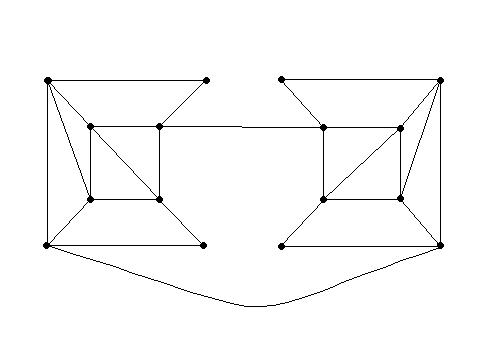
- Does this graph have an
Euler circuit? Explain how you can tell in a complete sentence or
two. Then, if there is a circuit, label the vertices a,b,c,... , then find an Euler circuit, and write out the vertices visited by the circuit, in order.
- Do chapter 11.4 #8,10,13,17 (some answers)
- Apr 25: Last homework quiz!
- Start to spend serious time organizing your "final exam page"
- You may bring to the final exam (and use during the final exam) one 8.5"×11" sheet of paper with anything you wish handwritten on one side. The second side must be blank.
- Photocopied or computer-printed pages will be confiscated. This needs to be something you personally have written.
- Composing and writing this page should form about 30% of your study time for the final; this page is a focus for organizing your understanding of course material.
- You will want the page to reflect: what sort of problems
have we solved, what methods have we learned to solve them, and how
does one identify the type of problem one is looking at (and type of
method needed to solve it)?
- (Spend the other 70% of your study time actually doing problems of sorts you believe are likely to appear on the final.)
- most students find that once they write this page, they may
not need it, but if they hadn't written it, they would need it badly.
- Your page will be stapled to your final exam when you turn it in. You may pick it up next semester, along with your final.
Week #15:
- Apr 28: Last day of class
Week #16:
- Monday, May 5, 8-11 a.m.: Final
Exam
Last modified on April 25, 2014.
Prof.
Janeba's Home Page | Send comments or
questions to:
mjaneba willamette.edu
Department of Mathematics | Willamette University
Home Page